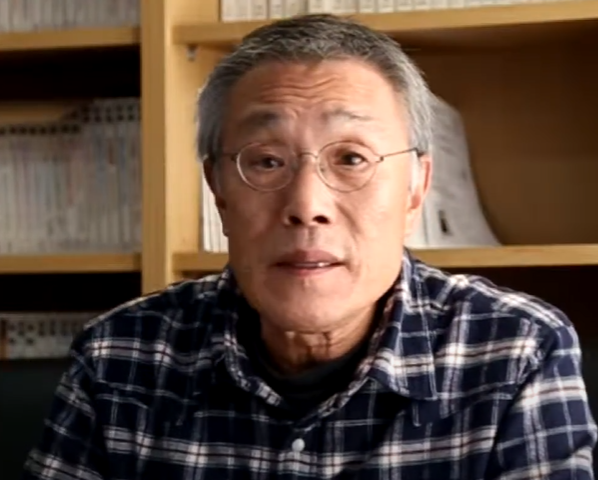
Hwang Sok-yong was born on 4 January 1943 in Changchun, then part of the Japanese puppet state of Manchukuo, where his family had moved during the colonial period. After Korea's liberation in 1945 the family returned south, eventually settling in Seoul. He grew up in the chaos of the Korean War as a child, and in the harshness of the postwar Rhee regime as a teenager. He briefly studied philosophy at Dongguk University before dropping out, restless and political.
In 1966 he was conscripted into the South Korean army, which under the Park Chung-hee government was deployed to Vietnam as part of the United States-led coalition. He served in combat and saw, by his own account, things that would shape every piece of fiction he ever wrote. He returned to Korea radicalised, took up factory and construction work, and made his literary debut in 1970 with the short story Pagoda. He soon became part of the loose movement of writers known as minjung literature, committed to the lives of workers, soldiers and the poor.
His early masterpiece is The Guest, but the novel that turned him into a public figure was The Shadow of Arms, a 1985 work drawing on his Vietnam service that depicted the war as a marketplace of bodies and goods. In 1989, in defiance of the South Korean National Security Law, he travelled to Pyongyang as part of a writers' delegation to meet North Korean colleagues. He could not return home without facing arrest, and entered a long exile that took him to Berlin, New York and Tokyo.
Twenty questions, eight minutes on the clock, and a percentile measured against everyone who has taken it. No sign-up.
Take the IQ test →He returned to South Korea in 1993 after the inauguration of Kim Young-sam's civilian government, and was promptly imprisoned for five years for violating the National Security Law. He continued to write in prison. In 2000 he published The Old Garden, a love story set across decades of the Korean democratic movement and a meditation on what political commitment costs the people who sustain it. The novel became, for many Korean readers of his generation, the defining work of fiction about the long dictatorship and its aftermath.
He has written more than twenty novels and short-story collections, including The Shadow of Arms, The Guest, Princess Bari, At Dusk and the autobiographical sequence The Prisoner. His subjects range from the Korean War and the Vietnam War to the Korean diaspora, the Gwangju uprising, the migrant working class, North Korean refugees and the spiritual cost of capitalist modernity. He is among the most translated South Korean writers in the world.
His prose is unusually patient. Where Han Kang compresses, Hwang accumulates. He reaches for the long political novel in a country whose literary culture often favours the short story, and he writes in a register that draws on the cadences of oral storytelling. Many of his books begin with one character travelling and end with that character having absorbed the story of a region or an era.
He is also a public intellectual of a kind Korea has produced rarely since democratisation. He has been outspoken about Korean conscription, about reconciliation with the North, about the gap between democratic rhetoric and the actual treatment of migrants and the poor. He has signed open letters, marched, refused state honours from governments he disagreed with and accepted them from those he did. He has been arrested, deported, and feted on the same continent within the space of a decade.
Now in his eighties, he continues to write. The Prisoner, his memoir, was translated into English in 2021 and is widely regarded as one of the most direct accounts of a writer's life inside the Korean democratic struggle. He has been nominated for the Nobel Prize in Literature multiple times and has often, in interviews, expressed a generous, almost paternal pride in the achievements of younger Korean novelists like Han Kang and Kim Young-ha. He is, by quiet consensus, the elder of the country's literary house.
“Writing in Korean is a way of carrying the weight of a divided peninsula in one's body.”— Hwang Sok-yong
“I wrote in prison because the alternative was to stop being myself.”— Hwang Sok-yong
| Person | Country | Milestone | Age / Stat |
|---|---|---|---|
| Hwang Sok-yong | South Korea | Literary conscience of post-democracy Korea; The Old Garden | 1943- |
| Han Kang | South Korea | Nobel laureate 2024; chronicler of state violence | 1970- |
| Yi Mun-yol | South Korea | Major Korean novelist of the late 20th century | 1948- |
| Kim Young-ha | South Korea | Contemporary novelist of the post-IMF generation | 1968- |
| Ko Un | South Korea | Poet of the democratic movement | 1933- |
He has produced the most sustained literary record of the South Korean democratic struggle, from the Vietnam War through the dictatorship and the era that followed.
His decision to cross illegally into North Korea in 1989, and his subsequent five years in prison, made him the most public-political figure in Korean letters.
Discover More Korean Geniuses
50 of the most influential Koreans alive today — pop, film, sport, science, business — shaping global culture.
Explore Korean Geniuses →




