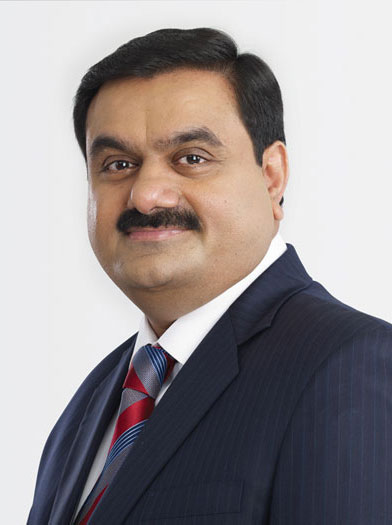
Gautam Shantilal Adani was born in Ahmedabad in 1962, the seventh of eight children of a small textile trader. He dropped out of Gujarat University after two years of a commerce degree and went to Mumbai at sixteen with the dim plan of sorting diamonds in Zaveri Bazaar. He worked at Mahendra Brothers for two years, made his first lakh of rupees, and went home to take over his brother's small plastics import-export shop in Ahmedabad.
Plastics led to coal. Coal led to imports. By 1988 he had founded Adani Exports — today Adani Enterprises — and was a quiet but unmistakable beneficiary of the early 1991 liberalization. The break came in 1995, when Gujarat's then chief minister handed him a stretch of marshy Kutch coastline at Mundra and asked him to make a port. He made the largest commercial port in India. Today Mundra handles a quarter of India's container traffic.
From ports, Adani went sideways into everything you need to move goods through ports: thermal power, transmission, gas, coal mining, edible oils (Fortune brand, joint venture with Wilmar), city gas, defence, cement (the 2022 Holcim acquisition for $10.5 billion), data centres, and — pivot of the decade — green energy. Adani Green Energy has a target of 45 gigawatts of renewable capacity by 2030, which would make it the largest renewables company in the world.
Through all of it, two things kept happening together. The companies grew at speeds that astonished even Indian standards — Adani Group's market value increased twenty-fold between 2018 and 2022. And the questions about how grew louder. Adani was, openly, close to Prime Minister Narendra Modi, a fellow Gujarati, from the early 2000s. Critics said the closeness explained the speed; supporters said the speed explained the closeness.
Twenty questions, eight minutes on the clock, and a percentile measured against everyone who has taken it. No sign-up.
Take the IQ test →Then came Hindenburg. The January 2023 report accused the group of stock manipulation and accounting fraud, citing offshore shell entities allegedly used to inflate share prices. Adani denied every charge in a 413-page rebuttal. The group's market cap dropped by more than $150 billion within a month. The Indian Supreme Court appointed an expert committee to investigate. The committee, in 2024, found no clear regulatory failure but said key questions remained open. SEBI's investigation continued. The U.S. Department of Justice indicted Adani and several executives in November 2024 over alleged bribery linked to solar contracts — Adani denied all charges.
Through the storms he kept building. He commissioned the Navi Mumbai International Airport. He took on the Dharavi slum redevelopment — the largest urban renewal project in Asian history — promising new housing to nearly a million people. He bought NDTV in late 2022 in a contested takeover that ended Prannoy Roy's three-decade ownership. He continued raising debt and equity at a pace global bond desks compared to early-2000s Korean chaebols.
He lives quietly with his wife Priti, a dentist by training, in Shantivan, a relatively modest bungalow in Ahmedabad — no Antilia, no superyacht in public registries. He has survived a kidnapping in 1998 (released after ransom, never disclosed) and was inside the Taj Mahal Palace Hotel during the 2008 Mumbai attacks, hiding in the basement kitchens for nine hours. Friends say neither event changed his routine of waking at four and working past midnight.
His two sons, Karan and Jeet, run the airports and energy verticals. Adani is the third-generation Indian magnate who is shaping how the country's physical infrastructure looks in 2030 — and the most polarizing single name in the South Asian capital markets.
“Failure is just another opportunity dressed in disappointment.”— Pranav Adani biographical address, 2020
“The size of your dreams should always exceed your current capacity to achieve them.”— JBIMS convocation, 2022
“I am a first-generation entrepreneur and I have built whatever I have brick by brick.”— India Today Conclave, 2014
| Person | Country | Milestone | Age / Stat |
|---|---|---|---|
| Gautam Adani | 🇮🇳 India | Adani Group chair | 1962 Ahmedabad |
| Mukesh Ambani | 🇮🇳 India | Reliance chair | 1957 Aden |
| Ratan Tata | 🇮🇳 India | Tata Sons emeritus | 1937 Mumbai |
| Anand Mahindra | 🇮🇳 India | Mahindra chair | 1955 Mumbai |
| Kumar Mangalam Birla | 🇮🇳 India | Aditya Birla chair | 1967 Kolkata |
Gautam Adani biography
Adani Hindenburg explained
He built the physical infrastructure — ports, power plants, transmission lines, airports — that the post-1991 Indian economy actually runs on.
His Hindenburg crisis and US DOJ indictment have become the global case study on Indian capital-markets transparency and political proximity.
Discover More Indian Geniuses
100 of the most influential Indians alive today — cinema, cricket, tech, music, sport and ideas — shaping the world.
Explore Indian Geniuses →





