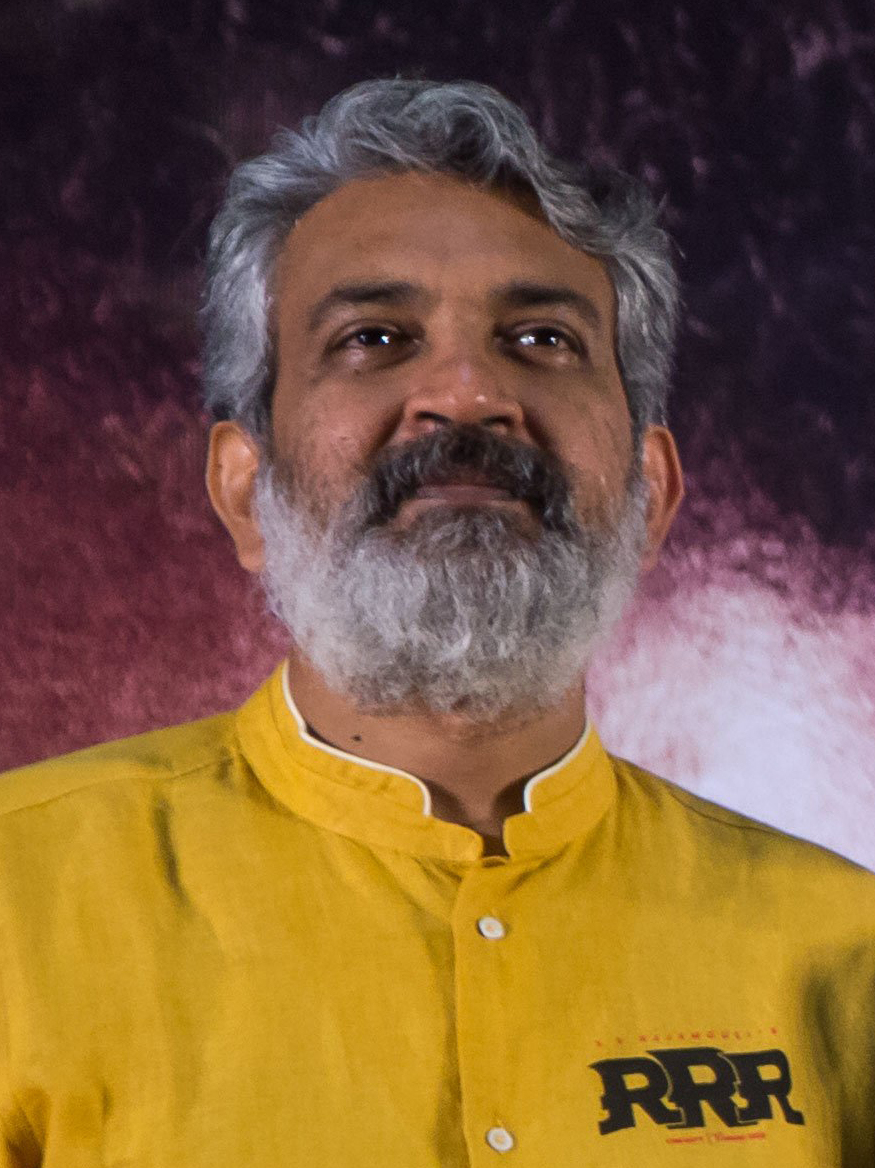
He was born in 1973 in Raichur, Karnataka, to V. Vijayendra Prasad, a screenwriter who would later script Baahubali, Bajrangi Bhaijaan and Manikarnika. The family was Telugu, the household was cinema, and Rajamouli's playground was the editing bay. As a child he watched cuts being made on his father's mid-1970s mythologicals; as a teenager he was already calling continuity for him. He directed television serials in his twenties before his first feature, Student No. 1, in 2001 — a college film made on a borrowed schedule that revealed a startling talent for staging mass moments.
Through the 2000s he made Telugu-language hits — Simhadri, Sye, Chatrapathi, Vikramarkudu, Magadheera — each one bigger than the last, each one a study in how to choreograph an audience's heartbeat. Magadheera (2009), a reincarnation epic with Ram Charan, ran for over a thousand days in some theatres. Eega (2012), in which the hero is reincarnated as a housefly seeking revenge against the businessman who killed him, became a cult export and his first true international calling card. Festival programmers in Fantastic Fest and Sitges began booking him.
Then came Baahubali. The first film, in 2015, was conceived as a two-part epic and made on a budget audacious by any Indian standard at the time. The cliffhanger ending — Why did Kattappa kill Baahubali? — became a national meme, debated on Doordarshan news panels and stand-up sets. The second part, in 2017, was the first Indian film to gross more than a thousand crore rupees and out-earned most Hollywood releases in India that year. Translated into nineteen languages, it played in territories that had never imported a Telugu film.
His method is austere. He storyboards every shot himself, often with stick figures, and shoots in long pre-visualised sequences that look almost ritualistic to outside observers. He distrusts improvisation. He reveres rhythm; his cuts, his music director and cousin M. M. Keeravani says, are timed to the breath of the audience, not the actor. He works exclusively in Telugu first, then dubs into Tamil, Hindi, Malayalam and Kannada under his direct supervision. He calls dubbing a sacred translation, not an afterthought.
Twenty questions, eight minutes on the clock, and a percentile measured against everyone who has taken it. No sign-up.
Take the IQ test →RRR, in 2022, fictionalised the early lives of revolutionaries Alluri Sitarama Raju and Komaram Bheem as a buddy epic with tigers, fire, motorbikes, and a dance sequence — Naatu Naatu — that would become the first song from an Indian film to win an Academy Award. The film grossed over 1,200 crore rupees worldwide and earned a standing ovation at Beyond Fest in Los Angeles, where audiences clapped through every interval. Variety, IndieWire and the Hollywood Critics Association each named it one of the films of the year.
He is married to Rama Rajamouli, his long-time costume designer, who has dressed every one of his films since Simhadri. They live in Jubilee Hills, Hyderabad, in a home built around a private screening room. He is an open atheist in a household of devout Hindus and a quiet supporter of M. M. Keeravani, whom he insists be credited above himself in every poster. His son S. S. Karthikeya is the principal producer on his recent films.
Critics in the West, late to him, called Baahubali camp and then admitted it was opera. In India, he is something stranger and older: a folk artist working at industrial scale, telling the stories that grandparents in Andhra villages have always told, with the production values of a studio in Burbank. He is currently in production on SSMB29, a globe-spanning adventure with Mahesh Babu being shot in Africa and Europe, scheduled for 2026.
He is also, increasingly, an ambassador for the entire Telugu industry, which until the last decade had been treated as a regional add-on to Bombay. After RRR, Korean theatrical circuits, Japanese anime conventions and Latin American cinephile clubs began booking Telugu films with subtitles. Rajamouli himself is famously polite about this transition. He bows when introduced. He does not drink, does not party, and goes to bed before midnight. The flood of attention, he has said, is welcome but slightly besides the point — he was already telling the stories he wanted to tell, on the scale he wanted to tell them, before the rest of the world started watching.
“I do not make films for critics. I make films for the man in the last row of the single-screen theatre in Vijayawada.”—
“Scale is not budget. Scale is how big you make the audience feel.”—
| Person | Country | Milestone | Age / Stat |
|---|---|---|---|
| S. S. Rajamouli | 🇮🇳 India | 1973 | |
| Sanjay Leela Bhansali | 🇮🇳 India | 1963 | |
| Karan Johar | 🇮🇳 India | 1972 | |
| Anurag Kashyap | 🇮🇳 India | 1972 | |
| Mani Ratnam | 🇮🇳 India | 1956 |
RRR — Naatu Naatu (Oscar-winning sequence)
Baahubali 2 — The Conclusion trailer
Made Indian cinema globally legible at scale, opening Western markets to non-Hindi Indian films
Won India's first Oscar for a song from a feature film, breaking a 95-year drought
Discover More Indian Geniuses
100 of the most influential Indians alive today — cinema, cricket, tech, music, sport and ideas — shaping the world.
Explore Indian Geniuses →


.jpg)


