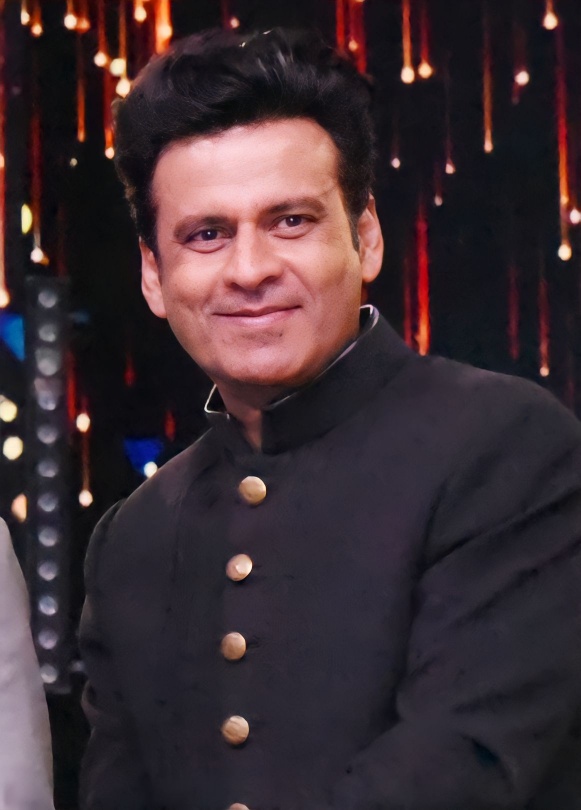
Manoj Bajpayee was born on 23 April 1969 in the village of Belwa, in the West Champaran district of Bihar, the third of six children of a Hindi-teacher father and a homemaker mother. The household had little money but a great deal of language: his father read Dinkar and Premchand aloud, his mother sang folk songs from the Bhojpur belt, and Manoj decided by the age of nine that he wanted to be Amitabh Bachchan when he grew up.
He moved to Delhi at seventeen to study at Ramjas College and to audition for the National School of Drama. He was rejected by NSD four times in a row — a fact he has referred to in interviews with the slight smile of a man whom revenge has rendered patient. He stayed in Delhi anyway, joined Barry John's theatre group at the Shri Ram Centre, and taught younger actors who could afford the classes he could not.
His first film role was a single-line appearance in Drohkaal (1994). His second was a marginally larger one in Bandit Queen (1994), Shekhar Kapur's biopic of Phoolan Devi, in which he played one of Vikram Mallah's gang. He spent the rest of the 1990s working in television serials and theatre, surviving on lentil rice and a small allowance from his elder brother. He was thirty when Satya was released.
Bhiku Mhatre — the volatile, half-tender, half-monstrous gangster of Satya — won him the National Film Award for Best Supporting Actor in 1999 and the Filmfare Award the same year. The film changed the Hindi gangster movie for good, and Bajpayee, almost immediately, was offered the kind of leading-man parts he had grown up wanting. He took some of them and turned down others. He played a corrupt politician in Shool (1999), a small-time crook in Pinjar (2003), and the title role in Hansal Mehta's Aligarh (2015), playing the gay Marathi professor Ramchandra Siras whose dismissal and death became a defining moment in Indian gay-rights jurisprudence.
Twenty questions, eight minutes on the clock, and a percentile measured against everyone who has taken it. No sign-up.
Take the IQ test →Aligarh remains the performance many of his peers consider his finest. Pankaj Tripathi has called it "the masterclass". The film, made on a small budget, asks Bajpayee to hold a single quiet emotional note for nearly two hours and he does it with a discipline that several of his contemporaries have admitted they could not have matched. He won a Special Jury Award at the Asia Pacific Screen Awards for the role.
The streaming era, when it came, was almost custom-built for him. In 2019 Amazon Prime Video released The Family Man, in which he plays Srikant Tiwari, a middle-aged officer of a fictional Indian intelligence agency, husband, father, and quietly exhausted man whose double life is mostly comic and occasionally lethal. The show became Amazon's most-watched Indian original of its era. Bajpayee, at fifty, was suddenly a household name in a way that two decades of festival favourites had not delivered.
He has been married since 2006 to the actress Shabana Raza (Neha), with whom he has a daughter. He has been outspoken, calmly and at length, about communalism, caste, the politics of Bihar, and the obligations of a Hindi-film star in a country whose public sphere has been narrowing. He has been awarded three National Film Awards — for Satya (1998), Pinjar (2003) and Bhonsle (2020) — and the Padma Shri (2019), and is the rare actor of his generation whom both the multiplex Bombay industry and the regional independent cinema circuit treat as a peer.
By 2025 he had crossed the fifty-five-year mark, three seasons into The Family Man, with a fourth in production. He has spoken about not retiring, ever, of his ambition to do the kind of slow, attentive late-career work that Anthony Hopkins and Bill Nighy are doing in English-language cinema. The Hindi industry, which has not historically known what to do with male leads after fifty, is, because of him and a small handful of his peers, beginning to figure it out.
“I was rejected by NSD four times. I am still angry about it. That is also why I am still working.”— Manoj Bajpayee, Indian Express interview, 2019
“A star is the man the audience watches. An actor is the man the audience listens to.”— Manoj Bajpayee, in conversation with Rajeev Masand, 2016
“I have been playing Srikant Tiwari for so long that he sometimes wakes me up in my own house.”— Manoj Bajpayee, on The Family Man, 2023
| Person | Country | Milestone | Age / Stat |
|---|---|---|---|
| Manoj Bajpayee | 🇮🇳 India | The Family Man; Satya; Aligarh; three National Awards | 1998–2023 |
| Pankaj Tripathi | 🇮🇳 India | Mirzapur's Kaleen Bhaiya | 2018 |
| Nawazuddin Siddiqui | 🇮🇳 India | Sacred Games' Ganesh Gaitonde | 2018 |
| Irrfan Khan | 🇮🇳 India | The Lunchbox; Life of Pi | 2012–2013 |
| Naseeruddin Shah | 🇮🇳 India | Sparsh; Masoom; A Wednesday | 1980s–2000s |
The Family Man — Official Trailer (Amazon Prime Video India)
Aligarh — Official Trailer (Eros Now)
Manoj Bajpayee is the through-line of three eras of Indian acting: the 1990s indie wave that began with Satya, the early-2000s art-house decade of Pinjar and Aligarh, and the streaming-led 2020s that produced The Family Man. Few actors in any country have anchored that long a stretch with that level of consistency, and almost none have done it while turning down the conventional star apparatus of Bollywood.
He is also, with Naseeruddin Shah and Om Puri before him and Irrfan Khan beside him, one of the actors who created the modern Indian leading man — the one whose authority comes not from height or stardom but from inwardness and craft. Srikant Tiwari, in particular, is the role that proved a fifty-year-old Hindi-speaking spy could carry a global streaming franchise. Every Indian-streaming green-light meeting of the 2020s, in some sense, has had to argue with the precedent he set.
Discover More Indian Geniuses
100 of the most influential Indians alive today — cinema, cricket, tech, music, sport and ideas — shaping the world.
Explore Indian Geniuses →


