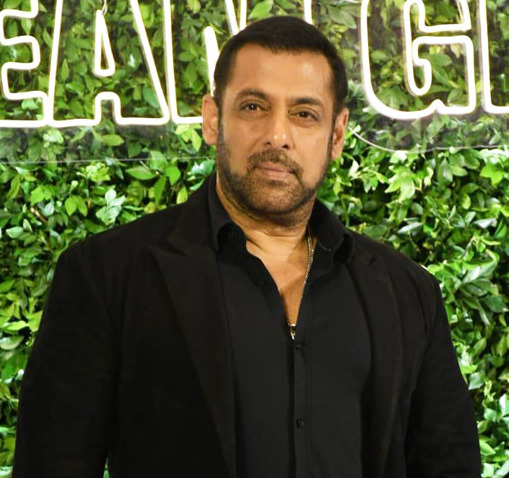
He was born Abdul Rashid Salim Salman Khan in Indore in December 1965, the eldest son of the screenwriter Salim Khan — half of the Salim-Javed partnership that wrote Sholay, Deewar and Zanjeer — and his first wife Sushila Charak. The household in Bandra was a writers' room before it was a home: Javed Akhtar dropped by, scripts were workshopped over chai, Amitabh Bachchan came to read lines. Salman was the quiet one, the gym one, the brother who took the younger Arbaaz and Sohail swimming at the Otters Club.
His debut as a supporting actor in Biwi Ho To Aisi (1988) attracted no notice. Then Sooraj Barjatya cast him as Prem in Maine Pyar Kiya (1989) and the result was a cultural reset. The film, a chaste love story scored by Raam-Laxman, ran for almost a year in some cinemas and made Salman the face of late-eighties Hindi romance. Hum Aapke Hain Koun..! (1994), the four-hour wedding musical that became the highest-grossing Indian film of all time on release, sealed the partnership with Rajshri Productions.
The nineties were uneven — Karan Arjun, Judwaa, Pyaar Kiya To Darna Kya, Bandhan, Hum Saath-Saath Hain — and the personal life began to leak into the headlines. The 2002 hit-and-run case on Bandra's Hill Road, the parallel poaching case from a 1998 Jodhpur shoot, the very public end of his relationship with Aishwarya Rai: by 2005 the press treated him as both star and defendant. He was acquitted in the hit-and-run case in 2015 and in the blackbuck-poaching case partially in 2018; legal proceedings have continued.
Through all of it, the films kept opening. Wanted (2009) reset him as an action lead. Dabangg (2010), directed by Abhinav Kashyap, gave him Chulbul Pandey — the corrupt-but-honourable UP cop with the police-belt swagger — and built a franchise. Bodyguard, Ek Tha Tiger, Kick, Bajrangi Bhaijaan, Sultan, Tiger Zinda Hai, Tiger 3. Between 2009 and 2019 he had eleven films cross ₹100 crore at the Indian box office, a record unmatched by any contemporary.
Twenty questions, eight minutes on the clock, and a percentile measured against everyone who has taken it. No sign-up.
Take the IQ test →Bajrangi Bhaijaan (2015), directed by Kabir Khan, is the film he is most asked about. He plays Pawan Kumar Chaturvedi, a Hanuman devotee who escorts a mute Pakistani child home. It grossed ₹920 crore worldwide and became the second-highest-grossing Indian film at the time. It is also, more quietly, the film in which he stopped performing star and started performing tenderness.
His television career — fronting the Hindi version of Big Brother as Bigg Boss since 2010 — has run for fifteen seasons and made the show India's most-watched reality property. Critics dismiss it; advertisers do not. He hosts in his own voice, fights with contestants, plugs his upcoming film, and earns reportedly the highest single-host fee on Indian television.
Being Human, the foundation he founded in 2007 with his brother Sohail, funds paediatric heart surgeries and rural education. The clothing label that funds it has over 600 stores. He has, in interviews, described the foundation as the part of his life he is least conflicted about. He still lives with his parents.
His personal mythology has been built less through interviews than through endurance. He has appeared annually on the Eid release slate since 2009 — fifteen consecutive years, broken only by the COVID-shuttered 2020 — and the dates themselves now function as franchise. Trade analysts speak of 'Salman releases' the way Hollywood once spoke of summer tentpoles: a built-in opening weekend, a single-screen heartland audience that turns up regardless of reviews, a soundtrack that becomes wedding-DJ inventory by autumn.
He is the most-followed Indian film star on Instagram and one of the youngest fitness icons in the country's mass imagination. He still trains at the family gym above Galaxy Apartments, choreographs many of his own action sequences with brother-in-law Atul Agnihotri's team, and refuses to dye his hair. His critics call the screen persona unchanging; his audience calls it consistent. In the last twenty years he has not, by any honest measure, lost his Eid weekend.
Inside the industry he functions as a kind of informal patriarch. He has launched Sonakshi Sinha, Daisy Shah, Saiee Manjrekar and Pooja Hegde; he gave Aayush Sharma and Zaheer Iqbal their first leads through Salman Khan Films; he has loaned scripts, financing and screen-credits to younger directors whose work he likes. The system he runs from Galaxy Apartments — Eid date, family-and-foundation pitch, mass-market hook, low-key piety — is one of the few enduring institutional structures in a Hindi-cinema industry otherwise governed by season-to-season improvisation. Whether one calls it stardom or franchise, three full decades of cinema in India have run, in part, on his calendar.
He paints. The walls of Galaxy Apartments carry, his visitors confirm, dozens of canvases in his hand — abstract heads, beach scenes, the occasional copied Hussain. The pieces have been auctioned for the foundation, mostly for paediatric heart surgeries; one work, a 2018 self-portrait, reportedly fetched over a crore at a closed Mumbai sale. The painting habit, like most of his life now, sits outside the press cycle. The Eid release lands; the film opens; the painting goes back up on the wall; the foundation cuts another cheque to a child in a Mumbai hospital. The pattern has held, with adjustments for legal proceedings, for almost twenty years.
“Do whatever you have to do — but once you give your word, keep it.”Salman Khan, Filmfare interview, 2015
“Mujh par ek ehsaan karna, mujh par koi ehsaan na karna.”Dabangg, dialogue spoken in character, 2010
| Person | Country | Milestone | Age / Stat |
|---|---|---|---|
| Salman Khan | 🇮🇳 India | Bollywood Action Icon — Dabangg, Tiger franchise | 1965 |
| Shah Rukh Khan | 🇮🇳 India | King Khan — DDLJ, Pathaan, Jawan | 1965 |
| Akshay Kumar | 🇮🇳 India | Action-Comedy King — Khiladi, Airlift, Hera Pheri | 1967 |
| Sylvester Stallone | 🇺🇸 USA | Hollywood Action Star — Rocky, Rambo | 1946 |
| Jackie Chan | 🇭🇰 Hong Kong | Action Star — Police Story, Rush Hour | 1954 |
Dabangg — Munni Badnaam Hui
He occupies a singular emotional contract with mass audiences — survival, loyalty, family — that critics cannot quantify and competitors cannot copy.
His career is the clearest case study in how Indian stardom now blends film, television, philanthropy and tabloid endurance.
Discover More Indian Geniuses
100 of the most influential Indians alive today — cinema, cricket, tech, music, sport and ideas — shaping the world.
Explore Indian Geniuses →


.jpg)


