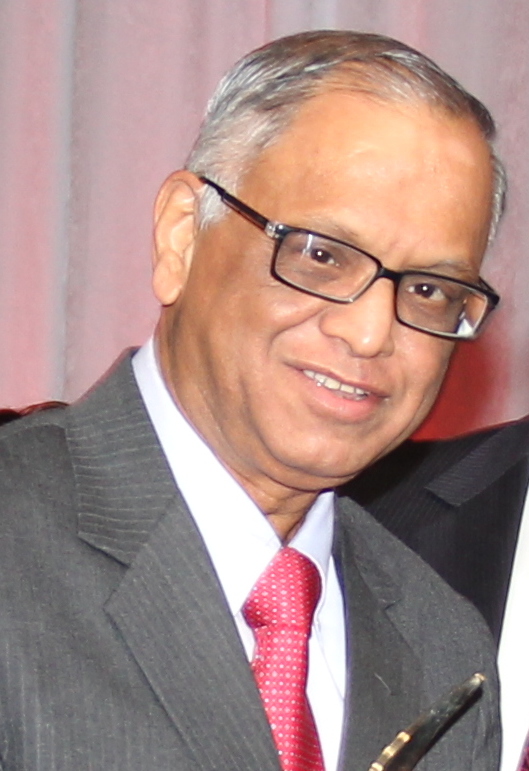
Nagavara Ramarao Narayana Murthy was born on August 20, 1946, in Sidlaghatta, Karnataka, the fifth of eight children of a Kannada schoolteacher. He topped his class through the National Institute of Engineering at Mysore, then earned an M.Tech in electrical engineering from IIT Kanpur in 1969 — sleeping on a hostel mattress and writing FORTRAN by hand at three in the morning because the punch-card slot was free then.
His first job was at IIM Ahmedabad as a chief systems programmer. He left to backpack through Europe in the early 1970s, a trip that produced one of the formative episodes of his life: arrested briefly in Bulgaria during the Cold War for political conversation, he came home a converted compassionate capitalist — a believer that wealth had to be created in private hands but distributed with discipline and visible ethics. He coined the phrase a decade later and never let it go.
He returned to India, founded a small company called Softronics that failed, and then in 1981 founded Infosys with six co-founders in a borrowed Pune apartment — Nandan Nilekani, S. Gopalakrishnan, S. D. Shibulal, K. Dinesh, N. S. Raghavan, and Ashok Arora. Sudha's loan paid for the first office equipment. For the first decade, Infosys was small and patient. They turned down deals that required bribes. They installed Indian IT's first ESOP. They moved to Bangalore. They listed on the NASDAQ in 1999, the first Indian company to do so.
Through the 1990s and 2000s, while Wipro and TCS scaled by sheer mass, Infosys scaled by brand. The Bangalore campus on Hosur Road — green lawns, employee gym, transparent glass walls — became a tourist stop for visiting heads of state. Murthy would meet them in plain white kurta and brown sandals and serve them filter coffee. He retired as executive chairman in 2011, came back briefly in 2013 to right the ship during a leadership stumble, and retired again in 2014.
Twenty questions, eight minutes on the clock, and a percentile measured against everyone who has taken it. No sign-up.
Take the IQ test →He has, in his second act, become India's most quoted business ethicist and one of its most polarizing public voices. He wrote A Better India: A Better World (2009). He chairs the Infosys Foundation alongside Sudha. He has lectured at every major Indian business school. He has also, in recent years, become controversial for arguing that Indian youth need to work 70 hours a week to make India globally competitive — a comment that detonated a national debate in late 2023 about Indian work culture, generational expectations, and what 'compassionate capitalism' actually means when you are 78 and your protégés are 28.
His personal life is the quietest part of the legend. He and Sudha live in a modest flat in Bangalore. They have two children, Akshata and Rohan. Akshata married Rishi Sunak — then a Stanford GSB classmate, later UK Chancellor of the Exchequer, then Prime Minister of the United Kingdom from October 2022 to July 2024. The Sunak-Murthy family is among the wealthiest in Britain on paper, almost entirely because of Akshata's stake in Infosys (Sudha and Murthy gifted shares to both children before listing). Akshata's non-domiciled UK tax status briefly became a political scandal in 2022.
Murthy's stake in Infosys today is below 1 percent. He has given more away — to the Murty Classical Library of India at Harvard, to the Public Library Project in Karnataka, to the IISc, to thousands of individual scholarships — than most Indian industrialists have accumulated. He does not own a car worth more than Rs 20 lakh. He flies economy on Indian domestic routes when no one's watching.
He turned eighty in 2026 and is still on stage, still controversial, still in white kurta and sandals. The phrase compassionate capitalism, when said in India, still belongs to one man.
“The softest pillow is a clear conscience.”— IIT Kanpur convocation, 2007
“In God we trust; everybody else must bring data to the table.”— Edward Robinson Murrow Lecture, 2007
“Performance leads to recognition. Recognition brings respect. Respect brings power.”— INSEAD, 2010
| Person | Country | Milestone | Age / Stat |
|---|---|---|---|
| N. R. Narayana Murthy | 🇮🇳 India | Infosys co-founder | 1946 Sidlaghatta |
| Azim Premji | 🇮🇳 India | Wipro chair emeritus | 1945 Mumbai |
| Nandan Nilekani | 🇮🇳 India | Infosys co-founder, Aadhaar architect | 1955 Bengaluru |
| Shiv Nadar | 🇮🇳 India | HCL Tech founder | 1945 Tamil Nadu |
| Sridhar Vembu | 🇮🇳 India | Zoho founder | 1968 Tamil Nadu |
Narayana Murthy on values
Murthy 70-hour week debate
He proved that an Indian company could be built on Western-grade governance and corporate ethics — and could list on NASDAQ.
He is the moral grandfather of the Indian IT services industry that today employs nearly 5 million people and exports over $200 billion a year.
Discover More Indian Geniuses
100 of the most influential Indians alive today — cinema, cricket, tech, music, sport and ideas — shaping the world.
Explore Indian Geniuses →


