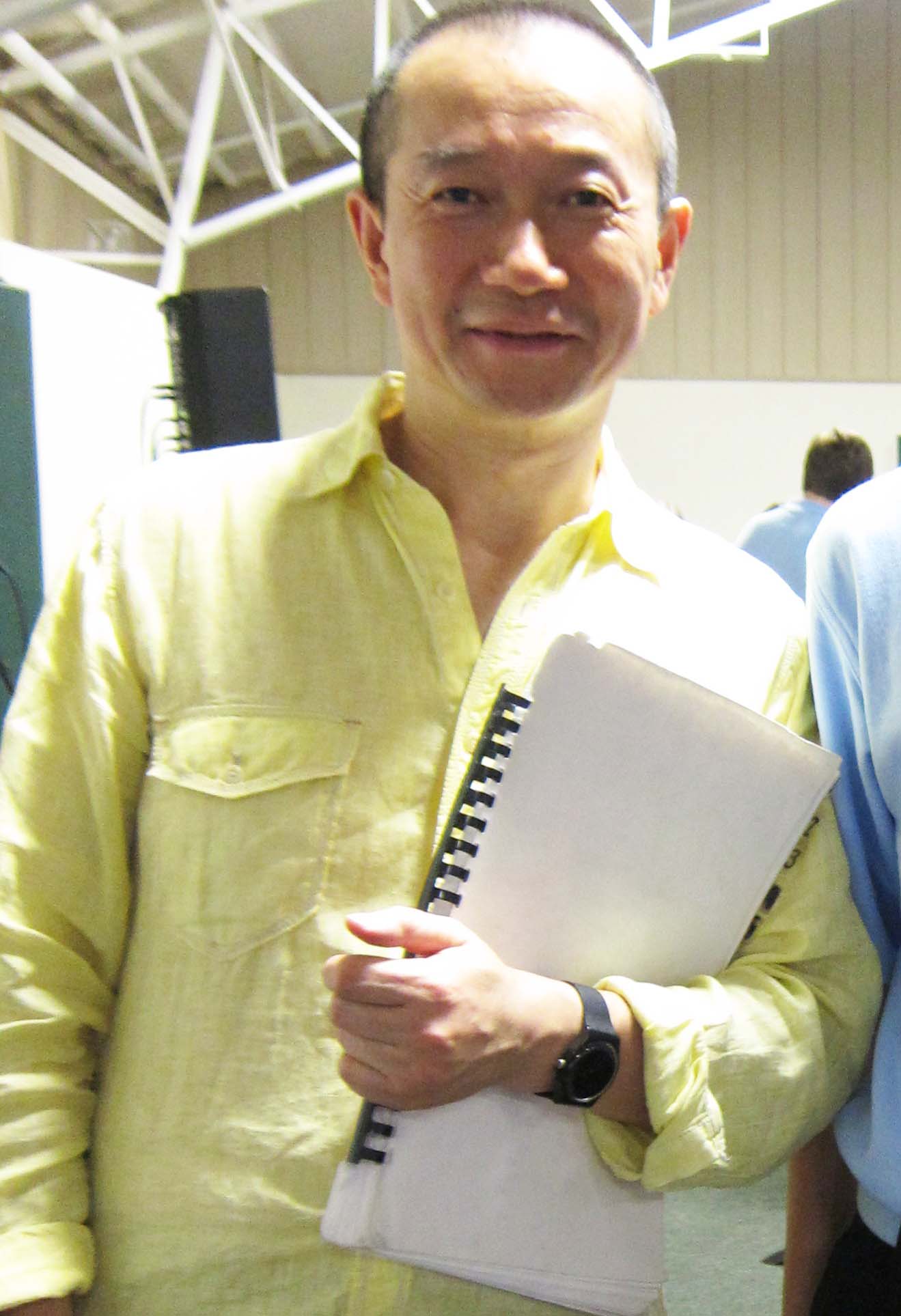
Tan Dun was born on August 18, 1957, in Si Mao, a rural village in Hunan province where shamanistic rituals and folk opera remained woven into daily life. His childhood unfolded against the backdrop of the Cultural Revolution, when Western classical music was banned and traditional Chinese culture faced systematic suppression. At fifteen, he was sent to plant rice and work the land, part of the massive campaign to relocate urban youth to the countryside. Those years proved formative in unexpected ways. Living among farmers and villagers, Tan absorbed the musical traditions that had been passed down orally for centuries: funeral songs, wedding ceremonies, harvest chants. He began transcribing melodies he heard, filling notebooks with folk material that would later become the foundation of his compositional voice. The paddies became his first conservatory, teaching him music rooted in labor, ritual, and the natural world.
When Beijing's Central Conservatory of Music reopened in 1978 after years of closure, Tan was among the first cohort admitted. At twenty-one, he found himself studying Western compositional techniques for the first time, analyzing Bach fugues and Beethoven symphonies alongside peers who would become known as China's New Wave composers. The conservatory environment was electric with possibility. Students who had spent years in factories and fields now devoured scores, theories, and techniques that had been forbidden. Tan studied under celebrated composer Zhao Xiaosheng, developing a personal style that began to integrate the folk materials he had collected in Hunan with avant-garde techniques. His early works from this period experimented with unconventional sound sources, incorporating stones, water, and paper alongside traditional instruments. The conservatory years gave him technical mastery, but the paddies had already given him his voice.
In 1986, Tan arrived at Columbia University to pursue doctoral studies, entering New York's downtown experimental music scene at its peak. The city offered unprecedented freedom to explore the boundaries between composition, performance art, and cultural fusion. At Columbia, he studied with composers including Chou Wen-chung and Mario Davidovsky, while downtown he collaborated with choreographers, visual artists, and musicians working outside traditional concert halls. His dissertation work explored organic music theater, a concept that would define his mature aesthetic. He completed his PhD in 1993, by which time he had already premiered works at major festivals across Europe and North America. New York gave him access to world-class orchestras and performers willing to experiment with his unconventional demands: orchestral musicians playing stones and water bowls, vocalists incorporating folk techniques, percussion sections expanded to include ceramic tiles and metal scrapers.
Twenty questions, eight minutes on the clock, and a percentile measured against everyone who has taken it. No sign-up.
Take the IQ test →The commission for Crouching Tiger, Hidden Dragon arrived in 1999, pairing Tan with director Ang Lee for a film that would redefine the wuxia genre for global audiences. Tan's score blended the cello artistry of Yo-Yo Ma with traditional Chinese instruments including the erhu, performed by virtuoso Ma Xiaohui. He incorporated elements of Peking opera, Hunan folk songs, and Western orchestral writing into a soundscape that felt simultaneously ancient and contemporary. The film premiered at Cannes in May 2000, and the score immediately garnered attention for its emotional depth and cultural synthesis. On March 25, 2001, Tan won the Academy Award for Best Original Score, becoming one of the few Chinese artists to claim Hollywood's highest honor. He also won a Grammy, a BAFTA, and numerous other accolades. The success established him as a composer capable of reaching mass audiences without diluting his artistic vision.
The Beijing Olympics commission in 2008 presented different challenges. Tan was tasked with composing the music that would accompany every medal ceremony, meaning his work would be heard thousands of times during the Games and broadcast to billions worldwide. He created a composition titled "Award Ceremony Music Suite" that incorporated ancient Chinese instruments with full orchestra, crafting a sonic signature that evoked both celebration and cultural pride. The piece played as athletes from every nation mounted the podium, creating an auditory through-line for the entire event. Beyond the medal ceremonies, Tan also composed "Logo Music" and "Music for the Countdown Ceremony." The Olympics solidified his position as a composer trusted with China's most visible cultural moments, capable of articulating national identity for a global stage while maintaining artistic integrity.
Tan's career encompasses far more than film and ceremonial works. His concert music includes operas that have premiered at major houses worldwide, including The First Emperor, commissioned by the Metropolitan Opera and premiered in 2006 with Placido Domingo in the title role. He has composed symphonies that incorporate video installations, Internet-linked performances, and audience participation. His "Organic Music" series explores environmental themes, using water, stones, and paper as primary instruments. Major orchestras including the Boston Symphony, London Symphony, and Berlin Philharmonic have commissioned and performed his works. Yo-Yo Ma, a frequent collaborator, has stated plainly: "Tan Dun has changed what an orchestra can sound like." That transformation extends beyond instrumentation to encompass what concert music can express about cultural identity, environmental consciousness, and the porousness of borders between musical traditions.
Today Tan serves as Dean of the Bard College Conservatory of Music in New York, training the next generation of composers while maintaining an active creative practice. He continues to compose prolifically, with recent works exploring technology's relationship to live performance and environmental sustainability. His compositions appear on concert programs from Tokyo to Vienna, performed by the world's leading musicians. At sixty-seven, he remains committed to the principle he articulated in a 2010 lecture at the Royal Academy: "My music is two civilisations talking through one orchestra." That conversation has expanded over decades to include not just East and West, but rural and urban, ancient and contemporary, acoustic and electronic. The boy who transcribed folk songs in rice paddies has spent his career proving that synthesis is not dilution, that cultural fusion can deepen rather than diminish artistic expression.
“My music is two civilisations talking through one orchestra.”— Tan Dun, Royal Academy lecture, 2010
“Tan Dun has changed what an orchestra can sound like.”— Yo-Yo Ma
| Person | Country | Milestone | Age / Stat |
|---|---|---|---|
| Tan Dun | 🇨🇳 China | COMPOSER | 1957 |
Tan Dun — Crouching Tiger Suite (Oscar-winning score)
Tan Dun Water Concerto live
Tan Dun's significance to contemporary classical music lies in his demonstration that cultural synthesis can operate at the highest artistic levels without collapsing into pastiche or exoticism. Before his emergence, Western orchestral music and Chinese folk traditions largely existed in separate spheres; when they intersected, the results often felt superficial, with Chinese elements treated as decorative additions rather than structural foundations. Tan fundamentally reimagined what orchestral composition could encompass by treating folk materials, unconventional instruments, and non-Western performance practices as equal partners with European classical forms. His Academy Award and Grammy for Crouching Tiger, Hidden Dragon proved that music rooted in this approach could reach audiences numbering in the hundreds of millions. His concert works have been performed by every major orchestra, establishing that experimental approaches to instrumentation and cultural fusion belong in the most prestigious concert halls. He changed the palette available to composers worldwide, expanding what sounds can legitimately appear in a symphony or opera.
For Chinese artists working in Western classical forms, Tan Dun demolished the assumption that excellence required erasing cultural specificity. Previous generations of Chinese composers often felt pressure to master European traditions so thoroughly that their own heritage became invisible. Tan pursued the opposite path, making his Hunan roots and folk research central rather than peripheral to his artistic identity. His success at the Oscars, the Met Opera, and the Beijing Olympics demonstrated that Chinese cultural materials could anchor works of global significance. He showed that a composer could be unmistakably Chinese and unmistakably contemporary without contradiction. That example opened pathways for younger artists across disciplines, proving that international recognition did not require cultural erasure. When he composed the music heard by billions during the Beijing Olympics medal ceremonies, he was not representing an abstract idea of artistic excellence but embodying a specific vision: that Chinese and Western musical traditions could coexist within a single artistic consciousness, each enriching the other.
Discover More Child Prodigies
50+ stories of contemporary young geniuses changing chess, music, science, and art.
Explore All Prodigies →




