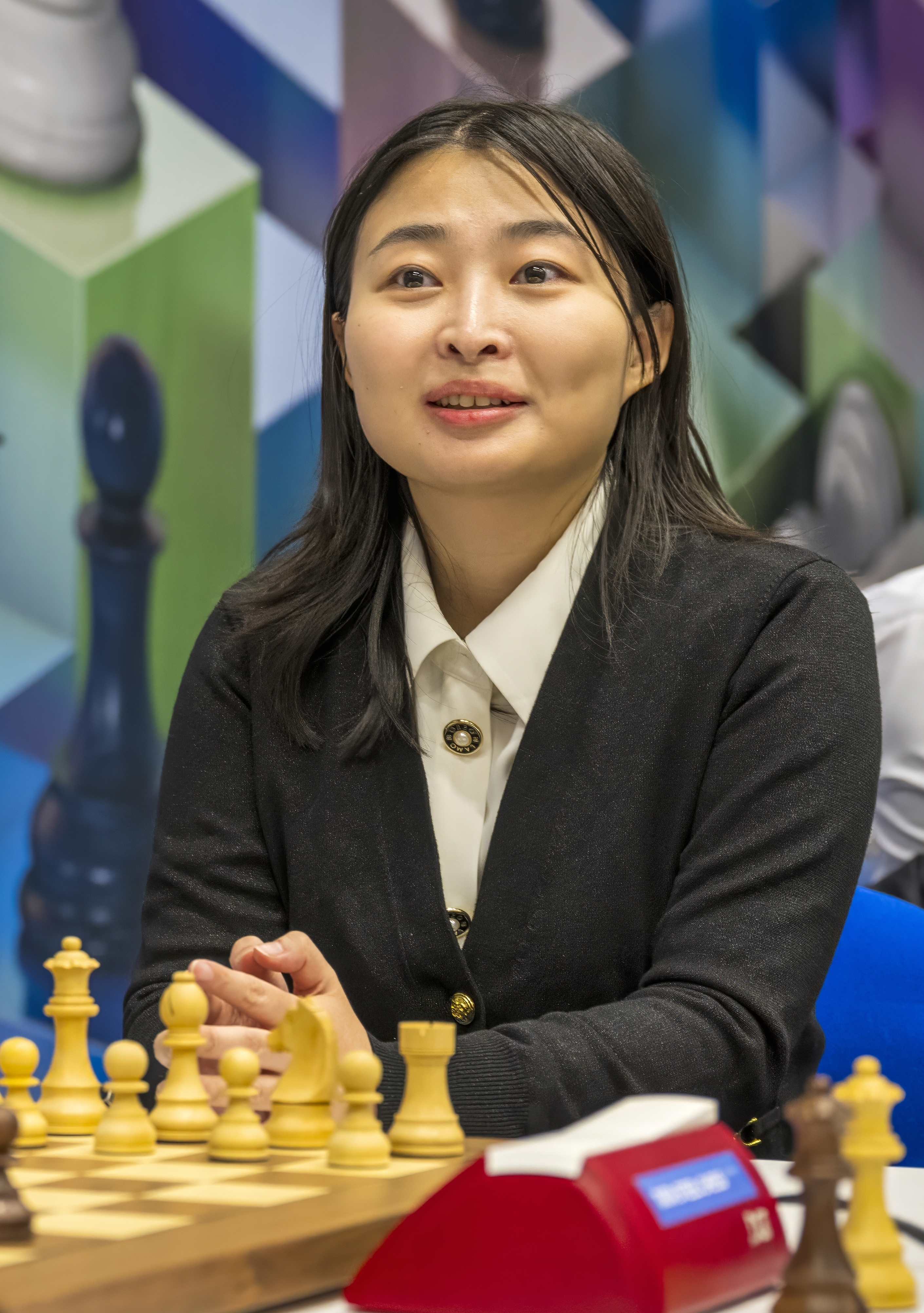
Shanghai in 1998 was a city hurtling toward the future, its skyline rising as fast as its ambitions. In that year of transformation, a seven-year-old girl named Ju Wenjun sat down to her first chess lesson, entering a world of sixty-four squares that would consume the next three decades of her life. The game arrived neither through family tradition nor prodigy mythology, but through the structured after-school programs that characterized urban Chinese childhood at the millennium's end. She learned pattern recognition before she learned algebra, studied endgames while her classmates studied English vocabulary. The training was methodical, rigorous, unromantic. By age ten she was competing in national junior events, her rating climbing with metronomic regularity. Shanghai's chess schools had produced strong players before, but none would carry the city's reputation as far as this quiet, focused girl who treated every position as a puzzle demanding perfect solution.
The Women's Grandmaster title arrived in 2007, when Ju was just sixteen, a recognition of talent that placed her among the elite tier of female players worldwide. The WGM norm requirements demanded performance ratings above 2250 against international opposition, a standard she met with room to spare across three separate tournaments. But the title was milestone, not destination. Through her late teens and early twenties, Ju played the circuit, traveling to European opens and Asian championships, accumulating rating points and experience in equal measure. Her style emerged slowly: positional, patient, willing to grind out advantages over fifty or sixty moves when flashier players sought quick knockouts. Coaches noted her endgame technique, her willingness to simplify into slightly better rook endings and convert them with technical precision. She won tournaments but not headlines, built rating but not celebrity. The apprenticeship was long.
The breakthrough to the global stage came at the 2014 Chess Olympiad in Tromsø, Norway, where Ju anchored the Chinese women's team to gold. Playing board two, she scored seven points from nine games, a performance rating that exceeded many male grandmasters in the open section. The team victory was dominant, China finishing two match points clear of Russia and India, and Ju's contribution was indispensable. Tromsø sits above the Arctic Circle, and the midnight sun illuminated games that stretched past usual time controls. Ju thrived in the endless daylight and pressure, her positional judgment sharpening under the weight of team expectations. Susan Polgar, the former women's world champion and Olympiad veteran, watched from the commentary booth and offered an assessment that would prove prescient: "Ju's positional understanding is on the level of the elite men. She just chose to play in the women's section."
Twenty questions, eight minutes on the clock, and a percentile measured against everyone who has taken it. No sign-up.
Take the IQ test →May 2018 brought the defining moment. In Shanghai, before a home crowd that filled every seat in the championship venue, Ju Wenjun faced Tan Zhongyi in the Women's World Championship match. Tan held the title, having won it through the knockout format the previous year, and arrived as favorite. The match format was classical: ten games, long time controls, no blitz tiebreaks unless absolutely necessary. Ju won the first game with black pieces, a psychological blow that Tan never fully absorbed. The match became a positional clinic, Ju demonstrating the grinding, suffocating style that had matured over a decade of tournament play. She won four games, lost one, drew five, claiming the title with a game to spare. The trophy presentation happened in the city where she had first learned the moves twenty years earlier, a symmetry that Chinese media seized upon. She was twenty-seven, finally world champion.
What followed was unprecedented consistency. In 2019, she defended against Kateryna Lagno in a match held across Vladivostok and Khanty-Mansiysk, winning convincingly. In 2020, the pandemic disrupted the calendar, but when the championship finally convened in early 2021 under the 2020 designation, Ju defeated Aleksandra Goryachkina in Shanghai once more, this time in a match that required rapid playoff games after a drawn classical portion. The 2023 defence against Lei Tingjie in Chongqing was perhaps the most difficult, facing a younger Chinese rival who knew her style intimately from years of national team competition. Ju prevailed again, making her the only player in chess history to win the Women's World Championship four times across different formats: knockout rounds, classical matches, and rapid tiebreaks. The achievement transcended individual brilliance and entered the realm of historical dominance.
The 2023 victory, her fourth title, extended her reign to five continuous years, a stretch of championship tenure unmatched in twenty-first-century women's chess. Previous champions had won and lost, won and lost, the title changing hands with regularity that reflected both the compressed knockout formats and the competitive depth of the women's game. Ju's four defences represented not just skill but psychological resilience, the ability to carry the target on her back through successive cycles and emerge victorious each time. Her rating peak of 2593, achieved in 2019, placed her consistently in the top five female players globally. She played with the calm of someone who understood that chess at the highest level was war of attrition, not lightning strikes. Opponents prepared for her, analyzed her games, found her tendencies, and still she won. The method was grinding; the results were irrefutable.
Today, Ju Wenjun remains world champion, her reign extending into a sixth year. She competes in elite round-robins and team championships, her presence elevating any tournament field. The Chinese Chess Association built a generation of female players around her example: disciplined preparation, positional soundness, psychological toughness. Younger players like Lei Tingjie and Zhu Jiner grew up studying Ju's games, absorbing her strategic preferences, and still could not overcome her when championship stakes arrived. Her legacy is not a single brilliant game or dramatic comeback, but the sustained excellence that redefined what longevity could mean in women's chess. She learned the moves at seven in Shanghai. At thirty-three, she still holds the crown, still prepares for the next defence, still carries the pressure that has become her signature. The trophy waits for no one, but for now, it waits with her.
“Each defence is harder than the one before. The pressure is the trophy.”— Ju Wenjun, after retaining the title, 2023
“Ju's positional understanding is on the level of the elite men. She just chose to play in the women's section.”— Susan Polgar
| Person | Country | Milestone | Age / Stat |
|---|---|---|---|
| Ju Wenjun | 🇨🇳 China | WOMEN'S WORLD CHAMPION | 1991 |
Ju Wenjun World Championship win 2018
Ju Wenjun best chess games
Ju Wenjun matters because she proved that dominance in women's chess could be sustained across formats, years, and opponents in an era when the depth of competition made such consistency nearly impossible. Before her reign, the Women's World Championship changed hands with dizzying frequency, titles won and lost in knockout formats that rewarded hot streaks over sustained excellence. Ju won four times across knockout rounds, classical matches, and rapid playoffs, demonstrating mastery across every conceivable format. Her positional style, grounded in endgame technique and strategic patience, stood in deliberate contrast to the tactical chaos that characterized much of women's top-level play. She did not win by outpreparing opponents in opening theory or finding brilliant sacrifices, but by reaching slightly better positions and converting them with machine-like efficiency over sixty moves. That grinding, relentless approach became a new template for championship chess, proving that method could defeat inspiration when the method was executed with sufficient discipline.
Ju's sustained success arrived at a moment when the broader world was awakening to the depth and sophistication of Chinese excellence across competitive domains. Women's chess had long been a Chinese strength, dating to Xie Jun's first world title in 1991, but Ju's four-title reign represented evolution beyond early breakthroughs into something like dynasty. She demonstrated that Chinese players could not only reach the summit but hold it against determined challenges from Russia, Ukraine, India, and rising talents from her own federation. Her reign coincided with Chinese achievements in mathematics, computer science, and strategic technologies, part of a larger narrative about patient, methodical excellence displacing the improvisation-worship of earlier generations. Ju made chess a domain where Chinese discipline and preparation were not merely competitive advantages but defining characteristics of modern championship play. The world learned to recognize not just Chinese talent, but Chinese staying power.
Discover More Child Prodigies
50+ stories of contemporary young geniuses changing chess, music, science, and art.
Explore All Prodigies →




