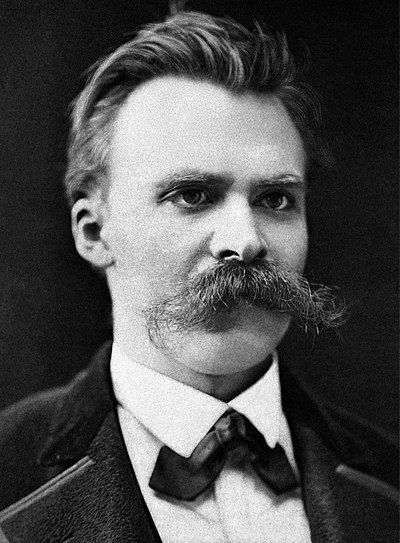
Fast Facts
- Born
- October 15, 1844
- Zodiac
- ♎ Libra (Sep 23 – Oct 22)
- Died
- August 25, 1900
- Nationality
- German (later stateless)
- Key Work
- Thus Spoke Zarathustra (1883–85)
- Main Idea
- Will to Power
- Era
- Post-Enlightenment / Existentialism
Friedrich Wilhelm Nietzsche was born on October 15, 1844, in the small Prussian village of Röcken, the son of a Lutheran pastor who died of a brain ailment when Friedrich was four. Raised in a household of women — his mother, sister, grandmother, and two aunts — the boy displayed extraordinary intellectual gifts early, writing poetry at the age of ten and composing music by his early teens. He attended the prestigious Schulpforta boarding school, where he received a classical education that would shape his philosophical style: aphoristic, poetic, and relentlessly critical of inherited assumptions. He studied classical philology at Bonn and then Leipzig, where his discovery of Schopenhauer's The World as Will and Representation at age twenty-one proved decisive. Here was a philosopher who spoke to Nietzsche's sense that beneath the surface of rational civilization lay something darker and more primal.
At twenty-four, before completing his doctorate, Nietzsche was appointed Professor of Classical Philology at the University of Basel — the youngest person ever to hold such a chair in the field. His inaugural work, The Birth of Tragedy (1872), scandalised the philological establishment. Rather than delivering sober textual scholarship, Nietzsche argued that Greek civilization rested on a tension between two fundamental forces: the Apollonian (order, beauty, rational form) and the Dionysian (chaos, ecstasy, the raw energy of life). Greek tragedy had synthesized these forces magnificently; modern culture, following Socrates' rationalism, had suppressed the Dionysian, producing a thin, life-denying civilization. The book was attacked by colleagues but admired by Wagner, with whom Nietzsche formed an intense intellectual friendship that would later collapse bitterly.
Ill health forced Nietzsche to resign his professorship in 1879. He spent the next decade wandering between boarding houses in Switzerland, Italy, and southern France, living on a small pension and writing at white heat. This period produced his greatest works. Human, All Too Human (1878) marked his break with Romanticism and metaphysics, adopting a rigorously psychological method. The Gay Science (1882) introduced the declaration that would define his legacy: "God is dead. God remains dead. And we have killed him." This was not a triumphant atheism but a diagnosis of cultural catastrophe: the collapse of the Christian framework that had provided Western civilization with its values left a dangerous vacuum. The question was not whether God existed but what would replace the moral order His death had dissolved.
Thus Spoke Zarathustra (1883–1885) was Nietzsche's visionary answer. Written in prophetic prose and structured as a philosophical poem, it introduced the Übermensch — not a racial or biological category (as his sister Elisabeth would later, disgracefully, appropriate) but a symbol of humanity that creates its own values rather than inheriting them from tradition or metaphysics. Zarathustra also taught the doctrine of eternal recurrence: the thought experiment that if you had to live your life over, exactly as it was, infinitely many times, could you affirm it? For Nietzsche, the ability to say yes to eternal recurrence was the ultimate test of a life fully embraced. Beyond Good and Evil (1886) and On the Genealogy of Morality (1887) extended his critique of conventional ethics, arguing that what we call morality is often the expression of resentment — slaves redefining weakness as virtue and power as evil.
The Twilight of the Idols and The Antichrist (both 1888) brought Nietzsche's war on decadence — his term for life-denying values — to its most savage pitch. In Ecce Homo, his extraordinary autobiography written in 1888, he posed chapter headings such as "Why I Am So Wise" and "Why I Write Such Good Books" with a lucidity that bordered on grandiosity. In January 1889, Nietzsche collapsed on a street in Turin, weeping and throwing his arms around the neck of a flogged horse. He never recovered his sanity. The causes of his breakdown remain debated — syphilis, a hereditary condition, the weight of his own thought. He spent his final eleven years in a state of mental collapse, cared for first by his mother and then by Elisabeth, who edited and distorted his unpublished notebooks to align with her German nationalist politics.
Nietzsche's influence on the twentieth century was immense and often misunderstood. Heidegger engaged him as the culmination of Western metaphysics. Existentialists from Camus to Sartre grappled with his diagnosis of nihilism. Foucault's genealogical method was explicitly modelled on Nietzsche's Genealogy of Morality. Psychologists from Freud to Alfred Adler absorbed his insights into the drives beneath rational behaviour. In literature, he shaped Mann, Lawrence, Yeats, and Rilke. His concept of perspectivism — that there are no facts, only interpretations — became a touchstone for postmodern philosophy. He died on August 25, 1900, on the first day of the century that would prove him most prescient.
To read Nietzsche is to confront philosophy as a visceral, personal challenge. His prose does not merely argue; it provokes, seduces, and demands. He wanted not followers but self-overcomers, readers who would take his critique seriously enough to forge their own answers. That demand remains as urgent as it was when he first made it from a boarding house in Sils-Maria, watching the mountains and writing in the margins of a life he was systematically destroying in the service of honesty.
Venti domande, otto minuti di orologio e un percentile misurato su tutti quelli che l’hanno fatto. Senza registrazione.
Fai il test del QI →"That which does not kill us makes us stronger."
— Friedrich Nietzsche, Twilight of the Idols, 1888Key Milestones
"Without music, life would be a mistake."
— Friedrich Nietzsche, Twilight of the Idols, 1888Questions people ask about Friedrich Nietzsche
What is Friedrich Nietzsche known for?
German philosopher, cultural critic, and poet whose work profoundly influenced existentialism, postmodernism, and twentieth-century thought.
When was Friedrich Nietzsche born?
Friedrich Nietzsche was born in 1844 in Röcken, Prussia.
What happened to Friedrich Nietzsche?
None of the sources used on this page follows Friedrich Nietzsche beyond the events described above. That absence is reported here rather than filled in.
What is Friedrich Nietzsche’s IQ?
No IQ figure for Friedrich Nietzsche appears in any source used on this page. Geniuses.club publishes an IQ number only when a named outlet has reported one.
Enlightenment Philosophers Compared
| Philosopher | Nation | Era | Central Concept | Key Work |
|---|---|---|---|---|
| Friedrich Nietzsche | Prussia/Germany | 1844–1900 | Will to power | Thus Spoke Zarathustra |
| Immanuel Kant | Prussia | 1724–1804 | Categorical imperative | Critique of Pure Reason |
| René Descartes | France | 1596–1650 | Cogito ergo sum | Meditations on First Philosophy |
| John Locke | England | 1632–1704 | Natural rights | Two Treatises of Government |
| David Hume | Scotland | 1711–1776 | Problem of induction | A Treatise of Human Nature |
Why Nietzsche Still Matters
Nietzsche diagnosed the disease before the symptoms were fully visible. His prediction that the death of God — meaning the collapse of a shared moral and metaphysical framework — would lead to nihilism, then to fanatical attempts to fill the void, anticipated the ideological catastrophes of the twentieth century with disturbing precision. His insistence that values must be created, not merely inherited, speaks directly to a moment when traditional frameworks are eroding and new ones have not yet been built. His concept of the will to power, properly understood not as domination over others but as the drive toward creative self-mastery, offers a psychology of human motivation that remains more honest and more demanding than comfortable alternatives. To engage seriously with Nietzsche is to be forced, uncomfortably, to ask what you actually believe — and why.
Watch & Learn
Nietzsche's philosophy explained — will to power and beyond
Friedrich Nietzsche — full philosophical documentary