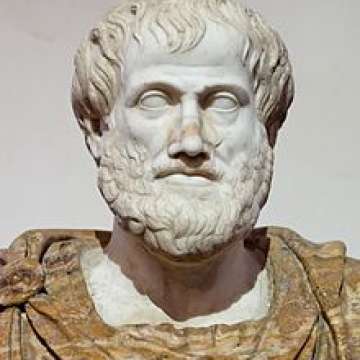
Short answer: There is no IQ score and no scholarly IQ estimate for Aristotle. He died in 322 BCE, and Catharine Cox's 1926 study, the benchmark for historical IQ estimates, covers only people born from 1450 to 1850. Figures on the internet are guesses. The documented evidence is the work itself: the earliest systematic logic, roughly 500 animal species distinguished, and treatises that scholars from Baghdad to Paris treated as the standard of knowledge.
At a glance
| Estimated IQ | No scholarly estimate |
|---|---|
| Basis of estimate | None: born 384 BCE, eighteen centuries before Cox's 1450–1850 sample; no childhood record |
| Measured score | None on record |
| Born – died | 384 BCE, Stagira – 322 BCE, Chalcis |
| Field | Logic, metaphysics, ethics, politics, biology |
| Signature achievement | The first systematic study of logic, in the Prior Analytics |
| Comparable minds | Plato, Thomas Aquinas, Charles Darwin |
What the record says about Aristotle's intelligence
Aristotle's IQ was never measured and has never been estimated by any published scholarly method. He was born in 384 BCE in Stagira, in Chalcidice, and died in 322 BCE at Chalcis on the island of Euboea. Our Aristotle profile covers the full life.
The one serious study of historical IQ, Catharine Cox's 1926 The Early Mental Traits of Three Hundred Geniuses, excludes him by design. Her 301 subjects were born between 1450 and 1850, and her raters scored each from dated evidence of childhood and youth: when a boy read, what he wrote, when he first published. The approach, and its limits, are laid out in our explainer on historical IQ estimates. For Aristotle the childhood is nearly blank.
His adult life is well dated. He joined Plato's Academy in Athens at 17 or 18 and stayed nearly twenty years, leaving in 348/47 BCE. In 343/42 BCE he became tutor to the young Alexander the Great. Around 335 BCE he founded his own school, the Lyceum, and ran his research program there for twelve years.
Where the popular numbers come from
Aristotle is a fixture of "smartest people ever" lists, usually beside a large number that no one can trace to a researcher or a method. The inference behind it is simple and unsound: he mastered everything, so his score must have been off the chart. That is a ranking of fame dressed as a measurement.
The scale itself rules out most of these claims. A modern IQ compares a test performance with a same-age norm group, with a mean of 100 and a standard deviation of 15. A score of 160 sits four standard deviations above the mean. The adult Wechsler scale, the standard clinical test for adults, stops there: its full-scale range runs from 40 to 160. Any figure far above that point for a man who lived in the fourth century BCE is arithmetic without data.
The evidence: logic from scratch, biology from observation
The strongest evidence is the Prior Analytics, which contains the earliest systematic study of logic. Its core is the syllogism: from two premises, a conclusion follows by form alone, whatever the subject matter. No earlier formal system survives. Our guide to Aristotle's categories and logic walks through the machinery. Building a working deductive system with no model to copy is precisely the abstract reasoning intelligence tests try to sample.
He was also the first person to study biology systematically. He distinguished about 500 species of birds, mammals and fish, described the internal anatomy of more than 100 animals and dissected about 35 of them. He spent two years on Lesbos, much of it studying marine life in the lagoon at Pyrrha, now the Gulf of Kalloni. Modern science has confirmed his reports of octopus camouflage and of the placenta-like development in certain dogfish.
Charles Darwin, in a letter written in 1882, the last year of his life, put it plainly: "Linnaeus and Cuvier have been my two gods, though in very different ways, but they were mere schoolboys to old Aristotle."
Range, influence and the errors
He wrote on logic, physics, metaphysics, ethics, politics, rhetoric, poetics and natural history. Only around a third of his output survives. That fraction still shaped medieval thought in both the Islamic world and Latin Europe: medieval Muslim scholars called him "the First Teacher," and Thomas Aquinas referred to him simply as "the Philosopher." The Stanford Encyclopedia of Philosophy notes that Aquinas's own eight million words are eight times what survives from Aristotle.
He was not infallible. His physics held that heavier bodies fall faster than light ones, a view that Galileo dismantled nearly two thousand years later. An honest assessment of his mind counts the misses with the hits. The hits were foundational; the misses were reasonable for a man working without instruments or experiments in the modern sense.
Aristotle against Plato, Aquinas and Kant
The teacher and the student share the same honest entry. Plato also predates Cox's window, so neither man has a scholarly estimate, and any claim that one out-scored the other is opinion. The contrast in method is real: Plato reasoned toward ideal forms, Aristotle toward categories built from observed cases. Our Aristotle vs. Plato page sets the two side by side.
Among the philosophers profiled in this series, the only one with an actual rating is Immanuel Kant, whom Cox's raters scored 135 for childhood and 145 for ages 17 to 26, from records she judged thin. See how the pair differ in Aristotle vs. Kant, and where each lands in our ranking of philosophers by estimated IQ.
What an IQ number cannot hold
A test measures what a mind can do in an hour. Aristotle's distinctive contribution took decades: he decided what questions each field should ask and how to organize its answers. The division of knowledge into logic, physics, ethics, politics and biology owes much to his map. He also dissected animals and recorded what he saw before he generalized. That habit of collecting before concluding is a trait of temperament as much as of intellect, and no IQ subtest scores it.
How we reached this answer
We confirmed that Cox's 1926 volume, the only large scholarly source of historical IQ estimates, samples births from 1450 to 1850 and therefore cannot include Aristotle. We checked dates and achievements against reference works and encyclopedias of philosophy and science, and we decline to print any number without a named estimator and a stated method. For Aristotle none exists.
Frequently asked questions
What was Aristotle's IQ?
Aristotle's IQ is unknown. He lived from 384 to 322 BCE, more than two thousand years before the first modern intelligence test in 1905, and he falls outside Catharine Cox's 1926 study of historical geniuses, which covers births from 1450 to 1850. Numbers attached to him online have no named source or method.
Was Aristotle a genius?
On the evidence of his work, yes. He produced the earliest systematic logic, founded biology as an organized science, and wrote foundational texts on ethics, politics and rhetoric. Darwin called Linnaeus and Cuvier "mere schoolboys to old Aristotle." Genius here is a judgment about achievement, not a test score.
Who had a higher IQ, Aristotle or Plato?
There is no way to know. Both lived in the fourth century BCE, both predate Cox's 1450–1850 sample, and neither has a scholarly IQ estimate. Aristotle studied at Plato's Academy for nearly twenty years. Their surviving work shows two different strengths: Plato's abstract dialogue and Aristotle's systematic classification.
Did Aristotle really tutor Alexander the Great?
Yes. Aristotle began tutoring the young Alexander in 343/42 BCE, after leaving Plato's Academy. Alexander was then about 13. A few years later Alexander took the throne of Macedon, and around 335 BCE Aristotle returned to Athens to found the Lyceum. See our Alexander the Great IQ analysis.
How much of Aristotle's work survives?
Only around a third of his original output has survived, according to standard reference accounts. What remains covers logic, physics, metaphysics, ethics, politics, rhetoric, poetics and biology. By one estimate in the Stanford Encyclopedia of Philosophy, the surviving Aristotle is about one-eighth the length of Thomas Aquinas's collected writings.
Sources
- Aristotle — Wikipedia — Dates, Academy years, tutoring Alexander, Lyceum, surviving output, 'First Teacher' and 'the Philosopher'
- Aristotle's biology — Wikipedia — About 500 species, dissections, Pyrrha lagoon, confirmed observations, Darwin's 1882 letter
- Thomas Aquinas — Stanford Encyclopedia of Philosophy — Aquinas's eight million words as eight times Aristotle's surviving corpus
- Cox, C. M. (1926). Genetic Studies of Genius, Vol. II — Internet Archive — Scope of the study (born 1450–1850) and Kant's raw ratings
Editorial standard: IQ figures for historical figures are retrospective estimates and are labeled as such; scores for living people appear only when the person disclosed them or a reputable outlet reported them. Corrections: contact the editors.