Big air is the most brutally simple event in snowboarding. A rider gets a small number of jumps off a single enormous ramp; the best two scores count; the difference between a medal and fourth place is often a hand touched down on landing. It rewards riders who can produce their hardest trick on demand and punishes anyone whose margin for error has been reduced. Competing with a broken arm reduces that margin considerably — it affects the grab, the landing absorption and, most of all, the willingness to commit to a rotation you cannot bail out of safely.
Martin's route to Livigno was quick. He announced himself internationally at the Winter Youth Olympic Games in Gangwon in 2024, where he took silver in big air and finished fifth in slopestyle. Youth Olympic results are a reasonable predictor in freestyle snowboarding precisely because the tricks are the same tricks; what changes at senior level is the size of the features and the depth of the field. He was named to the U.S. Snowboard Pro Team in 2025 and, within a season, had assembled the results an Olympic place requires: two bronze medals at World Championships and a World Cup victory.
That qualifying record is worth reading carefully. World Championship medals in freestyle snowboarding are not consolation prizes — the field is the same field that contests the Olympics, minus the national quota restrictions. Two of them, plus a World Cup win, in a single season, at sixteen and seventeen, put him among a small group of riders genuinely capable of an Olympic podium rather than merely qualified to attempt one.
He came fourth. The rider who displaced him, Su Yiming, had won big air gold at Beijing 2022 and remains the discipline's benchmark; being beaten by him is not evidence of a gap in ability so much as of the ordinary hierarchy of a sport in which the difference between first and fourth can be a single degree of rotation. Martin later described his approach to competition to Olympics.com in terms that suggest the fourth place was self-administered as much as externally imposed: "I try to put more pressure on myself."
He is part of a family and a team that runs deep in the discipline. His brother Kade Martin is a halfpipe rookie on the Hydro Flask U.S. Snowboard Team, and the American squad at Milano Cortina placed Martin alongside both established Olympic champions and other teenagers — a generational overlap that Yahoo Sports framed, covering the team, as new and old colliding. Red Gerard, the 2018 Olympic slopestyle champion, was still competing; Martin was ten years old when Gerard won.
The thing to watch is durability rather than difficulty. Martin has already shown he can land the tricks that medal at senior level; what he has not yet shown is a full season without the injuries that shaped his Olympic campaign. Freestyle snowboarding careers are frequently decided by which riders can accumulate competitive volume rather than which can produce the hardest single trick, and a seventeen-year-old who competes at the Olympics with a broken arm is displaying a temperament that cuts both ways.
“I try to put more pressure on myself.”— Ollie Martin, on his approach to competition, speaking to Olympics.com before Milano Cortina 2026
| Person | Country | Milestone | Age / Stat |
|---|---|---|---|
| Ollie Martin | 🇺🇸 United States | Fourth in Olympic big air at 17, competing with a broken arm | Age 17 |
| Su Yiming | 🇨🇳 China | Defending Olympic big air champion who took the bronze position from Martin | Senior pro |
| Choi Ga-on | 🇰🇷 South Korea | Olympic snowboard halfpipe champion at the same Games | Age 17 |
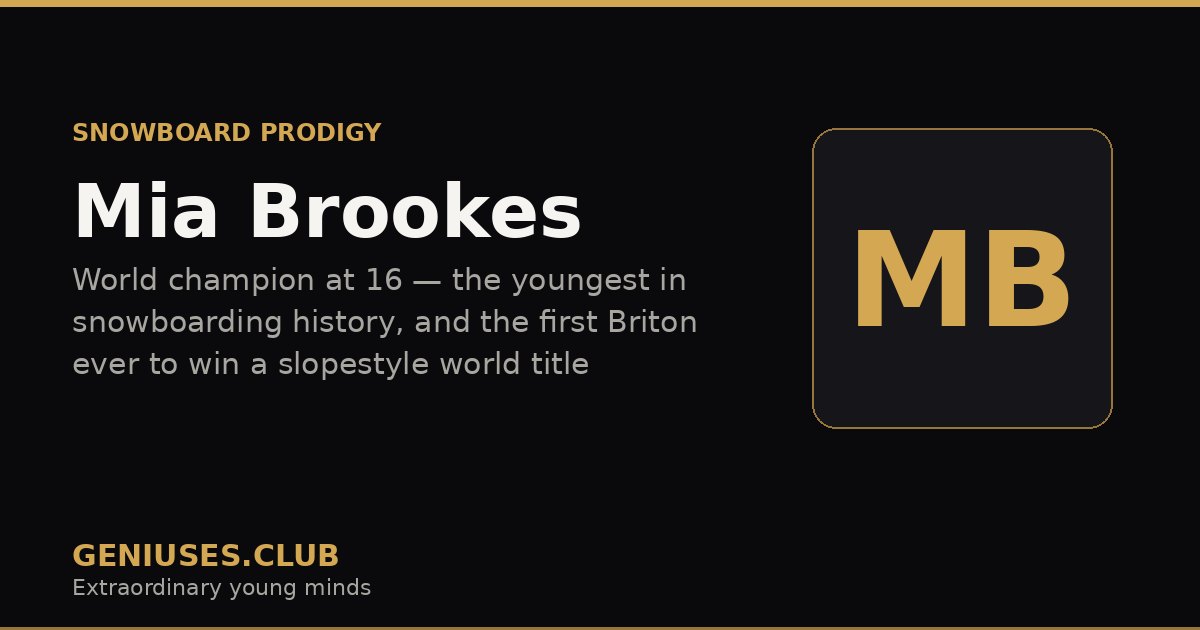
| Mia Brookes | 🇬🇧 Great Britain | Youngest snowboard world champion in history | Age 16 at title |
Fourth place is the least celebrated result in Olympic sport and, in big air, often the most instructive. Martin held a medal position in an Olympic final at seventeen, in his first Games, against a field including the defending champion — and he did it with a broken arm, which in a discipline decided by grabs and landing absorption is a material handicap rather than a detail.
His qualifying season is the harder evidence. Two World Championship bronze medals and a World Cup victory in the same year, at sixteen and seventeen, place a rider in the group genuinely capable of an Olympic podium rather than merely eligible for one. What remains untested is whether he can string together a full season without the injuries that defined this one.
Discover More Child Prodigies
50+ stories of contemporary young geniuses changing chess, music, science, and art.
Explore All Prodigies →