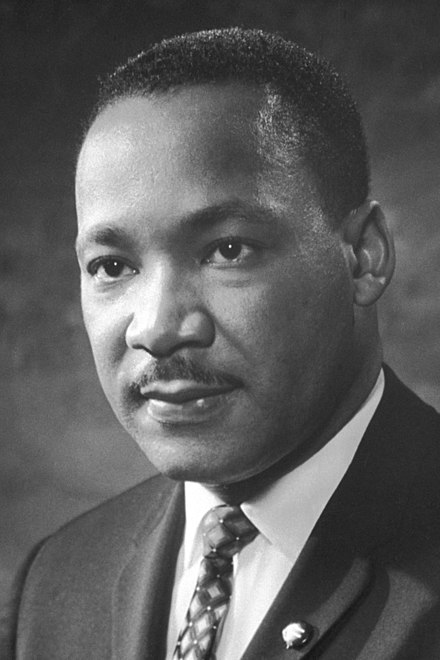
Michael King Jr. was born on January 15, 1929, in Atlanta, Georgia, the son and grandson of Baptist preachers. His father later changed both their names to Martin Luther King in honor of the German Protestant reformer, and the name would prove prophetic — the son, like the reformer, would reshape an institution and a society through the sheer power of moral argument. King entered Morehouse College at fifteen and later earned his doctorate in systematic theology from Boston University, equipping him with both the rhetorical brilliance of the Black church tradition and the philosophical tools of Western moral philosophy.
In 1955, Rosa Parks was arrested in Montgomery, Alabama, for refusing to give her bus seat to a white passenger. The Black community organized a boycott of the city's bus system, and a twenty-six-year-old pastor newly arrived at Dexter Avenue Baptist Church was chosen to lead it. Martin Luther King Jr. accepted, and for 381 days, Montgomery's Black residents walked, carpooled, and refused to board the buses. In November 1956, the Supreme Court ruled bus segregation unconstitutional. A movement was born, and King was its reluctant but irreplaceable voice.
King drew his strategic framework from Mahatma Gandhi's philosophy of satyagraha — soul force, or nonviolent direct action. He believed that suffering borne with dignity exposed the moral bankruptcy of the oppressor and created the conditions for transformation. This philosophy was tested at every turn: his home was bombed, he was stabbed, jailed fourteen times, and subjected to relentless FBI surveillance authorized by J. Edgar Hoover, who considered him "the most dangerous Negro in America." King considered the surveillance a mark of his effectiveness.
The pivotal year was 1963. In Birmingham, Alabama, Commissioner Bull Connor unleashed fire hoses and police dogs on peaceful protesters, including children. The images shocked the nation and the world. King wrote his "Letter from Birmingham Jail" while imprisoned there — a masterpiece of moral argumentation addressed to white moderate clergy who counseled patience. "We know through painful experience," he wrote, "that freedom is never voluntarily given by the oppressor; it must be demanded by the oppressed."
On August 28, 1963, King stood before 250,000 people at the Lincoln Memorial in Washington D.C. and delivered a speech that began with prepared remarks and ended with something transcendent. Near the conclusion, gospel singer Mahalia Jackson called out from behind him: "Tell them about the dream, Martin!" He set aside his notes and spoke extemporaneously about a dream rooted in the American creed — that one day his children would be judged not by the color of their skin but by the content of their character. The "I Have a Dream" speech became the moral benchmark of the American century.
In 1964, at thirty-five years old, King became the youngest recipient of the Nobel Peace Prize, donating the entire $54,600 prize to the civil rights movement. That same year, President Lyndon B. Johnson signed the Civil Rights Act, outlawing discrimination based on race, color, religion, or national origin. In 1965, the Voting Rights Act followed, securing the ballot for Black Americans across the South. These legislative triumphs translated the movement's moral authority into durable law.
King was assassinated on April 4, 1968, on the balcony of the Lorraine Motel in Memphis, Tennessee, where he had come to support striking sanitation workers. He was thirty-nine years old. The movement he had led left behind a legal architecture of equality and a standard of moral courage that every subsequent generation of activists would measure itself against.
"Darkness cannot drive out darkness; only light can do that. Hate cannot drive out hate; only love can do that."— Martin Luther King Jr., Strength to Love, 1963
"The arc of the moral universe is long, but it bends toward justice."— Martin Luther King Jr.
| Leader | Method | Key Achievement | Nobel |
|---|---|---|---|
| Martin Luther King Jr. | Nonviolent direct action | Civil Rights Act 1964 | 1964 |
| Malcolm X | Black nationalism, self-defense | Black consciousness movement | — |
| Rosa Parks | Civil disobedience | Sparked Montgomery Boycott | — |
| John Lewis | Nonviolent protest, legislation | Selma marches, Voting Rights Act | — |
I Have a Dream — Full Speech
Martin Luther King Jr. — Documentary
Why MLK Matters
Martin Luther King Jr. fused the spiritual authority of the Black church with the philosophical discipline of Gandhi's nonviolence and the legal machinery of American democracy to produce the most consequential social movement in twentieth-century America. The Civil Rights Act and Voting Rights Act he helped bring into being remain the foundation of American equality law.
His intellectual legacy runs deeper still. He theorized and demonstrated that oppressed people could shame a democracy into living up to its own stated ideals — that moral suasion, amplified through mass action and media, could move legislatures that had resisted for generations. Every subsequent American social movement, from feminism to LGBTQ rights to disability rights, has drawn from his strategic playbook and his rhetoric of universal human dignity.



