🗽
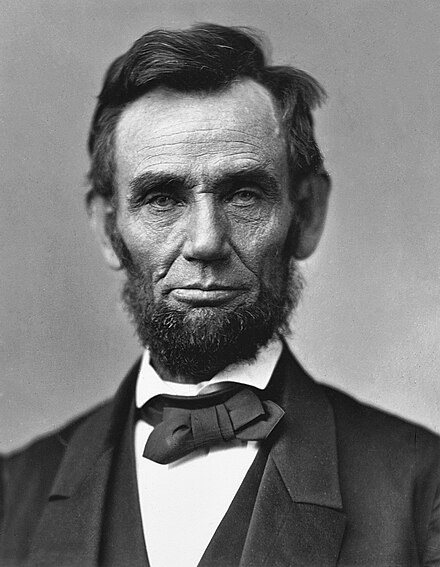
Abraham Lincoln
1809 – 1865 | Emancipation Proclamation | Gettysburg Address
Abraham Lincoln was born on 12 February 1809 in a one-room log cabin in Hardin County, Kentucky — the second child of Thomas and Nancy Lincoln. His origins could scarcely have been humbler: no formal education beyond scattered months of frontier schooling, a childhood of grinding rural poverty, and the early loss of his mother to milk sickness when he was nine. Yet through relentless self-education, borrowing books by firelight and devouring every text he could find, Lincoln forged one of the finest legal and literary minds in American history.
After working as a rail-splitter, flatboatman, store clerk, and postmaster, Lincoln taught himself law from Blackstone's Commentaries and was admitted to the Illinois bar in 1836. He served four terms in the Illinois state legislature and one term in the U.S. House of Representatives before losing two Senate races — each defeat refining rather than defeating him. His 1858 debates with Stephen Douglas over the expansion of slavery brought him national attention, and in 1860, the newly formed Republican Party nominated him as its presidential candidate. The South's response to his election was secession, and within months the nation was at war with itself.
Lincoln's presidency was an exercise in moral clarity and political genius under inconceivable pressure. He held together a fractious cabinet of rivals, sustained public morale through catastrophic defeats at Bull Run and Fredericksburg, and steadily moved the war's purpose from preserving the Union toward the liberation of four million enslaved people. The Emancipation Proclamation of 1 January 1863 was a masterstroke — legally limited but morally transformative, turning the Civil War into a war for human freedom and ensuring that Britain and France would not recognise the Confederacy.
"Four score and seven years ago our fathers brought forth on this continent, a new nation, conceived in Liberty, and dedicated to the proposition that all men are created equal."
At the dedication of the Soldiers' National Cemetery at Gettysburg on 19 November 1863, Lincoln delivered 272 words that recast the meaning of the American experiment. Where the featured orator Edward Everett spoke for two hours, Lincoln spoke for two minutes — and the Gettysburg Address has echoed for 160 years. It redefined the Declaration of Independence as a promise of equality rather than a historical fact, and reimagined the Union's cause as the fulfilment of that promise for all humanity.
Admitted to the Illinois bar; begins law practice in Springfield.
Vinte perguntas, oito minutos no relógio e um percentil medido contra todos os que já fizeram. Sem cadastro.
Fazer o teste de QI →Serves one term in the U.S. House of Representatives.
Lincoln–Douglas debates on slavery broadcast his anti-slavery convictions nationally.
Inaugurated as 16th president; Confederate states secede; Civil War begins.
Issues the Emancipation Proclamation; delivers the Gettysburg Address.
Delivers Second Inaugural Address; Lee surrenders at Appomattox; Lincoln assassinated five days later.
Lincoln's literary genius was inseparable from his political power. Shaped by the King James Bible, Shakespeare, and Aesop, his prose achieved a Biblical cadence unique in presidential rhetoric. His Second Inaugural Address — "With malice toward none, with charity for all" — is considered by many scholars the greatest speech in American history, a call for reconciliation that transcended the bitterness of four years of slaughter. Lincoln revised his speeches obsessively, understanding that the right words, precisely placed, could move a nation.
He was also a deeply empathetic leader. He personally reviewed thousands of court-martial cases, frequently granting clemency to soldiers condemned for desertion or sleeping on duty. He met regularly with ordinary citizens at the White House, an open-door policy unheard of for a wartime president. Frederick Douglass, who met Lincoln three times, described him as "the first great man that I talked with in the United States freely, who in no single instance reminded me of the difference between himself and myself." That quality — the capacity to see every human being without the filter of rank — was Lincoln's deepest greatness.
Lincoln's presidency established that a democratic republic could survive existential crisis without becoming a tyranny. He expanded executive power during wartime while never abandoning the Constitution's framework. He held firm to moral principle — the wrongness of slavery — while remaining a master of political practicality, moving only as fast as public opinion would sustain. In an era when democracies again face tests of institutional resilience, Lincoln's example of purposeful, empathetic, and rhetorically powerful leadership is more instructive than ever.
 Yusra MardiniSwam Refugees to Safety Across the Aegean — Olympic Athlete on…
 Mahnoor CheemaPassed 34 O-Levels by Age 13 — Pakistani-British Prodigy with…
 Dominique MoceanuYoungest member of the 1996 Olympic gold 'Magnificent Seven' at…
 Sho YanoMD-PhD at 21 — Korean-American Prodigy with Tested IQ Above 200


