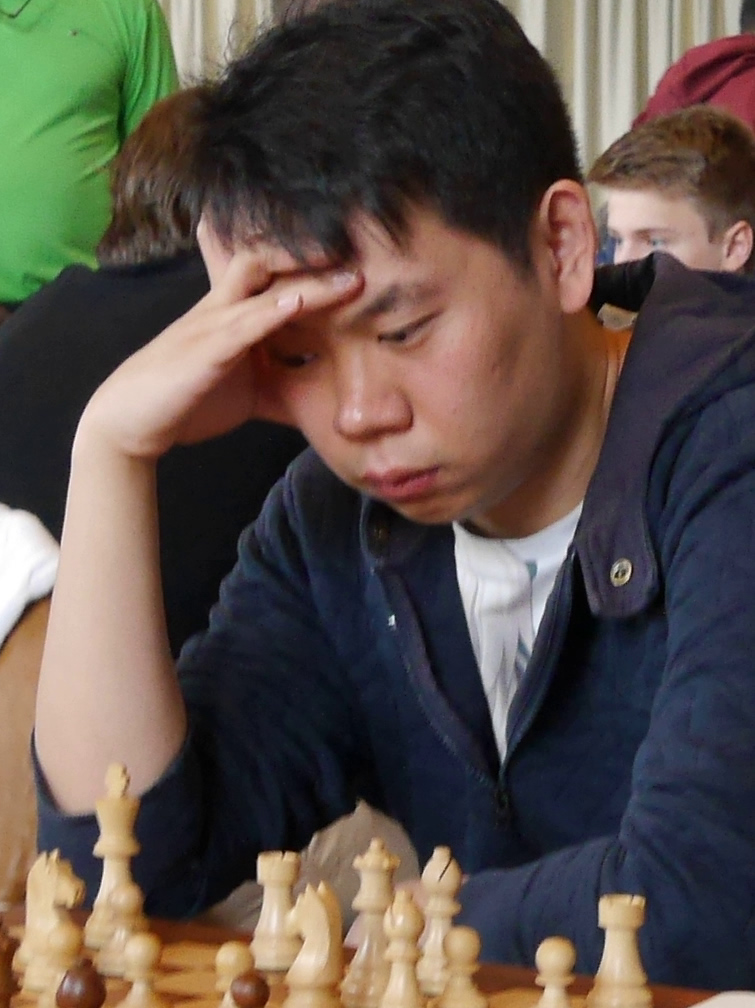
Wang Hao was born on August 4, 1989, in Harbin, the icy capital of Heilongjiang province where winter stretches seven months and indoor pursuits take root early. The city, better known for ice sculptures than chess champions, nevertheless produced a prodigy who learned the game at six and showed an immediate aptitude for calculation. By his early teens, Wang was already traveling south to Beijing for advanced coaching, studying under trainers who recognized in him the rare combination of tactical vision and inexhaustible work ethic. The Chinese Chess Federation, then investing heavily in developing world-class players to match the nation's rising global stature, provided resources and structure. Wang absorbed opening theory the way other teenagers absorbed pop music—obsessively, completely, building a repertoire that would become his signature weapon. The northern cold had forged a patience that would serve him across marathon tournaments.
In 2005, at sixteen years old, Wang earned the Grandmaster title, joining the elite ranks of chess at an age when most players are still navigating the amateur circuit. The achievement marked him as part of a new generation of Chinese players who were no longer curiosities on the international stage but credible threats. He had cleared the 2500 Elo threshold and secured his three GM norms through a combination of European open tournaments and carefully selected invitationals where his preparation could shine. The title came not from a single brilliant performance but from sustained excellence—exactly the pattern that would define his career. Unlike meteoric talents who flare and fade, Wang built his game methodically, adding weapons system by system. By his late teens, he was already a fixture on the national team, selected not just for talent but for the reliability coaches prize in team competitions.
The breakthrough that announced Wang to the broader chess world came in January 2010 at the Reggio Emilia tournament in Italy, one of the oldest and most prestigious events in the chess calendar. He won the tournament outright, finishing ahead of a field that included Magnus Carlsen, then already recognized as the game's rising force. The victory was no fluke: Wang's preparation in the Semi-Slav and Catalan openings gave him early advantages, and his technical endgame play converted them into full points. Reggio Emilia had crowned Mikhail Tal and Garry Kasparov in earlier decades; now it belonged to a 20-year-old from Harbin. The win propelled Wang into the 2700 Elo club, a threshold only dozens of players in history have crossed. More importantly, it established his reputation as a player whose homework was always done, whose opening preparation could bury opponents before the middlegame began.
Twenty questions, eight minutes on the clock, and a percentile measured against everyone who has taken it. No sign-up.
Take the IQ test →By 2013, Wang had climbed to tenth in the world rankings, peaking at 2754 Elo and establishing himself as one of the game's elite. That year represented the apex of his individual rating, though his contributions to team chess were only beginning to accumulate. Wang's style—solid, prepared, technically flawless—made him an ideal team player, the kind of board-one anchor who could be relied upon to face the opponent's strongest player and emerge unscathed. He scored consistently in super-tournaments from Wijk aan Zee to Biel, earning invitations to the world's strongest closed events. His games from this period reveal a player who rarely gambles, who builds pressure incrementally, who trusts that superior preparation and precise technique will eventually break through. Critics called him cautious; admirers called him professional. Both were right.
Wang's contributions to Chinese team success became his most visible legacy. He anchored the national squad to four gold medals at the Chess Olympiad, the biennial team world championship where federations field their strongest foursomes. The victories came in 2014 in Tromsø, 2018 in Batumi, and on two other occasions, each time with Wang playing top board and setting the tone for teammates. In Batumi, he scored 7.5 points from 10 games, a performance rating well above 2800, as the Chinese squad defeated Russia and the United States to claim gold. These were not individual triumphs but collective ones, yet Wang's steadiness made them possible. While teammates might have volatile tournaments, Wang delivered consistency. "Confidence in chess is built one variation at a time," he told the Chinese Chess Federation in 2019, and his Olympiad record proved the philosophy worked.
The 2019 Grand Swiss victory in the Isle of Man represented the culmination of Wang's career preparation. The eleven-round Swiss tournament, grueling and unforgiving, assembled over 150 of the world's strongest players competing for two Candidates spots. Wang navigated the field with minimal losses, his opening preparation neutralizing opponents' attempts at surprise, his endgame technique converting the resulting positions. The tournament format—Swiss rather than round-robin—rewarded stamina and consistency over brilliance, playing directly to Wang's strengths. When he clinched first place in the final round, he became the first Chinese player to qualify for the Candidates through this specific pathway, a distinction that mattered less for its novelty than for what it represented: a Chinese player had fought through the world's elite on neutral ground and emerged victorious. The subsequent Candidates Tournament, delayed by pandemic, would take place in 2020 and 2021.
Today, Wang Hao serves as both active competitor and symbol of Chinese chess's maturation. He continues to play for the national team and competes in elite tournaments, though his rating has settled in the 2720 range, just outside the top twenty. In 2021, he took on a coaching role with the Chinese Chess Federation while maintaining his playing career, passing on the preparation methods that made him formidable. His influence appears in the next generation of Chinese players—Wei Yi, Ding Liren, and others who treat opening preparation as an arms race requiring constant innovation. Wang's career arc—steady accumulation rather than explosive brilliance—may lack the narrative drama of faster meteors, but it offers a different model: the professional who maximizes talent through discipline, who treats chess as craft requiring daily refinement, who builds confidence one variation at a time.
“Confidence in chess is built one variation at a time.”— Wang Hao, China Chess Federation, 2019
“Wang Hao's preparation is a wall. You cannot climb it.”— Levon Aronian
| Person | Country | Milestone | Age / Stat |
|---|---|---|---|
| Wang Hao | 🇨🇳 China | CHESS | 1989 |
| Yu Yangyi | 🇨🇳 China | CHESS | 1994 |
| Bu Xiangzhi | 🇨🇳 China | CHESS | 1985 |
| Wang Yue | 🇨🇳 China | CHESS | 1987 |
Wang Hao wins Grand Swiss 2019
Wang Hao top chess games
Wang Hao matters because he represents the professionalization of chess in an era when preparation has become as important as over-the-board creativity. His qualification for the Candidates Tournament—the first Chinese player to do so via the Grand Swiss route—demonstrated that meticulous homework can compete with raw talent at the highest levels. In a game increasingly dominated by computer analysis and opening theory, Wang's approach offers a template: treat preparation as performance, build systems that withstand scrutiny, convert small advantages through flawless technique. His four Olympiad gold medals anchor his legacy in team success, a reminder that chess remains a collective endeavor despite its solitary image. While contemporaries like Carlsen and Caruana may attract more headlines, Wang's consistency over fifteen years at the elite level places him among the most successful players of his generation. He proved that a player from Harbin could not just compete but prevail against the game's traditional powers.
Wang's career transformed how the chess world views Chinese players—from promising newcomers to established elite. When he earned his GM title in 2005, Chinese players were still relative novelties in super-tournaments; by the time he won the Grand Swiss in 2019, they were expected contenders. His success, alongside teammates like Ding Liren, established Chinese chess as a global force rather than a regional curiosity. The four Olympiad golds he helped secure announced a new hierarchy in team chess, one where Chinese preparation and depth could overwhelm traditional powers like Russia and the United States. Wang's methodical style, emphasizing preparation and technique over romantic brilliance, also reflected broader shifts in how the game is played in the computer era. He became proof that excellence could be engineered through discipline and systems, a very contemporary Chinese approach applied to a very old game. Future generations will study not just his games but his method.
Discover More Child Prodigies
50+ stories of contemporary young geniuses changing chess, music, science, and art.
Explore All Prodigies →


