Short answer: Max Planck has no IQ score and no scholarly estimate. He never took a recorded test, and Catharine Cox's 1926 study of historical geniuses covered only people born by 1850; Planck was born in 1858. His documented record speaks instead: a doctorate at 21, the quantum hypothesis of 1900, and the 1918 Nobel Prize in Physics.
At a glance
| Estimated IQ | No scholarly estimate |
|---|---|
| Basis of estimate | None published; born eight years after the cutoff of Cox (1926) |
| Measured score | None on record |
| Born – died | 23 April 1858, Kiel – 4 October 1947, Göttingen |
| Field | Theoretical physics: thermodynamics and quantum theory |
| Signature achievement | The quantum of energy, E = hν (1900) |
| Nobel Prize | Physics 1918, awarded in 1919 |
| Comparable minds | Albert Einstein, Niels Bohr |
Eight years too late for the only study
Planck was born in Kiel on 23 April 1858. Catharine Cox's Early Mental Traits of Three Hundred Geniuses (1926), the one scholarly attempt to estimate the IQs of historical figures at scale, rated only people born between 1450 and 1850. Planck missed the cutoff by eight years. No IQ test result for him appears in the biographical record, and no later scholar has filled the gap.
For contrast, the physicists Cox did assess scored very high on her scale: Isaac Newton's corrected estimate is 190. See what an IQ of 190 means and why such figures cannot be tested today. Planck's life is covered in full on the Max Planck genius profile, and the method behind historical figures is explained in historical IQ estimates explained.
The professor who said physics was finished
Planck finished the Maximiliansgymnasium in Munich early, at 17. In 1878 the Munich physicist Philipp von Jolly advised him against theoretical physics: the field, Jolly said, was a "highly developed, nearly fully matured science" with little left to find. Planck went ahead anyway.
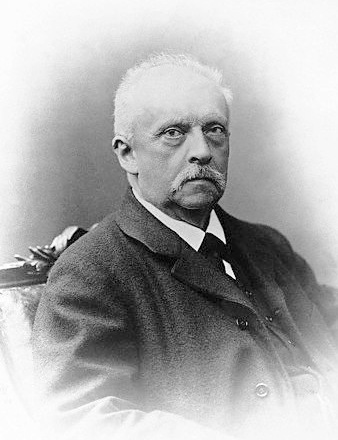
He studied at Munich and Berlin under Hermann von Helmholtz and Gustav Kirchhoff, and in February 1879, at 21, he defended a doctoral thesis on the second law of thermodynamics. He lectured at Munich from 1880, took a post at Kiel in 1885, and moved to Berlin in 1889, where he stayed until 1926.
14 December 1900: the birth of the quantum
The problem was black-body radiation: how much light of each color a hot object emits. The existing formulas failed to match new measurements across the full spectrum. Planck found a formula that fit the measurements, then searched for a reason. The reason required energy to be emitted only in discrete packets, each proportional to frequency: E = hν. The constant h now bears his name.
He presented the result to the German Physical Society on 14 December 1900. He later called his reluctant step "an act of despair." He was 42, and he had just founded quantum theory. The Nobel Committee reserved the 1918 physics prize and awarded it in 1919, "in recognition of the services he rendered to the advancement of Physics by his discovery of energy quanta."
The constant outlived every argument about it. Since the 2019 revision of the International System of Units, the kilogram itself has been defined by fixing Planck's constant at exactly 6.62607015 × 10^-34 joule-seconds. A number Planck introduced as a fitting parameter now anchors the world's standard of mass.
A late breakthrough, and what it says about IQ lists
IQ rankings favor prodigies. Werner Heisenberg built matrix mechanics at 23; Einstein published special relativity at 26. Planck's defining discovery came at 42, after two decades of patient work on thermodynamics. Cox's method, which scored behavior up to age 26, would have seen a strong student and a solid thesis. It would have missed the discovery entirely.
That is the core weakness of retrospective IQ estimates. They reward early signals and ignore sustained effort. Compare the younger generation in Werner Heisenberg's IQ, or see how Planck and Bohr line up at Planck vs. Bohr.
The establishment figure who backed Einstein
Planck was among the first senior physicists to see the importance of special relativity in 1905, and he used his standing to win it acceptance in Germany. The young patent clerk and the Berlin professor later became colleagues and friends. Einstein, who has no measured IQ either, is profiled in Albert Einstein's IQ; the two are compared at Einstein vs. Planck. For the full field, see physicists ranked by IQ.
Absolute pitch and a road not taken
Planck nearly chose music. He had absolute pitch and played piano, organ and cello, and as a student he composed songs and operas. He once considered a professional career in music before physics won. The breadth is documented; what it would have added to a test score is not.
Loss, the regime, and the society that bears his name
Planck led the Kaiser Wilhelm Society, Germany's leading research organization, until 1937. His later life was marked by loss. His first wife, Marie Merck, died in 1909. His son Erwin was hanged at Plötzensee Prison on 23 January 1945 for his part in the July 1944 plot against Hitler. Planck died in Göttingen on 4 October 1947, aged 89. The following year the Kaiser Wilhelm Society was renamed the Max Planck Society.
How we assessed this
We searched for any measured or estimated IQ for Planck and found none, so we publish no number. Dates, the Nobel citation and biographical details come from the Nobel Foundation and standard references. The assessment above rests on documented achievements and the ages at which he reached them. Read more in the Max Planck biography.
Frequently asked questions
What was Max Planck's IQ?
Max Planck has no known IQ score. No test result survives for him, and no researcher has attempted a retrospective figure. He was born in 1858, eight years after the cutoff for Catharine Cox's 1926 study of historical geniuses, so no scholarly figure exists. Online numbers cite no source.
Was Max Planck a genius?
Yes, by the standard of lasting achievement. He earned his doctorate at 21, introduced the quantum of energy in December 1900, won the 1918 Nobel Prize in Physics, and gave his name to a fundamental constant of nature. Modern quantum physics begins with his work.
Who had a higher IQ, Planck or Einstein?
Neither man took a recorded IQ test, and neither appears in Cox's 1926 study, so no comparison is possible. Einstein's widely quoted 160 is unsourced. Their records differ in timing: Einstein's major papers came at 26, Planck's quantum hypothesis at 42.
Who told Max Planck not to study physics?
In 1878 the Munich professor Philipp von Jolly advised Planck against theoretical physics, describing it as a highly developed, nearly fully matured science. Planck persisted, took his doctorate at 21, and in 1900 introduced the quantum hypothesis that transformed the field.
How old was Planck when he discovered the quantum?
He was 42. Planck presented his quantum hypothesis to the German Physical Society on 14 December 1900, more than two decades after his doctorate. It is one of the most important discoveries in physics made past the age of 40.
Sources
- Max Planck – Biographical (NobelPrize.org) — Birth, education, posts, quantum theory, music, Kaiser Wilhelm Society, death
- The Nobel Prize in Physics 1918 – Summary (NobelPrize.org) — Prize motivation; reserved and awarded in 1919
- Max Planck (Wikipedia) — Jolly's advice, doctorate at 21, 14 December 1900, act of despair, music, Erwin Planck, Max Planck Society
- Cox, C. M. (1926). The Early Mental Traits of Three Hundred Geniuses (full text) — Scope of the historical IQ study
- Estimated IQs of 301 Geniuses (AssessmentPsychology.com) — Newton's corrected Cox estimate of 190; sample born 1450 to 1850
Editorial standard: IQ figures for historical figures are retrospective estimates and are labeled as such; scores for living people appear only when the person disclosed them or a reputable outlet reported them. Corrections: contact the editors.