Short answer: Bach never took an IQ test. Catharine Cox's 1926 study, the only scholarly source, rated him 125 on his record to age 17 and 140 on his record from 17 to 26, on evidence she graded at a weak .43 reliability. She called 125 a safe rating. The 165 seen online is her corrected estimate, not a measurement.
At a glance
| Estimated IQ | 125 (to age 17) and 140 (ages 17–26), Cox 1926 |
|---|---|
| Basis of estimate | Biographical record; raters split over how to weigh musical achievement; data reliability .43 |
| Measured score | None on record |
| Born – died | 21 March 1685 (Old Style), Eisenach – 28 July 1750, Leipzig |
| Field | Composition; organ and keyboard |
| Signature achievement | The Well-Tempered Clavier, the St Matthew Passion, the Mass in B minor |
| Comparable minds | Mozart, Beethoven |
Yes, Bach is in Cox's study
Bach, born in 1685, falls inside the 1450–1850 window Catharine Cox used for The Early Mental Traits of Three Hundred Geniuses (Stanford University Press, 1926), and he is one of her 301 subjects. His case study sits in the chapter of subjects rated between 120 and 130 for childhood. The figures: 125 for the years to 17 and 140 for ages 17 to 26. The life and music are covered in our Bach profile.
Cox graded the evidence behind both figures at .43 on her reliability scale, a weak score. Mozart's record earned .75. Because thin records drag estimates down, a finding Cox stated herself, Bach's numbers rest on shakier ground than Mozart's, and they are best read as a floor.
Why Cox called 125 safe
The raters disagreed, and Cox explained why in one sentence: "In the case of Bach the disagreement among the raters resulted from the problem of weighting musical achievement." In 1926 no one knew how musical composition related to general intelligence. Cox chose caution, writing that 125 "appears a safe rating for the Bach of whom we have record."
She did not leave it there. The same paragraph credits the young Bach with "many of the personal characteristics of the gifted": intensity and continuity of interest, ambition, independence, determination and perseverance. Those traits, she added, came with composition of a high order and excellence in performance. The 125, in other words, is a lower bound set by missing documents, not a verdict on the man.
The boyhood evidence
The record Cox worked from is thin because Bach's early life was hard. His mother died in 1694 and his father in February 1695. At 10 he went to live with his elder brother Johann Christoph in Ohrdruf. The best-known story from those years has the boy secretly copying a manuscript his brother had forbidden him to use, because scores were valuable and paper was expensive.
By 3 April 1700 he was studying at St Michael's School in Lüneburg. In January 1703, not yet 18, he was appointed a court musician in Weimar, and on 14 August that year he became organist of the New Church in Arnstadt. In 1705 he set out for Lübeck to hear Dieterich Buxtehude, a trip of about 450 kilometers each way, reportedly on foot.
Counterpoint as cognition
The adult record is where Bach's intelligence becomes hard to dispute. On 7 May 1747, at Potsdam, Frederick the Great gave him a long, intricate theme, and Bach improvised a three-voice fugue on it at the keyboard. The king asked for six voices. Bach declined to improvise that, worked it out on paper and published it that September as the Ricercar a 6 in The Musical Offering.
Six independent lines, each obeying the rules of counterpoint while fusing into one harmony, form a constraint problem of exceptional difficulty. The Well-Tempered Clavier, the Brandenburg Concertos, the St Matthew Passion, the Mass in B minor and The Art of Fugue apply the same discipline at scale. In 1979 the cognitive scientist Douglas Hofstadter built Gödel, Escher, Bach, winner of the 1980 Pulitzer Prize for General Nonfiction, around the parallels between Bach's canons and formal logic.
The 165 figure
Online lists usually give Bach an IQ of 165. That number is Cox's reliability-corrected estimate as reproduced in secondary tables, her projection of what complete records might have yielded. It places Bach level with Mozart and Beethoven and erases a 25-point gap in the childhood ratings. Cox's documented judgment remains 125 and 140. For what those numbers mean on a modern scale, see IQ 140 and IQ 125.
Bach among the composers
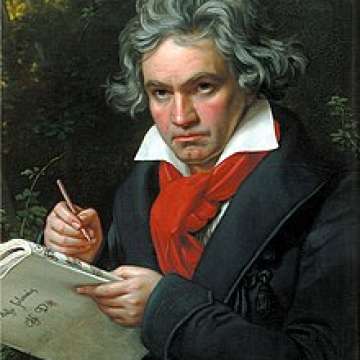
Cox's sample included 11 classical composers, according to the psychologist Dean Keith Simonton. Bach's childhood rating of 125 is lower than Mozart's 150 and Beethoven's 135. George Frideric Handel, born the same year, rated 145 and 155. By ages 17 to 26, Bach and Beethoven tie at 140.
The ranking may say as much about paperwork as about music. Cox graded Bach's record at .43, and her own analysis found that weaker records yield lower estimates. See Handel vs. Bach, Mozart vs. Bach and the full composers ranked by estimated IQ.
What the number leaves out
Bach fathered 20 children, seven with Maria Barbara and 13 with Anna Magdalena, and served as Thomaskantor in Leipzig from 1723 until his death in 1750. None of that registers on an IQ scale. Neither does the afterlife of the work: the Bach Revival gathered force only after Felix Mendelssohn conducted the St Matthew Passion in 1829. Cox rated the boy the documents could show her. The music shows the rest.
How we checked this
We read Bach's case study and Cox's rater discussion in the 1926 text, confirmed his placement in the 120–130 chapter and his two ratings, and cross-checked the composer sample against Simonton's 2009 review. For the general limits of scoring the dead, see how historical IQ estimates work.
Frequently asked questions
What was Bach's IQ?
No test exists. Catharine Cox's 1926 study estimated 125 from his record to age 17 and 140 from his record between 17 and 26, on evidence she rated only .43 reliable. The 165 on popular lists is her corrected estimate, a statistical projection rather than a finding.
Was Bach a genius?
Yes. He improvised a three-voice fugue on a theme handed to him by Frederick the Great, then published a six-voice version within months, and his output runs from The Well-Tempered Clavier to the Mass in B minor. Cox's cautious 125 reflects a thin boyhood record, not the scale of the achievement.
Who had a higher IQ, Bach or Mozart?
Mozart, on Cox's figures: 150 and 155 against Bach's 125 and 140. The comparison is weak. Mozart's childhood was documented by his father and by outside observers such as Daines Barrington; Bach's boyhood left few papers, and Cox showed that fuller records produce higher estimates.
Is Johann Sebastian Bach included in Cox's study of 300 geniuses?
Yes. Bach, born in 1685, is one of Cox's 301 subjects, with a case study among those rated 120 to 130 for childhood. His ratings are 125 and 140. Cox noted that the raters disagreed because they could not settle how to weigh musical achievement.
Why is Bach's estimate lower than Handel's?
Cox rated Handel, born the same year, at 145 and 155, and did not explain the gap directly. Two features of her method matter. Her raters disagreed over how to weigh Bach's musical achievement, and she graded his boyhood record only .43 reliable, a level at which her estimates tended to run low.
Sources
- Catharine M. Cox, Genetic Studies of Genius, Vol. II: The Early Mental Traits of Three Hundred Geniuses (Stanford University Press, 1926), full text — Bach's case study (AI IQ 125, AII IQ 140, reliability .43); Cox's discussion of rater disagreement and the 'safe rating'; Handel's ratings
- Dean Keith Simonton, “Looking back: Creative genius in classical music,” The Psychologist (British Psychological Society), December 2009 — Cox scored 11 classical composers; Mozart and Beethoven estimates for comparison
- Johann Sebastian Bach — Wikipedia — Birth and death; orphaned 1694–1695; Ohrdruf; Lüneburg 1700; Weimar and Arnstadt 1703; Lübeck trip; Thomaskantor 1723; 20 children; 1829 revival
- The Musical Offering — Wikipedia — 7 May 1747 visit to Frederick the Great; improvised three-voice fugue; six-voice ricercar published September 1747
- Gödel, Escher, Bach — Wikipedia — Hofstadter, 1979; 1980 Pulitzer Prize for General Nonfiction; canon form
- Cox’s IQ Estimates of 301 Eminent Geniuses Born from 1450 to 1850 (secondary tabulation) — Secondary tabulation of Cox's corrected figures (Bach 165)
Editorial standard: IQ figures for historical figures are retrospective estimates and are labeled as such; scores for living people appear only when the person disclosed them or a reputable outlet reported them. Corrections: contact the editors.