Was Einstein's IQ Really 160? Where the Famous Number Came From
He never took an IQ test. We traced every published figure since 1935, found no source for the 160, and checked what his record really shows.
Albert Einstein never took an IQ test, so his IQ is unknown. The 160 that appears in news stories, quiz sites and search snippets has no traceable source: no test, no study, no named estimator. In his own lifetime, magazines put him at 205 and 192. Later writers said 207, 200 and 150. The figure of 160 is simply where the internet settled.
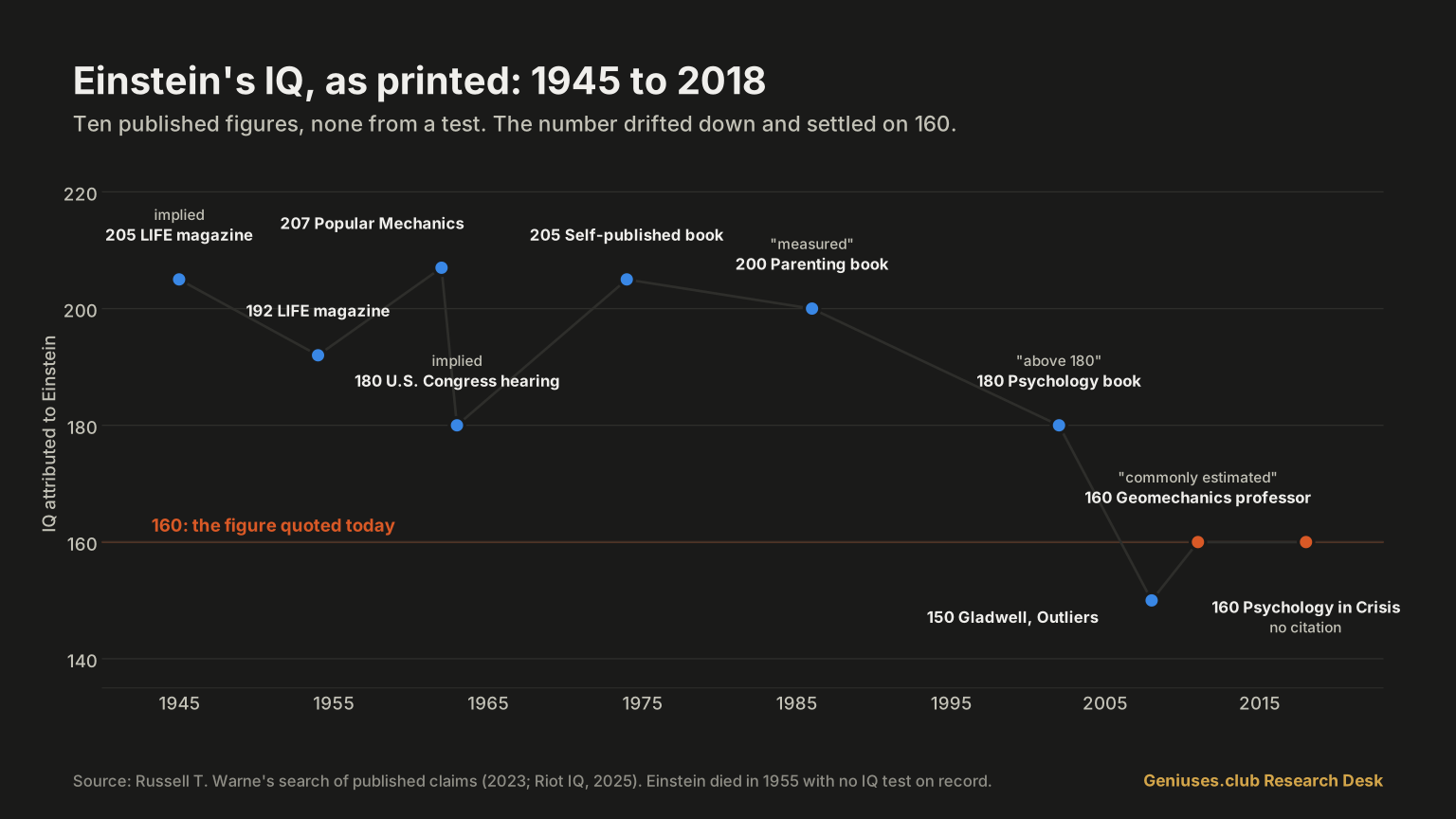
Every IQ figure we could trace for Einstein, by year of publication. None comes from a test. Chart: Geniuses.club Research Desk, from Russell T. Warne's search of published claims.
Bottom line
- What is on record: no IQ test result for Einstein exists. He was 26 when the first intelligence test appeared in 1905, and 38 when the first adult group test arrived in 1917.
- Where 160 comes from: nowhere that can be traced. The earliest printed figures were higher: LIFE magazine implied 205 in 1945 and printed 192 in 1954. The 160 became standard only in the 21st century, repeated without a citation.
- Why 160 feels right: it is four standard deviations above average, about 1 in 31,600 people, and it is the top score the most widely used adult IQ test reports. It reads as "maxed out the test". It is shorthand, not a measurement.
- What the record does show: top marks in mathematics and physics, calculus mastered before 15, entry to the Zurich Polytechnic at 17, and four landmark papers at 26.
- Our estimate: 180, with a range of 170 to 190, under Geniuses.club's published estimation method. It is an estimate from documented achievements, not a test score.
- Geniuses.club verdict on the 160: No traceable source.
Did Einstein ever take an IQ test?
No record says he did, and the timeline makes it very unlikely. When Alfred Binet and Théodore Simon published the first working intelligence test in France in 1905, it was built to find schoolchildren who needed extra help, and Einstein was a 26-year-old patent clerk in his "miracle year". William Stern coined the term intelligence quotient in 1912, when Einstein was 33.
Lewis Terman's Stanford-Binet followed in 1916, the year Einstein turned 37 and a few months after he completed general relativity. The first adult group test, the United States Army Alpha, came in 1917, when he turned 38 and was already a leading physicist in Berlin. David Wechsler's adult scale first appeared in 1939, when Einstein was 60, and the first edition of the Wechsler Adult Intelligence Scale, the ancestor of today's standard adult test, was published in February 1955. Einstein died on 18 April 1955, two months later.
Psychologist Russell T. Warne, who searched for every published claim about Einstein's IQ, argues that a world-famous physicist had nothing to gain from sitting an intelligence test in middle age. PsyPost, reviewing his work, reports that no test is mentioned in the Einstein archives or in his biographies.
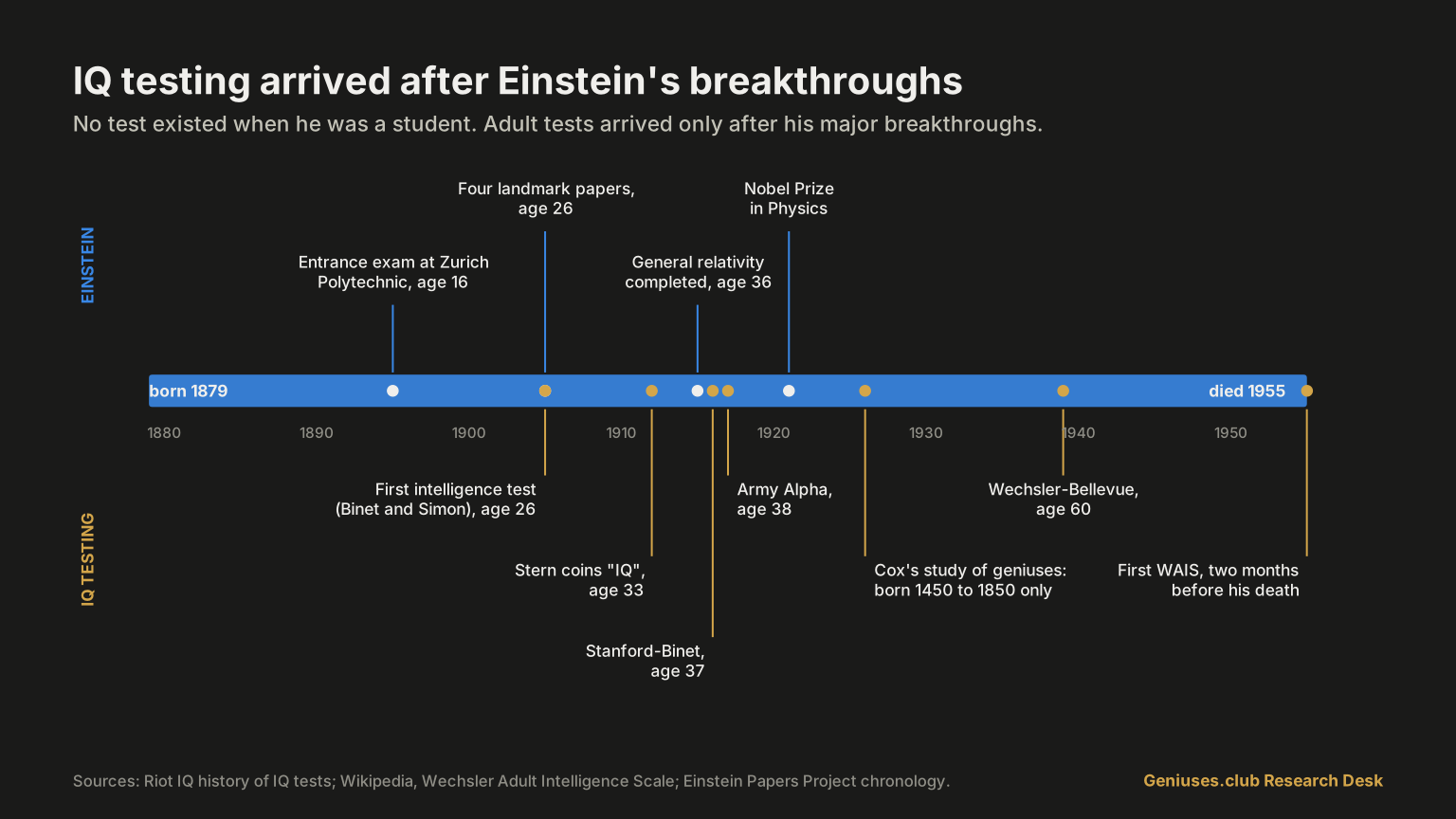
IQ testing grew up after Einstein's breakthroughs. Catharine Cox's famous 1926 study of genius estimated IQs only for people born between 1450 and 1850, so it never included him.
Where does the 160 come from? A number that drifted
Warne's search of books, magazines and congressional records, published in 2023 and republished by Riot IQ in 2025, shows that writers have been guessing Einstein's IQ for almost a century, and that the guesses never agreed.
- 1935: TIME magazine noted that critics of intelligence testing laughed whenever a child turned up with an IQ claimed to beat Einstein's. He was a benchmark before anyone had a number for him.
- 1945: LIFE reported that Merrill Kenneth Wolf, a 14-year-old Yale graduate with an IQ of 182, scored 23 points below Einstein, which implies 205.
- 1954: LIFE again, in another prodigy story, this time giving 192.
- During his lifetime: Coronet magazine suggested his IQ was probably a little above 160.
- 1962: Popular Mechanics said Einstein had been estimated at 207, while noting he never took a test.
- 1963: A United States congressional hearing put an IQ of 180 on the level of Darwin, Freud and Einstein.
- 1974: A self-published book by Mariann Olden stated 205 as fact.
- 1986: A parenting book claimed he had a measured IQ of 200.
- 2002: A child-development book said above 180.
- 2008: Malcolm Gladwell's Outliers gave 150. His source, Warne found, was the television quiz show Who Wants to Be a Millionaire?
- 2011: A geomechanics professor wrote that Einstein's IQ is commonly estimated at about 160, with no test confirmed.
- 2018: Psychologist Brian Hughes stated 160 in Psychology in Crisis, with no citation.
The figures run from 150 to 207. Experts, Warne notes, are almost entirely absent: the claims come from journalists and popular writers, and the one psychologist who stated 160 gave no source. His conclusion is that every existing claim of an IQ score for Einstein is "not credible". He also points out that no researcher has ever applied Catharine Cox's established method for estimating the IQs of historical figures to Einstein.
Why 160, of all numbers?
Nobody can prove why the internet chose 160. Three facts, in our analysis, make it the natural landing spot.
It is the ceiling of the test. The fourth edition of the Wechsler Adult Intelligence Scale, the most widely used adult IQ test, reports full-scale scores from 40 to 160. Saying "Einstein's IQ was 160" is a way of saying "as high as a test can measure".
It is rare enough to sound like genius. Modern IQ scores have an average of 100 and a standard deviation of 15. A score of 160 sits four deviations up: about 1 person in 31,600, or the top 0.0032 percent. See what that means in our guide to an IQ of 160.
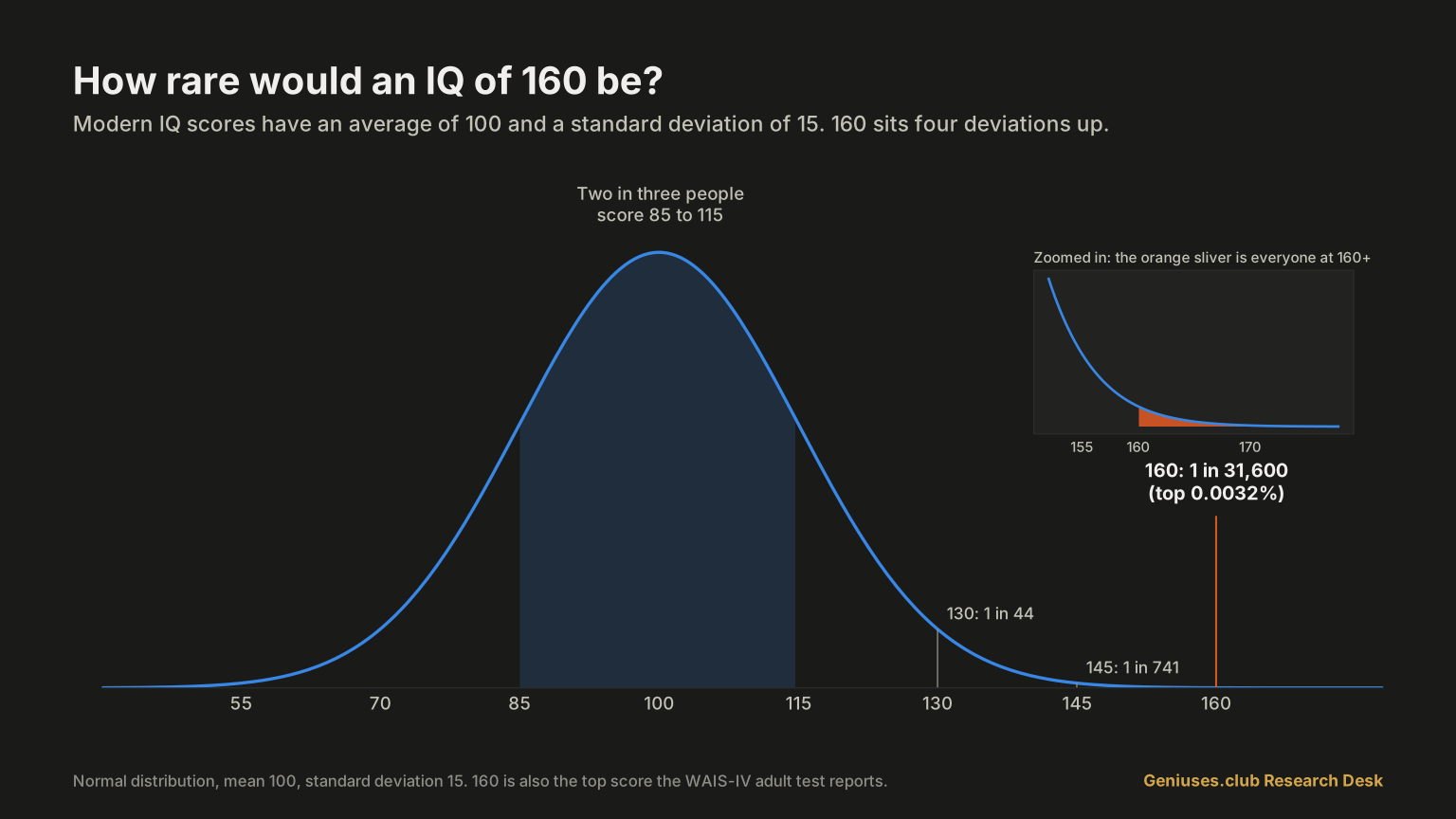
How rare a 160 would be. 130 is about 1 in 44 people, 145 about 1 in 741. Calculation: normal distribution, mean 100, standard deviation 15.
It is contagious. In our database of 93 famous IQ claims traced to their source, 160 is the single most common figure attached to a famous person: 13 entries, ahead of 180 (9 entries) and 190 (7). Nine of those 13 have no source at all, including Stephen Hawking, Bill Gates and Taylor Swift. Three are scholarly estimates (Benjamin Franklin, Thomas Jefferson and Steve Jobs) and one, Isaac Asimov, is a self-reported score from an army aptitude test. Hawking, who shares Einstein's unsourced 160 in countless headlines, had no time for the question. Asked his IQ in 2004, he replied: "People who boast about their IQ are losers."
Twenty questions, eight minutes on the clock, and a percentile measured against everyone who has taken it. No sign-up.
Take the IQ test →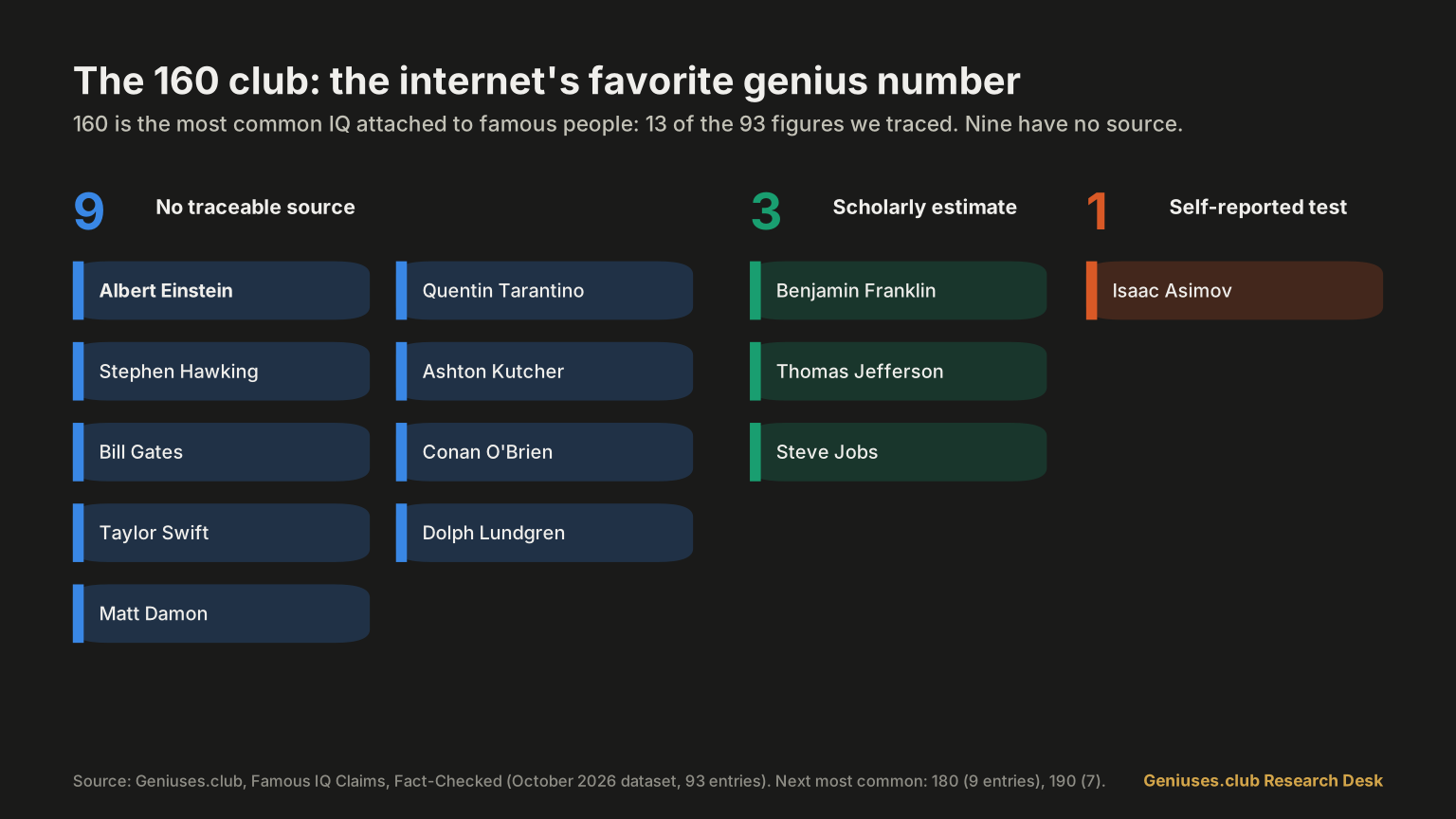
The 160 club. Source: Geniuses.club, Famous IQ Claims, Fact-Checked (October 2026 dataset).
What Einstein's record actually shows
If there is no score, the evidence has to come from what Einstein did. It is strong, and it starts with a myth worth killing.
He did not fail mathematics. In 1935 a Ripley's Believe It or Not! column claimed the greatest living mathematician had failed the subject. Shown the clipping, Einstein replied: "Before I was fifteen I had mastered differential and integral calculus."
He sat a university entrance exam two years early. In October 1895, aged 16 and a half, Einstein took the entrance examination of the Federal Polytechnic in Zurich with special permission, two years under the regular admission age of 18. He did very well in mathematics and physics but failed the general section, which covered languages and other non-science subjects.
He finished school with top marks in the sciences. After a year at the cantonal school in Aarau, he passed the Swiss Matura in 1896 with the top grade, 6, in physics and the mathematical subjects. On the Swiss scale, 6 is the best mark, and confusion over that scale has fed the "bad student" story ever since.

Einstein's Matura (school-leaving) certificate, Aarau, 1896. Public domain, via Wikimedia Commons.
He entered university at 17 and changed physics at 26. Einstein began at the Zurich Polytechnic in October 1896, at 17. In 1905, while working at the patent office in Bern, he published four papers that introduced special relativity, the equation E = mc², an explanation of Brownian motion and the light-quantum explanation of the photoelectric effect. He completed general relativity in 1915 and won the 1921 Nobel Prize in Physics for the photoelectric work. His full story is in our Albert Einstein biography, and our head-to-heads with Isaac Newton and Stephen Hawking put that record in context.
Experts read that record differently. Dean Keith Simonton of the University of California, Davis, warns that most estimates confuse general ability with achievement in one field, and that if you look closely at Einstein's early development, his IQ "seems far less striking". Jonathan Wai of the University of Arkansas points the other way: people who earn doctorates in physics tend to score very high, and the teenage thought experiment in which Einstein imagined chasing a beam of light suggests exceptional spatial reasoning. Einstein himself played it down. In a 1952 letter to his biographer Carl Seelig he wrote: "I have no special talents. I am only passionately curious."
Doesn't his brain settle it?
No. After Einstein's death in 1955, pathologist Thomas Harvey removed and preserved his brain. In 1999 a team led by Sandra Witelson reported in The Lancet that it weighed 1,230 grams, no heavier than the brains of 35 control men with an average IQ of 116, but that its parietal lobes, linked to spatial and mathematical thinking, were about 15 percent wider and had an unusual pattern of folds.
Those findings are contested. In a 2014 review in Brain and Cognition, psychologist Terence Hines argued that the studies of Einstein's brain were not blinded, ran many comparisons, and do not show that its structure reflects his abilities. Either way, no measurement of a brain can be converted into an IQ score.
Our estimate: 180, with a range of 170 to 190
Geniuses.club publishes an IQ estimate only where no test is on record, using fixed, published rules based on documented achievements. Applied to Einstein:
- Base 140: part of the historical canon of physics.
- Plus 15: transformed his field, with relativity and the light quantum.
- Plus 10: university entry before 18, at the Zurich Polytechnic at 17.
- Plus 10: frontier work in theoretical physics.
- Plus 5: the 1921 Nobel Prize in Physics.
That gives 180, with a range of plus or minus 10 points. Read it with three cautions. It is not a test score. Our method is a published house rule, not a peer-reviewed historiometric study, and Warne is right that no such study of Einstein exists. And estimates of this kind, like Cox's, do not sit on the same footing as a modern test result: read 180 as "the top of the scale for a physicist of his rank", not as a claim that he was one person in many millions. The popular 160 falls just below our range. If a documented test result for Einstein ever surfaces, it replaces this estimate.
Why the number matters less than the work
An IQ score ranks a person against other people. History already did that for Einstein, against the whole of physics. Warne makes the same point: whether the number were 150 or 207 would tell us nothing we do not already know. For comparison, Richard Feynman, another Nobel physicist, reportedly scored 125 on a school IQ test, according to his biographer James Gleick.
That is also why headlines about children with "a higher IQ than Einstein" mislead. They compare a real, usually childhood, test result with a number nobody ever measured. For the documented record, see the highest IQ ever recorded. For a real number of your own, our free IQ test reports a range and a percentile, not a single magic figure.
Frequently Asked Questions
What was Albert Einstein's IQ?
Unknown. No IQ test result for Einstein exists, and the widely quoted 160 has no traceable source. Under Geniuses.club's published method, his documented achievements give an estimated 180, with a range of 170 to 190. That is an estimate, not a test score.
Did Einstein ever take an IQ test?
There is no evidence that he did. The first intelligence test appeared in 1905, when Einstein was 26, and the first adult group test in 1917, when he was 38. No archive or biography records him taking one.
Where did the 160 IQ figure come from?
It has no traceable origin. Earlier publications gave 205 (LIFE, 1945), 192 (LIFE, 1954) and 207 (Popular Mechanics, 1962). The 160 became the standard figure in the 21st century and is repeated without citation.
How rare is an IQ of 160?
About 1 in 31,600 people. A score of 160 is four standard deviations above the average of 100, and it is the highest full-scale score the WAIS-IV adult test reports.
Did Einstein fail math?
No. He finished school in 1896 with the top grade, 6, in physics and the mathematical subjects, and said he had mastered calculus before he was 15. What he failed, in 1895, was the general section of a university entrance exam he sat two years early.
Did Einstein and Stephen Hawking both have an IQ of 160?
Neither man is known to have taken an IQ test. Both are attached to the same unsourced 160, and Hawking dismissed questions about his IQ.
Who has a higher IQ than Einstein?
Nobody can be compared with Einstein, because he has no score. The highest IQ Guinness World Records ever listed was 228, for Marilyn vos Savant, from a childhood test; Guinness retired the category in 1990.
Was Einstein's brain bigger than average?
No. It weighed 1,230 grams, within the normal range. Claims that its shape explains his genius are disputed, and no brain measurement can be turned into an IQ score.
Sources
- Russell T. Warne, "The Search for Albert Einstein's IQ", Riot IQ, 24 February 2025 (first published on russellwarne.com, 14 September 2023): https://www.riotiq.com/articles/general-iq-and-intelligence/the-search-for-albert-einstein-s-iq
- Eric W. Dolan, "What was Albert Einstein's IQ?", PsyPost, 19 February 2026: https://www.psypost.org/what-was-albert-einsteins-iq/
- Patrick J. Kiger, "What Was Albert Einstein's IQ?", Biography.com, updated 12 June 2020 (Dean Keith Simonton, Jonathan Wai, Robert McCall): https://www.biography.com/scientists/albert-einstein-iq
- Britannica, "What Was Albert Einstein's IQ?": https://www.britannica.com/topic/What-Was-Albert-Einsteins-IQ
- Wikipedia, "Wechsler Adult Intelligence Scale" (first edition February 1955; Wechsler-Bellevue 1939; full-scale range 40 to 160): https://en.wikipedia.org/wiki/Wechsler_Adult_Intelligence_Scale
- Riot IQ, "A Comprehensive History of IQ Tests" (Binet and Simon 1905, Stern 1912, Stanford-Binet 1916, Army Alpha 1917): https://www.riotiq.com/articles/a-comprehensive-history-of-iq-test
- Einstein Papers Project, Princeton University Press, chronology for 1895 (entrance examination, two years under the regular age): https://einsteinpapers.press.princeton.edu/vol11/195
- Einstein-Website, "Aarau" (October 1895 entrance examination at 16 and a half): https://einstein-website.de/en/aarau
- swissinfo.ch, "Zurich claims Einstein as prodigious son" (entered the Polytechnic in 1896 at 17): https://www.swissinfo.ch/eng/zurich-claims-einstein-as-prodigious-son/4774482
- Rare Historical Photos, "Albert Einstein's matriculation certificate, 1896" (top grade of 6 in physics and the mathematical subjects): https://rarehistoricalphotos.com/albert-einsteins-matriculation-certificate-1896/
- TIME, "Did Einstein flunk math?", from 20 Things You Need to Know About Einstein (Walter Isaacson): https://content.time.com/time/specials/packages/article/0,28804,1936731_1936743_1936758,00.html
- Mental Floss, "15 Relatively Brilliant Albert Einstein Quotes" (letter to Carl Seelig, 1952; Einstein Archives 39-013): https://www.mentalfloss.com/science/physics/15-relatively-brilliant-albert-einstein-quotes
- Witelson, S. F., Kigar, D. L. and Harvey, T., "The exceptional brain of Albert Einstein", The Lancet, 1999: https://doi.org/10.1016/S0140-6736(98)10327-6
- Hines, T., "Neuromythology of Einstein's brain", Brain and Cognition 88 (2014), 21–25: https://doi.org/10.1016/j.bandc.2014.04.004
- Today in Science History, I.Q. quotations (Stephen Hawking, 2004): https://todayinsci.com/QuotationsCategories/I_Cat/I.Q.-Quotations.htm
- Geniuses.club, "Famous IQ Claims, Fact-Checked" and its open dataset (93 entries, October 2026): https://geniuses.club/article/famous-iq-claims-fact-checked
- Wikimedia Commons, Albert Einstein's exam of maturity grades (public domain): https://commons.wikimedia.org/wiki/File:Albert_Einstein%27s_exam_of_maturity_grades_(color2).jpg
Corrections: send a documented test result or a source we missed to press@geniuses.club. We correct and date every change. Research completed 28 October 2026.