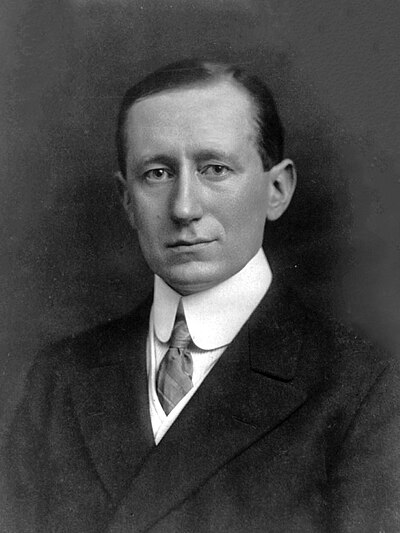
Fast Facts
- Born
- April 25, 1874
- Zodiac
- ♉ Taurus (Apr 20 – May 20)
- Origin
- Italian
- First Wireless Signal
- 1894, age 20
- Company Founded
- 1897, age 23
- Transatlantic Signal
- December 12, 1901, age 27
- Nobel Prize
- Physics, 1909, age 35
- Distance
- 3,500 km, Atlantic Ocean
- Died
- July 20, 1937, age 63
On December 12, 1901, at a receiving station set up in an abandoned military barracks on Signal Hill in St. John's, Newfoundland, Guglielmo Marconi pressed a telephone receiver to his ear and listened. Across 3,500 kilometers of open ocean, from Poldhu in Cornwall, England, a transmitter was sending three dots — the Morse code letter S — over and over through the cold Atlantic winter air. Marconi heard it. He was twenty-seven years old. Every expert in the world had told him it was impossible: radio waves, they said, traveled in straight lines and would fly off into space as the Earth curved away beneath them. Marconi either did not understand the objection or did not believe it. He had been building transmitters in his parents' attic since he was twenty, and he had never found a limit to how far a signal could reach, only a need for bigger antennae and more power. He pointed his equipment at the horizon and refused to accept that the horizon was the end.
Guglielmo Marconi was born on April 25, 1874, in Bologna, Italy, the second son of Giuseppe Marconi, a wealthy Italian landowner, and Annie Jameson, an Irish woman from the Jameson whiskey distilling family. He received no formal university education. His scientific training came from private tutors, including the physicist Vincenzo Rosa and the astronomer Augusto Righi at the University of Bologna, who allowed Marconi to attend his lectures informally. In 1894, when Marconi was twenty, he read an obituary of Heinrich Hertz — who had died that year — and encountered for the first time the concept of Hertzian waves, the invisible electromagnetic radiation that Hertz had discovered and that James Clerk Maxwell had mathematically predicted decades earlier. Hertz himself had seen no practical use for them. Marconi saw everything.
He retreated to the family's summer estate at Pontecchio, converted the upper floor into a laboratory, and began experimenting. Within a year, he had built a system capable of sending a wireless signal across the length of the property. He increased the antenna height, increased the power, and extended the range — first to a few hundred meters, then across a hill that blocked line of sight (proving the signal bent around obstacles), then to distances his neighbors found alarming. The Italian Ministry of Post and Telegraphs, approached for funding, showed no interest. His mother suggested he try England. He arrived in London in 1896, aged twenty-one, and demonstrated his apparatus to the British Post Office. The engineer William Preece declared it "remarkable."
"Have I done the world good, or have I added a menace?"
— Guglielmo Marconi, on reflecting on wireless telegraphy's military applicationsMarconi's Wireless Telegraph Company was incorporated in 1897. Within five years, Marconi stations were operating along the English coast, connecting ships to shore, and the British Admiralty had contracted his company to equip its fleet. In 1899 he transmitted wirelessly across the English Channel. The transatlantic signal in 1901 — received in Newfoundland just hours before a competing message from the Cunard line arrived, and despite violent storms that had destroyed his transmitting antenna twice — vindicated everything. The scientists who had predicted the failure were, as it turned out, wrong for the right reason: the signal bent around the Earth because it reflected off the ionosphere, a layer of the upper atmosphere whose existence Marconi's experiment effectively proved before anyone knew it was there.
The practical applications followed rapidly. By 1910, every major ocean liner carried Marconi equipment. In 1912, when the RMS Titanic sank, the surviving passengers were rescued largely because the Titanic's Marconi operator, Jack Phillips, transmitted distress calls that were received by the RMS Carpathia — which changed course and reached the lifeboats within four hours. A subsequent US Senate inquiry concluded that without wireless telegraphy, there would have been no survivors at all. Marconi received the Nobel Prize in Physics in 1909, sharing it with Karl Braun. He spent the remainder of his life developing shortwave radio transmission, demonstrating in the 1920s that short waves could carry signals around the world with a fraction of the power previously required — a discovery that opened the modern era of global radio broadcasting.
"Every day sees humanity more victorious in the struggle with space and time."
عشرون سؤالاً وثماني دقائق على الساعة، ونسبة مئوية مقاسة مقابل كل من خاضه. دون تسجيل.
اخوض اختبار الذكاء →Marconi died on July 20, 1937, in Rome, aged sixty-three. In tribute, radio stations throughout the world observed two minutes of silence — silence transmitted across the same invisible waves he had spent his life learning to command.
"The more I work with the power of nature, the more I am humbled before its laws."
— Guglielmo MarconiAchievement Timeline
Questions people ask about Guglielmo Marconi
What is Guglielmo Marconi known for?
Italian inventor and electrical engineer who developed Marconi's law and a radio wave-based wireless telegraph system.
When was Guglielmo Marconi born?
Guglielmo Marconi was born in 1874 in Bologna, Italy.
What happened to Guglielmo Marconi?
None of the sources used on this page follows Guglielmo Marconi beyond the events described above. That absence is reported here rather than filled in.
What is Guglielmo Marconi’s IQ?
No IQ figure for Guglielmo Marconi appears in any source used on this page. Geniuses.club publishes an IQ number only when a named outlet has reported one.
Marconi Among Wireless Pioneers
| Pioneer | Era | Key Contribution | Recognition |
|---|---|---|---|
| Guglielmo Marconi | 1874–1937 | Wireless telegraphy; transatlantic radio | Nobel Prize 1909 |
| Heinrich Hertz | 1857–1894 | Discovered radio waves (Hertzian waves) | SI unit "Hertz" named in honour |
| Nikola Tesla | 1856–1943 | Radio transmission patents (disputed) | AC electricity; Tesla unit |
| Alexander Graham Bell | 1847–1922 | Telephone; photophone | AT&T; 18 US patents |
| Lee de Forest | 1873–1961 | Audion vacuum tube; radio amplification | "Father of radio" |
Watch & Learn
Guglielmo Marconi — the man who invented radio
The story of Marconi's impossible transatlantic signal
Why This Matters
Guglielmo Marconi had no university degree and no formal training in physics. He had an attic, a stack of papers by Heinrich Hertz, and an absolute refusal to believe that distance was a limit. The transatlantic signal he received on Signal Hill in 1901 was not just a technical achievement — it was proof that electromagnetic waves could circle the globe, a discovery that physics had not yet provided a mechanism to explain. Every radio broadcast, every Wi-Fi connection, every GPS satellite, every mobile phone call, every radar installation on Earth operates on the principle he demonstrated from a freezing Newfoundland hilltop with improvised equipment and a kite-supported antenna. When the Titanic sank in 1912, Marconi's technology saved over 700 lives. Silence was his tribute. It should not be ours.








