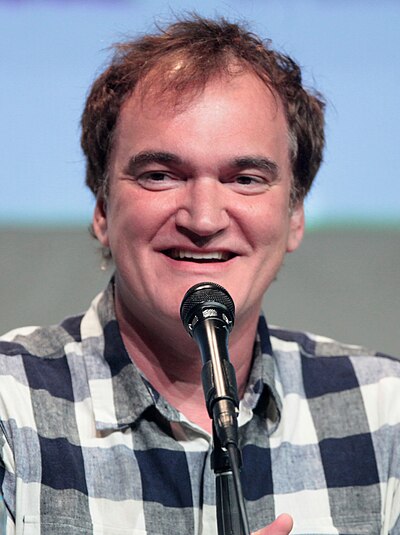
Fast Facts
- Born
- March 27, 1963
- Zodiac
- ♈ Aries (Mar 21 – Apr 19)
- Origin
- American
- First Screenplay
- Age 14
- Education
- Dropped out at 15; self-taught at Video Archives
- Reservoir Dogs
- 1992, age 29
- Pulp Fiction
- Palme d'Or, Cannes 1994
- Oscars Won
- Best Original Screenplay x2
- Films Made
- 10 (announced retirement after 10th)
He dropped out of school at fifteen, convinced that formal education had nothing to teach him that he could not learn faster at the movies. He was not wrong. Quentin Tarantino spent his late teens and twenties working at Video Archives, a video rental store in Manhattan Beach, California, where he and his colleagues watched an estimated two films a day and argued about them for hours afterward. By the time he directed Reservoir Dogs at twenty-nine, he had accumulated a self-taught film education more comprehensive than any university programme — an encyclopedic knowledge of exploitation cinema, Hong Kong action films, Italian gialli, French New Wave, Hollywood noir, and American crime drama that he would spend his entire career sampling, recombining, and transforming into something completely original. He did not go to film school. Film school went to him.
Quentin Jerome Tarantino was born on March 27, 1963, in Knoxville, Tennessee, and grew up primarily in Los Angeles. His mother, Connie, was sixteen when he was born; his father, Tony, was an actor of Italian-American descent who had left before Quentin was born. He was raised largely in the South Bay area of Los Angeles, a child who read voraciously, attended the cinema constantly, and discovered at a young age that he was less interested in what films were about than in how they were made — how a cut created tension, how dialogue could do the work of action, how genre conventions could be violated in ways that produced unexpected effects in an audience. He began writing screenplays at fourteen. None of the early ones were made, but all of them were practice.
He enrolled briefly at the James Best Theatre Company acting school, which gave him exposure to script analysis and performance technique but which he largely treated as a place to learn about storytelling rather than acting. His real education was the video store. Video Archives had an unusual culture: the staff were expected to be genuine cinephiles, capable of recommending almost any film to any customer. Tarantino thrived. He watched everything — Italian horror films, blaxploitation, samurai movies, Godard, Hawks, De Palma — and developed an ability to synthesise disparate influences into coherent arguments about the nature of cinema that his customers and colleagues found either fascinating or exhausting, depending on their patience for a very long conversation about the significance of a camera angle in a 1975 Taiwanese action film.
"When people ask me if I went to film school I tell them, 'no, I went to films.'"
— Quentin TarantinoReservoir Dogs was made for $1.2 million and premiered at Sundance in January 1992, where it was immediately recognized as something new. It was a heist film that showed neither the heist nor the robbery — only the aftermath, with a group of strangers locked in a warehouse, bleeding and accusing each other of betrayal, their fragmented recollections of the preceding hours offered in non-chronological order. The dialogue was unlike anything in American cinema: extended, digressive, darkly funny, perfectly observed, treating violence and pop culture with equal analytical interest. The film's famous ear-slicing scene, performed to the sound of a 1970s pop song, established a Tarantino signature — the juxtaposition of casual horror and upbeat music — that has been imitated and parodied hundreds of times since, and has never quite been replicated.
Pulp Fiction, released in 1994, made Tarantino the most discussed filmmaker in the world. It won the Palme d'Or at Cannes, earned seven Academy Award nominations, and grossed $213 million worldwide against a budget of $8 million. More significantly, it transformed independent film from a marginal category into a commercially viable industrial sector, establishing the Sundance-to-multiplexes pipeline that defined American cinema for the following decade. Its structure — three interlocking stories, told non-chronologically, all involving the Los Angeles criminal underworld — was immediately recognized as a stylistic breakthrough. Its dialogue, particularly the opening discussion of the cultural significance of a Quarter Pounder with Cheese in Paris, became perhaps the most quoted passage in American cinema since Casablanca.
"I steal from every single movie ever made. If my work has anything, it's that I'm taking this from this, combining with that, and you've never seen it put together this way before."
— Quentin TarantinoHe has directed ten films in thirty years, each one carrying his unmistakable signature while operating within a different genre framework: the spaghetti western (Django Unchained), the war film (Inglourious Basterds), the mystery (The Hateful Eight), the revisionist history (Once Upon a Time in Hollywood). He has announced that he will retire after his tenth film — a decision that, whether kept or not, signals a seriousness about his own body of work unusual in an industry that rewards indefinite continuation. He started at fourteen with a screenplay no one would make. He spent fifteen years watching movies in a video store. He made ten films that changed cinema.
"My whole life I've been telling myself I'm a filmmaker. That's all I ever wanted to be."
— Quentin TarantinoAchievement Timeline
Watch & Learn
Quentin Tarantino's filmmaking style analysed
Tarantino on cinema, influences and craft
Questions people ask about Quentin Tarantino
What is Quentin Tarantino known for?
Writing screenplays at 14, directed Reservoir Dogs at 29, and made Pulp Fiction — one of the most influential films ever made.
How old is Quentin Tarantino?
Quentin Tarantino was born in 1963 in Knoxville, Tennessee, USA, and is 63 in September 2026.
What happened to Quentin Tarantino?
The most recent event the sources on this page record is 1994. Pulp Fiction, released in 1994, made Tarantino the most discussed filmmaker in the world.
What is Quentin Tarantino’s IQ?
No IQ figure for Quentin Tarantino appears in any source used on this page. Geniuses.club publishes an IQ number only when a named outlet has reported one.
Tarantino Among Independent Cinema's Revolutionaries
| Director | Debut | Age | Revolution |
|---|---|---|---|
| Quentin Tarantino | Reservoir Dogs (1992) | 29 | Non-linear dialogue-driven crime cinema |
| Orson Welles | Citizen Kane (1941) | 25 | Invented modern cinematic language |
| Steven Spielberg | Jaws (1975) | 27 | Invented the summer blockbuster |
| Joel Coen | Blood Simple (1984) | 30 | Darkly comic crime — Fargo, No Country |
| Richard Linklater | Slacker (1990) | 29 | Dialogue-driven naturalist cinema |
Why This Matters
Quentin Tarantino never went to film school. He went to a video store and watched everything, and he emerged with a knowledge of cinema history more comprehensive than most critics possess, combined with an absolutely original sensibility for dialogue, structure, and violence. Pulp Fiction did not just produce a great film — it changed the economics of independent cinema and demonstrated that movies made outside the studio system could compete commercially with anything Hollywood produced. The lesson is not that formal education is unnecessary. The lesson is that genuine obsession, relentless self-education, and the courage to put your influences together in a way no one has done before constitute a perfectly adequate film school, if you're willing to put in the years.







