
The 2016 entry
The 3M Young Scientist Challenge names one winner a year and gives that winner the title of America's Top Young Scientist. Against 2016 its official list of past winners records Maanasa Mendu and a piezoelectric wind power enhancement device. The research record compiled for this page describes the same project in slightly different words, as a piezoelectric device that improves the efficiency of wind power.
The two descriptions point the same way and stop at the same place. The listing does not say what the device was built from, how it was mounted, what it produced, or whether it was tested anywhere outside the competition. No measurement of any kind is attached to it, and no photograph of it appears on the page.
What piezoelectricity means here
Piezoelectric materials give off a small voltage when they are bent, squeezed or set vibrating. That property makes them an obvious candidate for harvesting energy from movement that would otherwise be wasted, and it separates the approach from a conventional turbine, which converts sustained rotation through a generator.
A piezoelectric approach to wind therefore aims at flutter and vibration rather than spin, which in principle allows a smaller and simpler structure with fewer moving parts. What the official listing establishes is the category of the idea and the fact that judges in a national competition preferred it to everything else entered that year. How far Mendu took the design past that point is not recorded anywhere in this record.
One winner a year
America's Top Young Scientist is awarded once a year, to one entrant, in a national competition for middle-school students in the United States. There is no category split and no shared first place, so the title identifies a single project out of that year's whole field.
The competition publishes its verdict and then stops. That makes the winners listing authoritative about the outcome and silent about the winner, which is the standard shape of a student science prize and the reason a page like this one can be firm about 2016 and empty about the years on either side of it.
The company on the list
The same page sets 2016 inside a decade of winners. Peyton Robertson took the 2013 title for a salt-water sandbag against flood damage, Sahil Doshi the 2014 title for PolluCell, a battery drawing electricity from waste materials, and Hannah Herbst the 2015 title for an ocean energy probe meant to produce power and fresh water. Four consecutive years, four attempts at environmental infrastructure.
After Mendu the subjects turned towards health and detection: Gitanjali Rao's Tethys lead detector in 2017, Rishab Jain's artificial-intelligence method for pancreatic cancer radiotherapy in 2018, Kara Fan's nanoparticle wound care in 2019, Anika Chebrolu's molecular docking work on a COVID-19 antiviral in 2020, Sarah Park's Spark Care+ music therapy in 2021, Leanne Fan's phototherapy headphones in 2022, Heman Bekele's melanoma-treating soap in 2023, Sirish Subash's handheld pesticide detector in 2024 and Kevin Tang's fall-detection system in 2025.
Vinte perguntas, oito minutos no relógio e um percentil medido contra todos os que já fizeram. Sem cadastro.
Fazer o teste de QI →What is documented — and what is not
The firm facts are the year, the title and the invention, published by the organisation that awarded them: America's Top Young Scientist for 2016, for a piezoelectric wind power enhancement device.
Everything else is absent from the source used here. No age or date of birth, no grade, school, home town or photograph. No technical description, no output figure, no prize amount, no quotation from her and no follow-up reporting. Whether the device was developed any further, and what Mendu has done since 2016, is not established by this record, and filling that silence with a plausible career would be the easiest mistake to make with a page this thin.
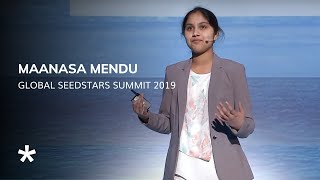
Watch: Maanasa Mendu on camera
| Pessoa | País | Marco | Idade / Dado |
|---|---|---|---|
| Sawsan Ahmed | Estados Unidos | A licenciada mais jovem do Broward College, aos 12 anos, em dezembro de 2021 | 12 anos |
| Arvind Mahankali | Estados Unidos | Venceu o Scripps National Spelling Bee de 2013 aos 13 anos | 13 anos |
| Kerry Close | Estados Unidos | Venceu o Scripps National Spelling Bee de 2006 aos 13 anos | 13 anos |
| Shania Muhammad | Estados Unidos | A licenciada mais jovem da Universidade Langston, aos 15 anos | 15 anos |
| Maanasa Mendu | Estados Unidos | Jovem Cientista de topo dos Estados Unidos, 2016 | — |
What is documented — and what is not
✓ Documented
- Named America's Top Young Scientist in the 2016 3M Young Scientist Challenge (official winners listing)
- Winning entry recorded as a piezoelectric wind power enhancement device
- The challenge names one winner a year, with no categories and no shared first place
? Unverified, disputed or wrong
- No technical description, materials or output figures for the device
- No age, grade, school, home town or photograph in the source
- No prize amount stated, and no reporting on anything after 2016
Questions people ask about Maanasa Mendu
What did Maanasa Mendu invent?
The 3M Young Scientist Challenge's official winners listing records a piezoelectric wind power enhancement device, intended to improve how much electricity is drawn from wind. The listing gives no further description.
What is America's Top Young Scientist?
The title given to the single annual winner of the 3M Young Scientist Challenge, a national science competition for middle-school students in the United States.
How old is Maanasa Mendu?
No source in this record gives an age or a date of birth. The winners listing carries only a year, a name and an invention.
Where is Maanasa Mendu now?
Not documented here. The competition records its 2016 verdict and does not follow winners afterwards, and no later reporting appears in this record.
Is Maanasa Mendu on Wikipedia?
The research record compiled for this page lists no Wikipedia article for her, and no source used here points to one.
How does a piezoelectric device differ from a wind turbine?
Piezoelectric materials produce a voltage when they are bent or vibrated, so the approach targets flutter and movement rather than the sustained rotation a turbine converts through a generator. The listing does not describe how Mendu's version was built.
Who won the challenge the year after her?
Gitanjali Rao, in 2017, for Tethys, a device for detecting lead in drinking water.
Did she win prize money?
No prize amount appears in the source used here.
Quick quiz: how well do you know Mendu’s story?
In which year was Maanasa Mendu named America's Top Young Scientist?
What kind of device was her winning entry?
How many winners does the 3M Young Scientist Challenge name each year?
Sources
- Young Scientist Lab — past winners of the 3M Young Scientist Challenge — 3M Young Scientist Challenge (official)
Checked by the Geniuses.club editorial team. Ages are given as of September 2026.
Descubra Mais Crianças Prodígio
Mais de 50 histórias de jovens gênios contemporâneos que transformam o xadrez, a música, a ciência e a arte.
Explorar Todos os Prodígios →Perfis de Crianças Prodígio Relacionados
 Shania Muhammad🇺🇸 Estados Unidos — Concluiu uma licenciatura aos 15 anos. Um ano depois...
 Arvind Mahankali🇺🇸 Estados Unidos — Soletrou 'knaidel', ganhou o concurso nacional e depois o iídiche...
 Sawsan Ahmed🇺🇸 Estados Unidos — Levou o seu urso de peluche a um laboratório de biologia…
 Kerry Close🇺🇸 Estados Unidos — Quatro concursos nacionais terminaram em derrota. O quinto terminou…
 Sriram Hathwar🇺🇸 Estados Unidos — Foi o concorrente mais jovem do concurso aos oito anos. Seis anos…
 Balu Natarajan🇺🇸 Estados Unidos — O filho de um imigrante ganhou o concurso de inglês dos Estados…
.jpg)