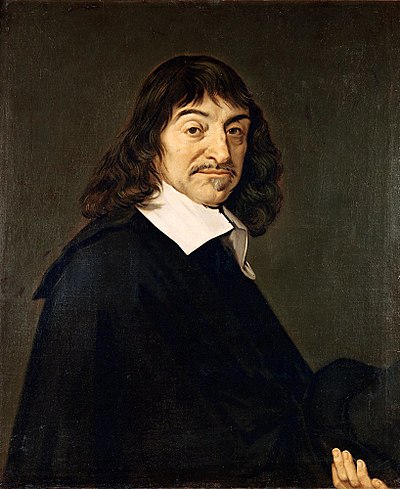
Fast Facts
- Born
- March 31, 1596
- Zodiac
- ♈ Aries (Mar 21 – Apr 19)
- Died
- February 11, 1650
- Nationality
- French
- Key Work
- Meditations on First Philosophy (1641)
- Main Idea
- Cogito ergo sum
- Era
- Early Modern / Rationalism
René Descartes was born on March 31, 1596, in La Haye en Touraine (now Descartes), a small town in the Indre-et-Loire region of France. His mother died of tuberculosis when he was thirteen months old, leaving him with a persistent cough and a fragile constitution that would dog him throughout his life. Raised largely by his grandmother and a nurse, Descartes entered the Jesuit college of La Flèche at the age of eight or ten — one of the finest schools in Europe — where he studied the classics, rhetoric, logic, and the scholastic philosophy of Aristotle alongside mathematics. He was a brilliant pupil, and the priests reportedly allowed him to sleep late, a privilege that stuck: Descartes remained a late riser his entire life, spending his mornings in bed thinking. It was in bed, he later recalled, that his most productive philosophical work was done.
After graduating from La Flèche, Descartes studied law at the University of Poitiers, receiving his degree in 1616 — but he had no intention of practising law. He enlisted as a gentleman soldier, first under Maurice of Nassau in the Dutch States Army and later under Maximilian I of Bavaria. Military service was less a calling than a strategy: it allowed him to travel, meet mathematicians and natural philosophers, and think. The pivotal night came on November 10, 1619, when Descartes was encamped in a heated room near Ulm and experienced a series of three dreams that he interpreted as divine signs urging him to develop a new unified science grounded in mathematics. The conviction that a single mathematical method could unlock all knowledge would shape everything he wrote thereafter.
Descartes spent most of his productive life in the Dutch Republic, prizing its relative freedom of thought and the anonymity it offered. He moved house frequently — reportedly over twenty times in twenty years — to avoid acquaintances and protect his solitude for work. In 1633, he was completing a treatise on cosmology, Le Monde, which endorsed the Copernican heliocentric model, when he heard of Galileo's condemnation by the Inquisition. He immediately suppressed the work; the manuscript would not be published until after his death. The episode illustrated the tension Descartes perpetually navigated between radical philosophical inquiry and prudent conformity with religious authority.
His first published work, the Discourse on the Method (1637), appeared with three scientific appendices — on optics, meteorology, and geometry — that demonstrated his method in action. The Geometry was perhaps the most immediately consequential: it invented analytic geometry by showing how geometric problems could be solved algebraically by representing points as pairs of numbers on perpendicular axes. The Cartesian coordinate system — the x-y plane taught to every school student — is his direct legacy. It made possible Newton's calculus, modern physics, and ultimately the digital representation of space that underlies computer graphics, engineering, and GPS navigation.
The Meditations on First Philosophy (1641) is his philosophical masterwork. Descartes begins by resolving to doubt everything that can possibly be doubted: sensory experience (which can deceive us), mathematics (which an evil demon might cause us to miscalculate), and even his own existence. At the nadir of this systematic doubt, he finds one proposition that cannot be doubted: the act of doubting itself proves that there is a doubter. Cogito ergo sum — I think, therefore I am — is the Archimedean point from which he rebuilds knowledge. From the certainty of his own existence as a thinking thing, Descartes derives the existence of God (as the only adequate cause of the idea of an infinite being in a finite mind) and, via God's non-deceptiveness, the reliability of clear and distinct perceptions. The external world is thus reinstated — but transformed into a mathematical mechanism describable by physics.
Descartes' division of reality into two distinct substances — thinking substance (res cogitans) and extended substance (res extensa) — produced the mind-body problem that has haunted philosophy and science ever since. If mind and body are entirely different in kind, how do they interact? His answer — that they interact through the pineal gland — was an anatomical speculation that satisfied no one, and the problem remains unresolved. Yet the framework itself was enormously productive: by defining matter as purely mechanical and quantitative, Descartes made space for a physics that could ignore soul, purpose, and quality, treating nature as a clockwork machine governed by mathematical laws. Newton's mechanics, Darwin's biology, and modern neuroscience all work within the Cartesian space Descartes defined.
In 1649, Descartes accepted an invitation from Queen Christina of Sweden to tutor her in Stockholm. The queen insisted on lessons at five in the morning — a catastrophic departure from his lifelong habit of late rising. The Swedish winter, the early hours, and likely pneumonia combined to kill him on February 11, 1650. He was fifty-three. His remains were later returned to France and now rest in the church of Saint-Germain-des-Prés in Paris. The coordinate system that bears his name encircles the planet: every digital map, every satellite, every screen renders space in the axes Descartes invented from a warm bed in the Dutch Republic.
Twenty questions, eight minutes on the clock, and a percentile measured against everyone who has taken it. No sign-up.
Take the IQ test →"I think, therefore I am."
— René Descartes, Discourse on the Method, 1637Key Milestones
"The reading of all good books is like a conversation with the finest minds of past centuries."
— René Descartes, Discourse on the Method, 1637Questions people ask about René Descartes
What is René Descartes known for?
French philosopher, mathematician, and scientist, often called the Father of Modern Philosophy.
When was René Descartes born?
René Descartes was born in 1596 in La Haye en Touraine, France.
What happened to René Descartes?
None of the sources used on this page follows René Descartes beyond the events described above. That absence is reported here rather than filled in.
What is René Descartes’s IQ?
No IQ figure for René Descartes appears in any source used on this page. Geniuses.club publishes an IQ number only when a named outlet has reported one.
Enlightenment Philosophers Compared
| Philosopher | Nation | Era | Central Concept | Key Work |
|---|---|---|---|---|
| René Descartes | France | 1596–1650 | Cogito ergo sum | Meditations on First Philosophy |
| Immanuel Kant | Prussia | 1724–1804 | Categorical imperative | Critique of Pure Reason |
| John Locke | England | 1632–1704 | Natural rights | Two Treatises of Government |
| David Hume | Scotland | 1711–1776 | Problem of induction | A Treatise of Human Nature |
| Jean-Jacques Rousseau | Geneva/France | 1712–1778 | General will | The Social Contract |
Why Descartes Still Matters
Descartes drew the line that defines the modern world. By separating the mathematical, mechanical realm of nature from the subjective realm of consciousness, he made modern science possible and created the deepest puzzle of philosophy: how does mind arise from matter? Every neuroscientist studying consciousness, every AI researcher asking whether machines can think, every philosopher of mind working on the hard problem is working inside the frame Descartes built in the winter of 1641. His coordinate system is the invisible skeleton of the digital world — every pixel on every screen occupies a Cartesian address. And his method, demanding that we accept nothing without clear and distinct justification, is the intellectual posture of every scientist who has ever insisted on evidence rather than authority. The cogito is not just a philosophical argument; it is the founding charter of intellectual self-reliance.
Watch & Learn
Cogito ergo sum — Descartes' foundational argument explained
René Descartes — life, philosophy, and legacy






.jpg)

