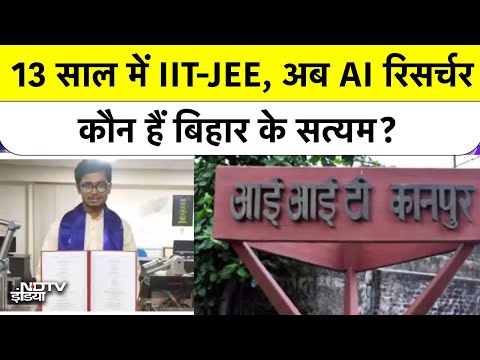
The rank he turned down
In May 2012 the results of the IIT Joint Entrance Examination — the gateway to India’s Indian Institutes of Technology — listed a twelve-year-old from a Bihar village among the qualifiers. Satyam Kumar had sat the exam on April 8, aged 12 years and 8 months, and earned an all-India rank of 8,137. Of the 479,651 candidates who took the exam that year, 24,112 qualified for 9,647 seats; his rank placed him in roughly the top 1.7 percent.
He turned the seat down. “I am happy to crack IIT-JEE but I will not join IIT this year because of my poor rank,” he told the news agency IANS. “I will attempt next year for a good rank.” His father, Sidhnath Singh, a farmer, was proud either way. “It is a matter of pride that my son is the youngest to qualify for IIT-JEE,” he said — and back home, “the entire village celebrated his success bursting firecrackers and consuming sweets.”
No school until Class VIII
Satyam was born on July 20, 1999, in Bakhorapur, a village of about 4,900 people in Bhojpur district, Bihar. His family could not afford school, and he had no formal schooling until Class VIII. An uncle, Pashupati Singh, a clerk at a local college, taught him at home. “We used to give him basic level teaching at home itself,” his uncle told DNA. “His memory and grasping power always surprised us.”
In 2007, when Satyam was eight, another uncle, Ram Pukar Singh, took him to Kota, the Rajasthan city that has become India’s capital of exam coaching. He was admitted directly into Class VIII at Modern School in Kota, and R. K. Verma — founder of the Resonance coaching institute, described in some reports as his principal — paid for his schooling and his IIT preparation. Satyam passed Class X at about ten and Class XII at twelve, with 85 percent.

Rank 679 at thirteen
In June 2013 he sat JEE Advanced, the new second stage of the exam, and came back with an all-India rank of 679 in the general category — roughly the top 0.6 percent of the 115,971 candidates. He was 13 years and 10 months old. Resonance called him the youngest student ever to qualify for the IITs. The exam’s organizers publish no age records, but no younger qualifier has been documented; the previous widely reported mark belonged to Sahal Kaushik, who cleared the exam at 14 in 2010.
“I was not satisfied with my low rank and hence repeated the test this year,” he told DNA. His routine was disciplined rather than heroic: up at five, in bed by ten, about six hours of focused study a day. “I study regularly for six hours a day with complete focus,” he said. For relief, “I see movies, play football and fiddle with mobile.” His ambitions at thirteen ranged from building a social network like Facebook to one day teaching children in his home district.
In July 2013 he joined IIT Kanpur’s combined bachelor’s and master’s program in electrical engineering.
Kanpur, France, Zurich: learning to read the brain
At IIT Kanpur he found his field: brain–computer interfaces, systems that turn brain signals into commands for machines. At 16, according to his CV, he won a Charpak scholarship — one of 25 given to Indian students — for a research internship at Télécom Bretagne in France. In 2017 he was a visiting student at ETH Zurich’s rehabilitation engineering laboratory. His master’s thesis, supervised by Professor Laxmidhar Behera, dealt with motor-imagery interfaces, which decode the brain activity produced when a person imagines a movement.
He graduated in 2018. That autumn, at the French research institute Inria in Bordeaux, he began work with the researchers Fabien Lotte and Florian Yger that produced his most-cited paper, published in 2019.

A doctorate in Texas
In September 2019 he began a PhD in electrical and computer engineering at the University of Texas at Austin, in the lab of José del R. Millán, a pioneer of non-invasive brain–machine interfaces. His doctoral research attacked a practical obstacle: each new user of a brain–computer interface normally has to spend time calibrating it. He showed that decoders trained on experienced users can transfer to newcomers — including stroke patients controlling a robotic exoskeleton — reducing the need for calibration.
The first-author paper from that work appeared in PNAS Nexus in 2024. He also co-authored studies on EEG sensors printed directly onto the scalp as electronic tattoos and on spinal-cord stimulation to speed up interface learning. He defended his thesis, “Transferring BCI Skills: From Experts to Ecological Settings,” on September 24, 2024, at 25. By September 2026 his work had about 400 citations on Google Scholar.

Apple, a patent — and what the headlines get wrong
During the PhD he took two industry internships. At InterDigital, a wireless-technology research company, in 2022 he worked on a project that produced a patent application listing him as a co-inventor. At Apple he was a machine-learning intern working on speech technology; his first-author paper on personalized voice-activity detection, presented at Interspeech 2024, notes that the work was done at Apple.
Parts of the Indian press turned the internship into a job. Headlines said he “works at Apple”; others moved his exams to 2011 and 2012, gave his rank as 670, or had him finishing his PhD at 24. None of that is right. He was an Apple intern, sat the exams in 2012 and 2013, ranked 679, and defended his doctorate at 25.
Where is Satyam Kumar now?
Since October 2024, according to DNA India, he has worked as a machine-learning systems research engineer at Texas Instruments. He still publishes with his former lab: a preprint on decoding the start and end of movements from brain signals appeared in March 2026. He is 27.
The path out of Bakhorapur runs in the family. His younger brother, Shivam Kumar, also coached at Resonance, cleared JEE Advanced in 2018 at 15, with an all-India rank of 383.
“IIT-JEE를 통과해 기쁘지만 순위가 낮아 올해는 IIT에 들어가지 않겠습니다.”사티암 쿠마르, 12세 (IANS, 2012)
“아들이 IIT-JEE에 합격한 최연소자가 된 것은 자랑스러운 일입니다.”시드나스 싱, 아버지 (IANS, 2012)
“그의 기억력과 이해력은 항상 우리를 놀라게 했습니다.”파슈파티 싱, 집에서 가르친 삼촌 (DNA, 2013)
Visual story: Satyam Kumar on camera


Resonance, 2023: 사티암과 그의 멘토 R. K. 베르마의 대담 (힌디어)
2012년 5월: 12세의 나이로 IIT-JEE를 통과한 소년에 대한 TV 보도
| 인물 | 국가 | 이정표 | 나이 / 기록 |
|---|---|---|---|
| Satyam Kumar | 인도 | IIT 합격; 1년 후 679위 | 12 |
| Sahal Kaushik | 인도 | IIT-JEE 전 인도 33위 (2010) | 14 |
| Shivam Kumar | 인도 | JEE Advanced 383위 (2018) | 15 |
| Tathagat Avatar Tulsi | 인도 | 물리학 석사 학위; 21세에 IISc에서 박사 학위 | 12 |
| Michael Kearney | 미국 | 학사 학위 | 10 |
What is documented — and what is not
✓ Documented
- Born July 20, 1999, in Bakhorapur, Bhojpur; his father is a farmer, Sidhnath Singh.
- IIT-JEE 2012 at twelve with rank 8,137; JEE Advanced 2013 at thirteen with rank 679.
- B.Tech–M.Tech in electrical engineering at IIT Kanpur, 2013–2018.
- PhD at the University of Texas at Austin, defended September 24, 2024.
- Machine-learning internship at Apple; InterDigital patent application as co-inventor.
? Unverified, disputed or wrong
- “Works at Apple” — false; it was an internship.
- Texas Instruments role — reported by DNA India and others; not confirmed by the company.
- “PhD at 24” — he defended at 25. “AIR 670” and exam years of 2011–2012 — wrong.
- “Youngest ever” — the exam’s organizers keep no age records.
- Reported job offers from Amazon, Microsoft or Google — unverified.
사티암 쿠마르의 기록은 누구나 확인할 수 있는 두 가지 숫자에 근거합니다. 세계에서 가장 경쟁이 치열한 시험 중 하나에서 12세에 8,137위, 13세에 679위를 기록한 것입니다. 더 의미 있는 숫자는 그가 스스로 거절한 숫자일지도 모릅니다. 순위가 좋지 않다는 이유로 IIT 자리를 거절한 12세 소년은 단순한 속도가 아닌 판단력을 보여주었습니다.
그의 이후 경력은 더욱 드문 이야기입니다. 많은 아동 기록 보유자들이 정체되지만, 그는 선도적인 공과대학에서 박사 학위를 받고 뇌졸중 환자가 뇌 신호로 보조 로봇을 제어하도록 돕는 연구를 이어갔습니다. 그의 삶을 다룬 헤드라인 버전들은 계속해서 세부 사항을 틀리게 보도하고 있습니다. 진짜 이야기는 어떠한 부풀림도 필요하지 않습니다.
Questions people ask about Satyam Kumar
Where is Satyam Kumar now?
Since October 2024 he has worked as a machine-learning systems research engineer at Texas Instruments, according to DNA India. He still co-authors brain–computer-interface research with UT Austin; his latest preprint appeared in March 2026.
How old is Satyam Kumar?
Born on July 20, 1999, he is 27.
What was Satyam Kumar’s IIT rank?
All-India rank 8,137 in IIT-JEE 2012, at twelve, and rank 679 in JEE Advanced 2013, at thirteen. Reports citing “AIR 670” are wrong.
Does Satyam Kumar work at Apple?
No. He was a machine-learning intern at Apple; his Interspeech 2024 paper notes the work was done there. Headlines saying he works at Apple are wrong or out of date.
Did Satyam Kumar finish his PhD at 24?
No — he defended his PhD at the University of Texas at Austin on September 24, 2024, at 25.
Is Satyam Kumar the youngest IITian ever?
He is the widely reported record holder: he qualified at twelve, younger than Sahal Kaushik, who cleared the exam at 14 in 2010. The exam’s organizers do not publish age records.
What is Satyam Kumar’s salary?
Unknown. No credible source has published it.
Which coaching institute did Satyam Kumar attend?
Resonance, in Kota. Its founder, R. K. Verma, mentored him and paid for his studies.
Quick quiz: how well do you know Satyam’s story?
How old was Satyam when he first qualified for the IITs?
He sat IIT-JEE 2012 at 12 years and 8 months.
Why did he skip his first IIT seat?
“I will attempt next year for a good rank” — and came back with 679.
What does his research study?
Systems that turn brain signals into commands for machines.
Sources
- 12-year-old Bihar boy clears IIT-JEE 2012 — India.com (IANS), May 21, 2012
- IITian at 13: Bihar’s child prodigy Satyam Kumar has a Nobel wish — DNA India, June 25, 2013
- 13-year-old Satyam cracked IIT-JEE twice — askIITians, December 16, 2013
- JEE Advanced 2013 results: Resonance Kota — Resonance, June 24, 2013
- Bihar brothers: youngest IIT-JEE qualifiers — The Better India, August 30, 2018
- Satyam Kumar successfully defended his PhD thesis — UT Austin, Millán lab, September 26, 2024
- A comparative analysis of personalized voice activity detection — Apple Machine Learning Research, June 2024
- Meet India’s youngest IITian … he is now doing … — DNA India, September 17, 2025
- IIT-JEE 2012 report — Joint Entrance Examination, 2012
- JEE Advanced 2013 report — Joint Entrance Examination, 2013
- Satyam Kumar — Google Scholar profile — Google Scholar, September 2026
- 12-yr-old boy clears XII after cracking IIT-JEE — Free Press Journal, 2012
- Curriculum vitae — Satyam Kumar (neurosatya.github.io), undated
- Patent application WO2024064880A1 — Google Patents, March 28, 2024
Checked by the Geniuses.club editorial team. Ages are given as of September 2026.


