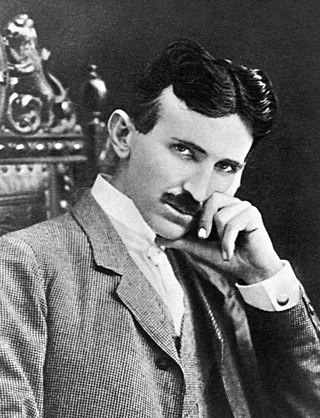
In the summer of 1856, in the small Serbian village of Smiljan in what was then the Austrian Empire, a child was born during a lightning storm. The midwife reportedly called it a bad omen. His mother, Georgina, reportedly replied: "He will be a child of light." She could not have known how literally true that would prove. Nikola Tesla grew up in a household ruled by intellect — his father was an Orthodox priest who composed poetry and spoke multiple languages, his mother an inventor in her own right who built household tools and memorized entire books without ever learning to read. The capacity for obsession, for seeing the world as a system of invisible forces waiting to be named and harnessed, was in him from birth.
He studied at the Graz University of Technology in Austria, where he first encountered the Gramme dynamo — a direct current machine — and made an observation that would define his life. The machine ran wastefully. Its brushes sparked. Its commutator was an engineering compromise. Tesla told his professor, Jakob Poschl, that he believed the commutator was unnecessary — that a motor could run on alternating current, without brushes, without sparking, by exploiting the rotating magnetic field. Poschl was dismissive. He delivered a lecture explaining to the class why this was theoretically impossible. Tesla spent the next several years proving him wrong.
He arrived in New York in 1884 with four cents in his pocket, a poem, and a letter of introduction to Thomas Edison. Edison hired him. The collaboration lasted less than a year. Edison was a direct current man, empire-minded, commercially entrenched. Tesla proposed alternating current. Edison offered him fifty thousand dollars to fix his DC motor system — and when Tesla delivered, told him it had been a joke. Tesla resigned. The War of Currents had begun.
George Westinghouse believed in Tesla's vision and licensed his AC patents in 1888. The battle that followed — Edison's DC system versus Tesla and Westinghouse's AC system — was not merely a technical dispute. It was a contest about the future architecture of civilization. Edison ran a public relations campaign depicting AC as lethally dangerous, commissioning the electrocution of animals with AC current and lobbying for the AC-powered electric chair. Tesla and Westinghouse won the contract for the 1893 World's Columbian Exposition in Chicago, lighting the fair with alternating current. Twelve million people saw the future. The following year, Westinghouse built the Niagara Falls power station using Tesla's AC system, transmitting electricity twenty-six miles to Buffalo. The modern electrical grid was born.
But Tesla was never satisfied with what he had already built. His laboratory became a theater of wonders — sparking coils, phosphorescent lamps lit without wires, X-ray images made before Roentgen's official discovery, demonstrations that left visitors speechless. The Tesla coil, developed in 1891, was both a scientific instrument and a work of performance art: a resonant transformer capable of producing extremely high voltage at high frequency. It revealed the electromagnetic properties of space itself. Tesla filed patents on a radio system in 1897 — two years before Marconi's first transatlantic demonstration. The patent dispute would last until the US Supreme Court upheld Tesla's priority in 1943, the year he died.
His grandest obsession was Wardenclyffe Tower, begun in 1901 on Long Island with funding from J.P. Morgan. Tesla envisioned a global system of wireless energy transmission — electricity beamed through the earth and atmosphere to any point on the planet, free and universally available. Morgan withdrew funding when he understood the implications: a system that made electricity free offered no obvious profit mechanism. The tower was never completed. It was demolished in 1917 to pay debts. Tesla never recovered financially. He spent his final years in the Hotel New Yorker, feeding pigeons, declining invitations. He died alone on January 7, 1943.
The rehabilitation of Tesla's reputation in the late twentieth century was partly driven by a growing understanding of how thoroughly Edison's superior publicity machine had obscured the actual distribution of credit. The unit of magnetic flux density — the tesla — was named in his honor in 1960. His AC system remains the global standard for electrical power distribution. The company Elon Musk named after him produces the world's best-selling electric vehicles. Every time you plug something in, every time the lights come on, you are drawing on a system that exists because one Serbian immigrant saw, in 1881, that alternating current could replace the wasteful compromise of direct current — and refused to be told it was impossible.
"The present is theirs; the future, for which I really worked, is mine."— Nikola Tesla
"If you want to find the secrets of the universe, think in terms of energy, frequency, and vibration."— Nikola Tesla
| Inventor | Key Invention | Year | Civilizational Impact |
|---|---|---|---|
| Nikola Tesla | AC Electrical System | 1888 | Powers every home and city on Earth |
| Thomas Edison | Practical Incandescent Bulb | 1879 | First widespread artificial lighting |
| Alexander Graham Bell | Telephone | 1876 | Long-distance voice communication |
| Guglielmo Marconi | Radio (commercial) | 1901 | Wireless mass communication |
| James Watt | Steam Engine (improved) | 1769 | Powered the Industrial Revolution |
Nikola Tesla — Full Documentary
Tesla vs Edison — The War of Currents
Every electrical grid on Earth runs on alternating current. Every motor in every appliance, every generator in every power plant, every transformer on every street corner traces its operating principle to Tesla's rotating magnetic field insight of 1882. Without AC power transmission, electricity would have remained a local phenomenon — each city its own small island of light, unable to draw power from distant rivers or wind fields. Tesla's system made the large-scale electrification of civilization possible.
Beyond AC power, Tesla's work in radio, X-ray imaging, remote control, and resonant circuits seeded entire industries that emerged decades after his death. His vision of wireless energy — of a world where power flows through the air like radio waves — remains both a scientific goal and a philosophical statement about what technology should be for. He was not building businesses. He was trying to change what it meant to live on Earth. That ambition, more than any single patent, is why the world keeps coming back to him.







