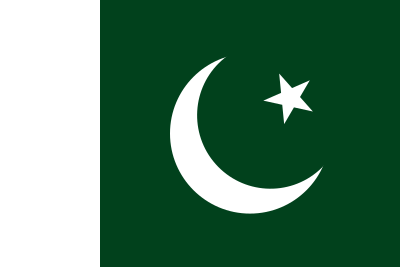
Flag: Wikimedia Commons / Public Domain
Pakistan's Chess Federation has held national women's championships since the sport was formally organised in the country, and the winners' list tells a partial story of women's achievement in a society that does not always make achievement easy. Women's chess in Pakistan occupies a peculiar and courageous space: it is a competitive sport in which women must travel to tournaments, face opponents across a board in a public setting, and be recognised by name and record in a context that measures excellence objectively. For young women, particularly in a conservative society, the act of becoming a national chess champion involves not only the mastery of the game but the navigation of expectations that the game itself does not contain. Shehar Bano Qureshi has navigated all of it and won.
Born around 2004 in Pakistan, Shehar Bano grew up in a country where cricket dominates sports culture so completely that other disciplines must fight for attention, resources, and recognition. Chess has a small but serious community in Pakistan — centred particularly in Lahore, Karachi, and Islamabad — sustained by a federation that participates in international events and by families who understand that chess offers something cricket does not: a game in which girls can compete on entirely equal terms, where physical difference is irrelevant, and where intelligence and preparation are the only currencies that matter.
She came to chess early and progressed quickly through the domestic competitive structure. The Pakistan Chess Federation runs national championships at various levels, and the women's national championship — typically contested by the country's strongest adult and youth women players — is the definitive test of women's chess in the country. To win it once is significant. To win it multiple times as a teenager is the mark of a player whose talent and preparation are genuinely exceptional within the national context. Shehar Bano Qureshi achieved exactly this, becoming a multiple-time national women's chess champion while still in her teens and establishing herself as arguably the most dominant young woman in Pakistani chess history.
Her chess style reflects the practical demands of competitive chess in a resource-constrained environment: she is a versatile, pragmatic player whose opening repertoire covers both aggressive and solid systems, whose tactical alertness is high, and whose endgame technique is sufficient to convert advantages against opponents who may have more formal training but less competitive experience. In tournaments where analysis software and premium coaching are not universal, the player who wins most often is the one who understands chess intuitively as well as technically — who can read a position's requirements quickly and make decisions under time pressure without losing thread of the position's deeper logic. These are qualities that formal training can develop but that competitive experience builds most rapidly, and Shehar Bano has competed in enough national events to have developed them to a significant degree.
Venti domande, otto minuti di orologio e un percentile misurato su tutti quelli che l’hanno fatto. Senza registrazione.
Fai il test del QI →Pakistan sent teams to the 2024 Chess Olympiad in Budapest — both open and women's sections — and the women's team, while not among the medal contenders in a field dominated by India, China, and the United States, acquitted itself with competitive seriousness and gained the international exposure that is essential for development. Playing against women's grandmasters and international masters from other countries in a FIDE-rated event is a different order of challenge from the national championship circuit, and the Olympiad experience provides young players like Shehar Bano with both the data about where they stand internationally and the motivation to close the gap.
The context for her achievement is a women's chess culture that is being built as much as it is being played. In Pakistan, the infrastructure for women's sport has historically lagged behind the infrastructure for men's sport — fewer tournaments, less sponsorship, less media attention, and the social constraints that in some communities make it difficult for young women to travel to competitions or to be publicly celebrated for victories in a mixed-gender setting. Shehar Bano Qureshi has succeeded within these constraints, not by ignoring them but by performing at a level that makes the constraints themselves harder to maintain — because national champions get recognition, and recognition creates permission for the next generation of girls who want to sit down at a chess board and play seriously.
Her story is still in its early chapters. The WFM (Woman FIDE Master) or WIM (Woman International Master) titles that mark the formal international recognition of women's chess ability are within plausible reach for a player of her national standing. International tournament results at Open events would give her FIDE rating momentum and the normative performance points toward those titles. The Chess Federation of Pakistan, if it continues to invest in player development and international participation, provides the pathway. What Shehar Bano Qureshi has already demonstrated is that the talent is present, the will is present, and the results — multiple national titles — are real. The rest is the future, which she has earned the right to pursue.
"Pakistan's women in chess are proving that it is a queen's game — and the queens are getting younger and more formidable with every national championship."— Images Magazine (Dawn), on Pakistan women's chess, 2022
Fast Facts
Milestone Timeline
"A national chess champion in Pakistan is not just a chess player — she is proof that Pakistani women can compete, win, and be celebrated for intellectual achievement in the most public arena imaginable."— Geniuses Club editorial assessment, 2024
Pakistan Women's Chess
Pakistan's women's chess community — the tournaments, the players, and the growing culture that has produced champions like Shehar Bano Qureshi in one of South Asia's most challenging environments for women in sport.
Pakistan at the Chess Olympiad — the women's team that carries the flag for a new generation of Pakistani chess players breaking barriers and competing on the world stage.
Questions people ask about Shehar Bano Qureshi
What is Shehar Bano Qureshi known for?
National women's chess championship titles as a teenager. ♛ SBQ 🇵🇰 Flag: Wikimedia Commons / Public Domain Pakistan's Chess Federation has held national women's championships since the sport was formally organised in the country, and the winners' list tells a partial story of women's achievement in a society that does not always make achievement easy.
Where is Shehar Bano Qureshi from?
Pakistan.
What happened to Shehar Bano Qureshi?
The most recent event the sources on this page record is 2004. Born around 2004 in Pakistan, Shehar Bano grew up in a country where cricket dominates sports culture so completely that other disciplines must fight for attention, resources, and recognition.
What is Shehar Bano Qureshi’s IQ?
No IQ figure for Shehar Bano Qureshi appears in any source used on this page. Geniuses.club publishes an IQ number only when a named outlet has reported one.
In Context: Women's Chess Champions Across South Asia
| Player | Country | Title | Key Achievement | Breakthrough Age |
|---|---|---|---|---|
| Koneru Humpy | 🇮🇳 India | Grandmaster | World Rapid Champion; World No. 2 | 15 |
| Harika Dronavalli | 🇮🇳 India | Grandmaster | World Women's Championship semifinalist 3× | 16 |
| Laila Masood | 🇵🇰 Pakistan | WIM | First Pakistani woman to earn WIM title | 20s |
| Ghazal Hakimyar | 🇵🇰 Pakistan | WFM | Multiple national women's champion | 20s |
| Shehar Bano Qureshi | 🇵🇰 Pakistan | WFM / rising | Multiple national women's champion as teenager | ~15–17 |
Why This Matters
In most countries, a national chess champion is a sporting figure. In Pakistan, for a young woman, it is something more: a statement about possibility, capability, and the right to compete in the most visible intellectual arena without apology. The Chess Federation of Pakistan has worked to create space for women to compete, but space created by institutions is only half the equation — the other half is the players who walk into that space and perform at a level that makes the space worth creating. Shehar Bano Qureshi has done that. She has won national titles as a teenager, represented her country internationally, and become the kind of figure that younger girls across Pakistan can point to when someone tells them that chess, or competition, or intellectual ambition, is not for them. The queen is the most powerful piece on the board. In Pakistan's chess story, Shehar Bano Qureshi is demonstrating exactly what a queen can do.