The problem, in one number
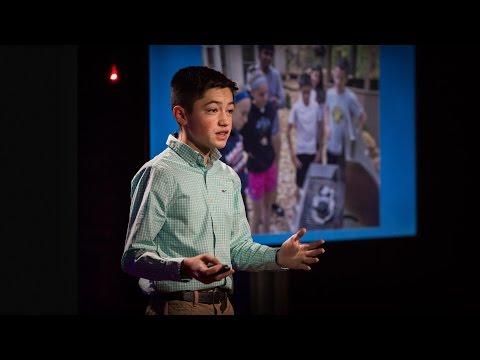
TED's description of the talk states the case in a sentence: from packing peanuts to disposable coffee cups, the United States alone produces some two billion pounds of Styrofoam each year, none of which can be recycled. Expanded polystyrene is mostly air by volume, which makes it uneconomic to collect and transport, and it does not break down usefully in landfill.
That combination, enormous volume and no viable recycling route, is what makes it a standing target for student science projects. What distinguishes Cofer's is that the team went after the chemistry rather than the collection problem.
What they built
The approach, as TED describes it, was a heating treatment that breaks used Styrofoam down into something useful. The talk runs just under six minutes and was recorded at TED-Ed Weekend in December 2016.
What exactly the Styrofoam becomes is not specified on the TED page used here, and the teammates are not named there either. The Google Science Fair record, as summarised in the Wikipedia article on the competition, lists the award as going to Cofer with teammates and gives his age at the time as 14.
The Google Science Fair, 2016
The Google Science Fair ran annually as a global online competition for teenagers, with entrants narrowed to a small group of finalists who presented to judges, and a set of named awards attached to sponsors including Scientific American, National Geographic, Virgin Galactic and Lego Education. Cofer's project took one of the 2016 awards.
The precise name of the award, and the names of his teammates, come from the Wikipedia summary of the competition rather than from a Google announcement in the material used here, and should be treated accordingly. The TED page, which is the stronger source, confirms the project and the team but not the prize.
What is documented, and what is not
Firm: the invention as TED describes it, a heating treatment that breaks used Styrofoam down into something useful; the TED-Ed Weekend talk of December 2016 and its title; and the two-billion-pound figure for annual US Styrofoam production.
Not documented in these sources: his date of birth, which is why the birth year here is derived from a reported age of 14 in 2016; his home town and school; what the treated material becomes; whether the process was patented, scaled or licensed; and anything about him since 2016. A named award and a named team appear only in the secondary summary used here.
Venti domande, otto minuti di orologio e un percentile misurato su tutti quelli che l’hanno fatto. Senza registrazione.
Fai il test del QI →Why student projects on waste rarely go further
A great many science fair projects propose solutions to plastic waste, and very few of them reach an industrial plant. The obstacle is rarely the chemistry. It is that the economics of waste turn on collection, sorting and transport, and a process that works on a benchtop still has to compete with the cost of putting the same material in a hole in the ground.
That is worth saying plainly on a page about a 14-year-old's invention, because the honest measure of this work is not whether Styrofoam recycling has since been solved. It is that a school team identified a material everyone had written off, found a thermal route to make it useful, convinced a panel of judges, and then explained it in under six minutes to an audience that had never thought about packing peanuts. The sources here document all four of those things and none of what came after.
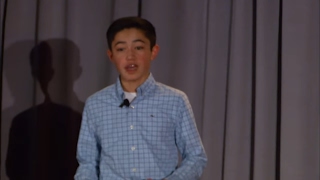
Watch: Ashton Cofer on camera

| Persona | Paese | Traguardo | Età / Dato |
|---|---|---|---|
| Ashton Cofer | Stati Uniti | Un trattamento termico per il polistirolo usato | 14 anni |
| Leanne Fan | Stati Uniti | Finsen Headphones, per rilevare e curare le infezioni dell'orecchio medio | 14 anni |
| Valerio Pagliarino | Italia | LaserWAN, collegamenti internet a banda larga basati su laser | 16 anni |
| Naisargik Lenka | India | Pradhan Mantri Rashtriya Bal Puraskar 2019, categoria innovazione | 17 anni |
| Jeremiah Thoronka | Sierra Leone | Optim Energy, che trasforma la vibrazione stradale in elettricità | — |
What is documented — and what is not
✓ Documented
- A heating treatment to break used Styrofoam down into something useful, developed with science fair teammates
- TED-Ed Weekend talk in December 2016 titled A plan to recycle the unrecyclable
- TED's figure of some two billion pounds of Styrofoam produced annually in the United States, none recyclable
- An award at the 2016 Google Science Fair at age 14
? Unverified, disputed or wrong
- Date of birth, home town and school are not stated in these sources
- What the treated Styrofoam becomes is not specified on the TED page
- The award's exact name and the teammates' names come from a secondary summary, not a primary announcement
- Whether the process was patented, scaled or licensed is not documented, and nothing records him after 2016
Questions people ask about Ashton Cofer
How old is Ashton Cofer?
He was reported as 14 at the time of the 2016 Google Science Fair award. No source used here gives his date of birth, so the birth year on this page is approximate.
What did Ashton Cofer invent?
With science fair teammates, a heating treatment that breaks used Styrofoam down into something useful, as TED describes it.
What is his TED talk called?
A plan to recycle the unrecyclable, recorded at TED-Ed Weekend in December 2016 and running just under six minutes.
How much Styrofoam does the United States produce?
Some two billion pounds a year, according to TED's description of the talk, none of which can be recycled.
Who were his teammates?
The TED page does not name them. A secondary summary of the Google Science Fair records a team, but the names are not confirmed by a primary source here.
Is Ashton Cofer on Wikipedia?
He appears in the winners list within the Wikipedia article on the Google Science Fair. No separate article on him was found among these sources.
Where is Ashton Cofer now?
Not documented. Neither source used here follows him beyond 2016.
Quick quiz: how well do you know Ashton’s story?
How much Styrofoam does TED say the United States produces each year?
What is Ashton Cofer's TED talk called?
What kind of treatment did the team develop?
Sources
- A plan to recycle the unrecyclable — TED, 2016-12
- Google Science Fair — Wikipedia
Checked by the Geniuses.club editorial team. Ages are given as of September 2026.
Scopri Altri Bambini Prodigio
Oltre 50 storie di giovani geni contemporanei che trasformano scacchi, musica, scienza e arte.
Esplora Tutti i Prodigi →Profili di Bambini Prodigio Correlati
 Valerio Pagliarino🇮🇹 Italia — Un adolescente italiano ha costruito la banda larga usando fasci laser e…
 Leanne Fan🇺🇸 Stati Uniti — Cuffie che diagnosticano un'infezione all'orecchio e la…
 Naisargik Lenka🇮🇳 India — A 16 anni ha vinto il premio nazionale indiano per l'infanzia per il lavoro…
 Kenneth Shinozuka🇺🇸 Stati Uniti — Suo nonno vagava di notte. Ha costruito un sensore che…
 Jeremiah Thoronka🇸🇱 Sierra Leone — È cresciuto in un campo senza elettricità. A 17 anni generava…
 Arunima Sen🇮🇳 India — Un grattacielo che risparmia energia, un modo per coltivare più orzo…


