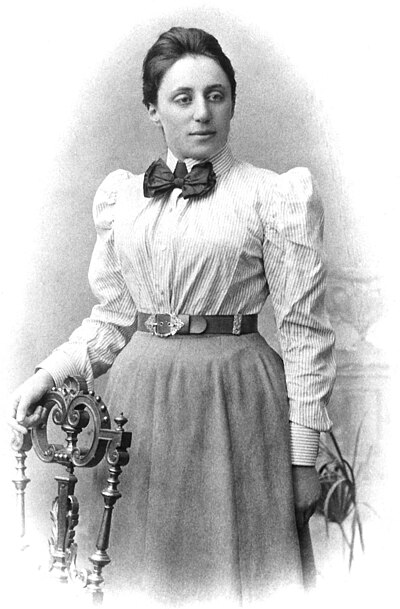
Fast Facts
- Born
- March 23, 1882
- Zodiac
- ♈ Aries (Mar 21 – Apr 19)
- Origin
- German
- PhD
- University of Erlangen, 1907
- Key Theorem
- Noether's Theorem, 1915
- Einstein's Verdict
- "Most significant creative mathematical genius thus far produced"
- Exiled
- 1933, Nazi Germany
- Institution
- Bryn Mawr College (USA)
- Fields
- Abstract algebra, theoretical physics
The letter came back with a refusal. Emmy Noether had submitted her completed doctoral dissertation to the University of Erlangen in 1903, but the university did not admit women as degree candidates. She audited lectures — she was permitted to sit and listen, but not to be examined, not to receive credit, not to exist in any official sense. She persisted. By 1904, the rules had shifted enough that she could enroll. By 1907, she had her doctorate. Her dissertation, on invariant theory, was later described — by Noether herself — as "a jungle of formulas." She had already outgrown it. The work she was warming up to do would take the rest of her life and would ultimately reshape theoretical physics at its foundations.
She was born in Erlangen, Bavaria, on March 23, 1882, the eldest child of Max Noether, himself a distinguished mathematician at the University of Erlangen. The family was Jewish, middle-class, academically serious. Her father's colleagues treated mathematics as the highest calling, and Emmy absorbed that conviction early. She was, by all accounts, an ordinary child by the standards of the era — she studied languages, planned to teach French and English, showed no particular sign of what was coming. Then she encountered mathematics in earnest and the ordinariness evaporated. She discovered that she could think in ways that other people could not, and that the thinking felt, to her, like the most natural activity in the world.
After her doctorate, she spent eight years at Erlangen without pay, sometimes lecturing in her father's stead, because the university would not hire women as faculty. In 1915, David Hilbert and Felix Klein — two of the most powerful mathematicians in Europe — brought her to Göttingen, the center of German mathematical life, to work on the mathematics of Einstein's newly developed general theory of relativity. Even here she could not hold a formal position. Hilbert, enraged by the faculty's resistance, reportedly told his colleagues: "I do not see that the sex of the candidate is an argument against her admission. After all, we are a university, not a bathhouse."
"In the judgment of the most competent living mathematicians, Fräulein Noether was the most significant creative mathematical genius thus far produced."
— Albert Einstein, letter to the New York Times, May 1935In 1915, working on the mathematical underpinnings of general relativity, Noether proved what is now called Noether's theorem. The theorem establishes a deep and beautiful correspondence between symmetries and conservation laws: every symmetry of a physical system corresponds to a conserved quantity. The conservation of energy follows from the fact that the laws of physics don't change over time. The conservation of momentum follows from the fact that the laws of physics don't change across space. The conservation of angular momentum follows from rotational symmetry. These connections — which physicists had observed empirically for centuries without understanding why — were shown by Noether to be not coincidences but logical necessities, flowing from a single elegant mathematical structure. The theorem is now considered one of the most important results in theoretical physics. Every physicist uses it. Many do not know her name.
By the 1920s, she had pivoted to abstract algebra and was doing work that would define the field for the century to come. The structures mathematicians now call "Noetherian rings" — defined by a particular chain condition she identified — appear throughout modern algebra and algebraic geometry. Her 1921 paper on ideal theory in rings is considered a founding document of modern abstract algebra. Students came from across Europe and beyond to study with her; they called themselves the "Noether boys." She lectured in a rapid, informal style, thinking out loud, encouraging argument, dismissing formality. She was, by all accounts, a terrible dresser and an extraordinary teacher.
"She changed the face of algebra by her work."
बीस प्रश्न, घड़ी पर आठ मिनट, और अब तक टेस्ट देने वालों के सामने मापा गया पर्सेंटाइल। साइन-अप नहीं।
IQ टेस्ट दें →In April 1933, one week after Hitler's government came to power, Emmy Noether was among the first Jewish professors dismissed from their positions under the Law for the Restoration of the Professional Civil Service. She had no position to dismiss — she had never held a permanent academic post. But she had an unofficial one, and they took that. She received offers from several countries and accepted a visiting professorship at Bryn Mawr College in Pennsylvania. She was fifty-one. She had been doing the most important mathematics of her life for thirty years without the institutional recognition that any male mathematician of comparable stature would have received automatically. In America, for the first time, she had an actual salary, an actual office, students who were enrolled in her actual classes. She had twenty months to enjoy it. In April 1935, she died of complications following surgery to remove an ovarian cyst. She was fifty-two.
"She was not clay, pressed by the artistic hands of God into a definitively human shape, but rather a piece of primordial mathematical stuff."
— Hermann Weyl, eulogy for Emmy Noether, 1935Achievement Timeline
Questions people ask about Emmy Noether
What is Emmy Noether known for?
German mathematician who proved Noether's theorem, one of the most important results in theoretical physics, linking symmetry to conservation laws.
When was Emmy Noether born?
Emmy Noether was born in 1882 in Erlangen, Bavaria, Germany.
What happened to Emmy Noether?
None of the sources used on this page follows Emmy Noether beyond the events described above. That absence is reported here rather than filled in.
What is Emmy Noether’s IQ?
No IQ figure for Emmy Noether appears in any source used on this page. Geniuses.club publishes an IQ number only when a named outlet has reported one.
Emmy Noether Among Pioneering Mathematicians
| Mathematician | Country | Key Contribution | Barrier Faced |
|---|---|---|---|
| Emmy Noether | Germany | Noether's Theorem; Abstract Algebra | Gender exclusion; Nazi dismissal |
| Maryam Mirzakhani | Iran / USA | Riemann surfaces; Fields Medal 2014 | First woman to win Fields Medal |
| Sofia Kovalevskaya | Russia | Partial differential equations; Cauchy-Kovalevskaya theorem | Forbidden from attending Russian universities |
| Srinivasa Ramanujan | India | Number theory; 3900+ formulas | Poverty; colonial academic gatekeeping |
| Alan Turing | UK | Computer science; Enigma decryption | Prosecuted for homosexuality |
Emmy Noether on Mathematics
Noether's Theorem explained — symmetry, conservation laws, and the most beautiful theorem in physics
Emmy Noether: the most important mathematician you've never heard of — her life and revolutionary theorems
Why This Matters
Emmy Noether did not merely succeed despite extraordinary obstacles — she produced work of such fundamental importance that it reshaped two entire disciplines while those obstacles were still in full force. Every physicist who invokes conservation of energy, conservation of momentum, or conservation of angular momentum is using her theorem, whether they know her name or not. Every algebraist working with rings and ideals is working in a framework she constructed. She did this without a permanent position, without a salary for most of her career, without the institutional support given automatically to every male colleague of lesser achievement. Her story is not a triumph-over-adversity narrative. It is an indictment — of every institution that made her fight for the right to exist in the room where the mathematics was being made — and a testament to the power of a mind that could not be stopped.






.jpg)

