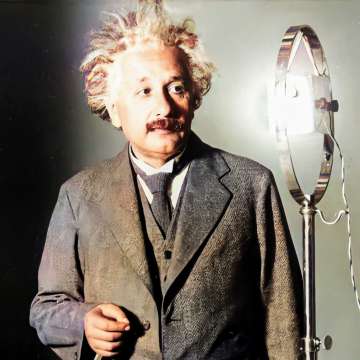
Short answer: No. Albert Einstein was right-handed. Photographs show him holding a pen and handling paper with his right hand and playing the violin as a right-hander. Researchers at the Albert Einstein Archives found no evidence that he was left-handed at any point, including as a child pushed to switch hands. The left-handed Einstein is a myth spread by lists of famous lefties.
At a glance
| Verdict | Right-handed |
|---|---|
| Writing hand | Right, in photographs of him with pen and paper |
| Violin | Played as a right-hander |
| Evidence of a switched left-hander | None found by the Albert Einstein Archives |
| Born – died | March 14, 1879, Ulm – April 18, 1955, Princeton |
| Share of people who are left-handed | About 10 percent (2020 meta-analysis) |
| A genius who really was left-handed | Leonardo da Vinci |
What the archives and photographs show
The clearest statement comes from the people who hold Einstein's papers. Writing for the Albert Einstein Archives, Barbara Wolff and Hananya Goodman took up the handedness question directly. Photographs, they noted, show Einstein holding a pen in his right hand, seizing paper with his right hand and playing the violin like a right-hander. On the question of left-handedness, their conclusion was blunt: "no evidence was found." They took it for granted, in their words, that he was a right-hander.
That finding matters because it rests on the primary record, not on anecdote. Einstein was photographed constantly from 1919, when the eclipse test of general relativity made him world-famous, until his death. A left-handed writer would show up in that record again and again. He does not. For the rest of his biography, see his genius profile.
The violin: a clue, not a proof
Einstein began violin lessons at 5, disliked them, and fell for the instrument at 13 after discovering Mozart's sonatas. He played for the rest of his life, often in chamber groups in Bern, Zurich and Berlin. He bowed with his right hand.
On its own, that proves little. Left-handed violinists usually learn the instrument the standard way, bow in the right hand, not least because orchestra seating assumes it. The violin is consistent with right-handedness; the writing photographs are what settle it. Honest myth-busting means saying which evidence carries the weight.
Was he a converted left-hander?
A common fallback claim holds that Einstein was born left-handed and forced to write with his right hand at school. Schools of his era often did retrain left-handed children, so the idea is not absurd. But it needs evidence, and none exists. The archivists addressed this version specifically: they found no sign that he was, or originally had been, left-handed.
We found no school record, family letter or recollection from his sister Maja, who wrote an early sketch of his childhood, that supports the story. A claim with no source should not survive on the grounds that it cannot be disproved.
Where the left-handed Einstein came from
The myth has three engines. The first is the list. Books, posters and websites celebrating left-handers compile famous names, and each list tends to copy the last. Einstein, the most recognizable genius of the 20th century, is the name every list wants. Once he appeared on one, he appeared on hundreds.
The second is pop psychology. Roger Sperry's split-brain research, recognized with a Nobel Prize in 1981, was simplified in popular culture into the idea of creative right-brained people and logical left-brained ones. Left-handers, whose writing hand is driven by the right hemisphere, were cast as natural creators. Placing the era's great creative scientist among them felt right. It was not.
The third is the flipped photograph. A reversed print turns every right-hander into a left-hander. The most famous case is not Einstein at all: a tintype of Billy the Kid, printed as a mirror image, persuaded generations that the outlaw was left-handed until historians noticed the rifle's loading gate was on the wrong side. Mirror-image reproductions of well-known portraits circulate the same way online. The lesson is simple: judge handedness from original prints, not reproductions.
A family of Einstein myths
The left-handed story belongs to a larger family of legends about Einstein as an unlikely genius: the dull child, the dyslexic, the boy who failed math. The same archive article dismantles them. Einstein was admitted to Munich's competitive Luitpold-Gymnasium at 9 and a half. He did fail an exam, but not the one the legend describes: in 1895, at 16, about a year and a half below the usual admission age, he fell short on the general section of the Zurich Polytechnic entrance examination while performing with distinction in mathematics and physics.
Each myth flatters a reader. If Einstein was left-handed, lefties share his gift. If he failed at school, poor grades mean nothing. The record supports neither. Our survey of geniuses who struggled in school separates the real cases from the invented ones.
What Einstein's brain can and cannot tell us
Pathologist Thomas Harvey removed Einstein's brain after his death in 1955; it weighed 1,230 grams. In 1999 Sandra Witelson's team reported in The Lancet that part of the Sylvian fissure was missing in the parietal region, an unusual anatomy the authors connected to mathematical and spatial thinking. Dean Falk's 2013 analysis of previously unpublished photographs described further unusual features in several cortical regions.
None of this establishes handedness, and all of it carries caveats. Every study rests on a single brain, examined by researchers who knew whose brain it was. Critics have pointed to the risk of finding what one expects. The story of the organ itself is told in what happened to Einstein's brain.
Are left-handers smarter?
About 10 percent of people are left-handed, according to a 2020 meta-analysis by Marietta Papadatou-Pastou and colleagues. Men are somewhat more likely to be left-handed than women. On intelligence, the evidence is clear and undramatic. A 2018 meta-analysis by Ntolka and Papadatou-Pastou found right-handers scored slightly higher on IQ tests, by about 1.5 points, a difference the authors judged negligible.
Handedness, in short, does not predict genius. Some great minds were left-handed. Leonardo da Vinci is the best-documented case: his mirror-image script and the direction of his hatching strokes mark the left hand. Others, like Einstein, were not. Our guide to left-handed geniuses sorts the confirmed cases from the disputed ones.
How we checked
We gave the most weight to the Albert Einstein Archives because it works from original photographs and documents. We checked biographical dates against standard references and treated the brain studies as context rather than evidence, since anatomy cannot confirm a writing hand. We found no primary source, from Einstein, his family or his schools, describing him as left-handed. For what the record does say about his mind, see our analysis of Einstein's IQ.
Frequently asked questions
Was Einstein left-handed or right-handed?
Right-handed. Photographs show him writing with a pen in his right hand, handling paper with his right hand and playing the violin as a right-hander. The Albert Einstein Archives reviewed the question and found no evidence that he was ever left-handed. Lists that name him as a famous left-hander repeat a myth.
Was Einstein ambidextrous?
There is no evidence that he was. The photographic record shows a consistent right-hand writer, and the Albert Einstein Archives found no sign of left-handedness at any stage of his life. The ambidextrous claim appears to be a compromise version of the left-handed myth rather than a finding from any source.
Why do people think Einstein was left-handed?
Three reasons. Lists of famous left-handers copy one another, and Einstein is the name every list wants. Pop psychology cast left-handers as creative right-brained thinkers, and Einstein fit the image. Mirror-reversed photographs can make any right-hander look left-handed. None of these is evidence about Einstein himself.
Which famous geniuses were actually left-handed?
Leonardo da Vinci is the strongest documented case; his mirror-image handwriting and hatching strokes in his notebooks point to the left hand. Many other names on popular lists are disputed or rest on no evidence at all. Our left-handed geniuses guide separates confirmed cases from disputed ones.
Are left-handed people smarter?
No. About 10 percent of people are left-handed, and meta-analyses find no meaningful IQ advantage. A 2018 analysis by Ntolka and Papadatou-Pastou found right-handers scored about 1.5 points higher on average, a difference too small to matter for any individual. Handedness does not predict intelligence or genius.
Sources
- The Legend of the Dull-Witted Child Who Grew Up to Be a Genius (Wolff and Goodman), Albert Einstein Archives — Right-handedness from photographs and violin; no evidence of left-handedness; schooling and 1895 entrance exam
- Albert Einstein in popular culture, Wikipedia — The left-handed belief described as a myth; he wrote with his right hand
- Albert Einstein, Wikipedia — Birth and death dates; violin from age 5; 1895 Zurich entrance exam
- Albert Einstein's brain, Wikipedia — Harvey, Witelson (1999) and Falk (2013) findings and criticisms
- Handedness, Wikipedia — About 10 percent left-handed (2020 meta-analysis); 2018 meta-analysis on IQ
- Flopped image, Wikipedia — Mirror-reversed photographs and the Billy the Kid handedness error
Editorial standard: IQ figures for historical figures are retrospective estimates and are labeled as such; scores for living people appear only when the person disclosed them or a reputable outlet reported them. Corrections: contact the editors.