Early Life and Training
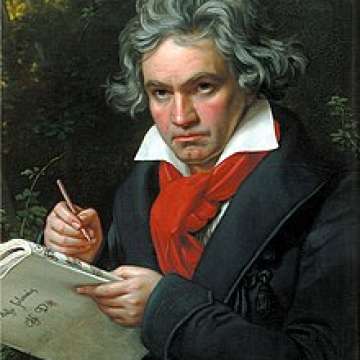
Beethoven was born to a music family—his grandfather was a musician and his father a court musician. However, his father was a harsh teacher, and Beethoven's childhood was difficult. His father recognized his talent but, concerned about commercial success, provided rigorous training. By age eleven, Beethoven was already performing publicly.
In his teens, he traveled to Vienna to study with Mozart but returned to Bonn due to his mother's illness. He eventually returned to Vienna and became a student of Haydn, one of the greatest composers of the era. Through intense study and practice, Beethoven absorbed the classical traditions of Mozart and Haydn while developing his own distinctive voice.
Early Success and Recognition
Beethoven's early years in Vienna brought rapid success. His piano performances dazzled audiences with their power and virtuosity. His early compositions, including piano sonatas and chamber works, demonstrated mastery of classical form combined with emotional intensity. By the early 1800s, Beethoven was recognized as one of Vienna's leading composers.
His Symphony No. 1, premiered in 1801, announced a new voice in music—one that pushed against classical conventions while remaining rooted in the traditions of Mozart and Haydn. His subsequent symphonies grew increasingly ambitious and experimental.
The Onset of Deafness
Beginning around 1798, Beethoven noticed a terrifying symptom: he was losing his hearing. The cause was never definitively determined, though various medical theories have been proposed. By 1801, his hearing loss was unmistakable, and by 1814, he was profoundly deaf. For a musician—one who depended on hearing to perform and to appreciate the sounds of his own creations—deafness seemed like a tragedy of unbearable proportions.
The Heiligenstadt Testament of 1802, a letter never sent to his brothers, reveals his anguish. He contemplated suicide, describing himself as a talented musician rendered useless by this affliction. Yet he determined that his art gave him reason to live. He resolved to continue composing despite his deafness.
Twenty questions, eight minutes on the clock, and a percentile measured against everyone who has taken it. No sign-up.
Take the IQ test →The Heroic Period and Middle Works
From approximately 1803 to 1815, Beethoven entered what is known as his "Heroic Period," producing some of his greatest works despite—or perhaps because of—his deafness. These works demonstrated unprecedented power and emotional range. His Symphonies No. 3 through 8, his Violin Concerto, and his opera Fidelio all date from this period.
The Third Symphony, originally titled "Buonaparte," was a revolutionary work of unprecedented length and complexity. Beethoven's later symphonies became increasingly ambitious, exploring new harmonic territories and pushing the boundaries of musical form. His opera Fidelio, with its theme of human freedom and dignity, reflected his values and personal struggles.
Late Period and the Ninth Symphony
Beethoven's final years produced some of his most profound and experimental works. His last five string quartets are considered among the greatest chamber music ever written, exploring abstract musical ideas with extraordinary complexity and beauty. His final three piano sonatas are meditative and technically demanding.
His greatest final achievement was the Ninth Symphony, completed in 1824 when Beethoven was profoundly deaf and in declining health. This monumental work includes a choral finale setting Friedrich Schiller's "Ode to Joy" to music. The work synthesizes Beethoven's entire artistic vision: it combines instrumental and vocal music, employs unprecedented forces, and expresses a vision of universal brotherhood and joy.
At the premiere, Beethoven was brought onstage for the applause but could not hear the audience's ovation. An attendant had to turn him around so he could witness the magnitude of the public's acclaim for his greatest work.
Compositional Method and Legacy
How did Beethoven continue composing while completely deaf? He used "conversation books" into which people wrote to communicate with him. He composed entirely in his mind, without the need to hear sounds. In fact, many music scholars argue that his deafness freed him from the constraints of what was physically performable, allowing him to imagine sounds and musical structures that were more radical and daring than what hearing musicians of his time might have conceived.
Beethoven transformed music itself. He expanded the scope and ambition of the symphony, making it a vehicle for expressing profound philosophical and emotional ideas. He bridged the classical world of Mozart and Haydn and the emerging Romantic movement. He demonstrated that music could express specific ideas and emotions, not merely provide pleasant entertainment.
Death and Immortal Legacy
Beethoven died on March 26, 1827, in Vienna, during a thunderstorm. Thousands attended his funeral, an unprecedented public recognition of his cultural importance. His last words reportedly included "Pity, pity—too late!"—a poignant reflection on his isolation and on his recognition of his own genius.
Beethoven's legacy extends far beyond music. He became a symbol of artistic heroism: the artist who transcends personal tragedy through dedication to his art. His struggle with deafness and his achievement of his greatest works while deaf remain inspiring testaments to human resilience and the power of creative determination.
His music influenced every subsequent composer. The Ninth Symphony's "Ode to Joy" became a symbol of universal brotherhood and is played at celebrations of peace and freedom worldwide. His works continue to move audiences as profoundly as they did at their premieres, more than two centuries ago.