The Strangest Coincidences in the History of Genius
Two revolutionaries born the same day, two founders dying on the same anniversary, and the writer who kept his appointment with a comet.
History is under no obligation to be poetic. And yet, every so often, it files its facts as if a novelist had arranged them. The coincidences below are all real, all documented — and all strange enough that historians feel obliged to keep re-checking them.
12 February 1809: the day that changed two worlds
On the same date — 12 February 1809 — two boys were born an ocean apart: Charles Darwin, in a wealthy Shrewsbury household, and Abraham Lincoln, in a one-room Kentucky log cabin. One would overturn humanity's understanding of its origins; the other would end American slavery. They were born not merely in the same year but on the same day — a fact that has powered a small library of dual biographies asking which birthday changed the world more.
4 July 1826: the fiftieth anniversary
Thomas Jefferson and John Adams — collaborators on the Declaration of Independence, then bitter rivals, then reconciled correspondents through 158 late-life letters — died within hours of each other on 4 July 1826: the fiftieth anniversary, to the day, of the Declaration. Adams's reported last words, "Thomas Jefferson survives," were wrong by about five hours. Contemporaries did not treat it as coincidence at all; John Quincy Adams wrote in his diary that it was a "visible and palpable" mark of divine favour. It remains the most extraordinary documented death-date coincidence in political history.
1835–1910: the comet's passenger
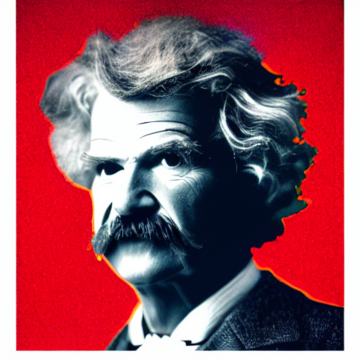
Mark Twain was born in November 1835, two weeks after Halley's Comet reached perihelion. In 1909 he told his biographer: "I came in with Halley's Comet... It is coming again next year, and I expect to go out with it. It will be the greatest disappointment of my life if I don't." He died on 21 April 1910 — one day after the comet's return perihelion. The prediction is documented; the punctuality was his own.
Twenty questions, eight minutes on the clock, and a percentile measured against everyone who has taken it. No sign-up.
Take the IQ test →23 April 1616: the double exit
William Shakespeare and Miguel de Cervantes — the twin summits of European literature — both died on 23 April 1616. Here the record demands its famous asterisk: England still used the Julian calendar, Spain the Gregorian, so the two deaths were actually about ten days apart in real time. The shared date was, however, real enough for UNESCO: World Book Day is celebrated every 23 April in their joint honour — a coincidence upgraded into an institution.
1642: the relay of mechanics
Galileo Galilei died in January 1642; Isaac Newton was born the following December. By England's old calendar the birth fell on 25 December 1642 — allowing generations of physicists to note, with a smile, that the year Galileo died, Newton was born, as if mechanics itself refused to pause. (Convert to the modern calendar and Newton arrives on 4 January 1643 — the asterisk that keeps the anecdote honest.)
"Truth is stranger than fiction, but it is because Fiction is obliged to stick to possibilities; Truth isn't."
— Mark Twain
What coincidence teaches
Statisticians will correctly note that with enough famous lives, calendars are bound to rhyme somewhere. But that is precisely why these cases fascinate: each was noticed immediately, by the participants' own contemporaries — Adams's America, Twain himself — and each has survived two centuries of fact-checking. History contains no hidden hand, but it does contain, occasionally, perfect timing.
Watch: Mark Twain Documentary (1963)
For the patterns that are not coincidence — the youth of revolutionaries, the age of masters — see our study of breakthroughs made before 26 and the great works created after 70.
Frequently Asked Questions
Were Darwin and Lincoln really born on the same day?
Yes — both were born on 12 February 1809, Darwin in England and Lincoln in Kentucky.
Did Jefferson and Adams really die on the same day?
Yes — both died on 4 July 1826, the fiftieth anniversary of the Declaration of Independence, within hours of each other.
Did Mark Twain predict his own death?
He predicted in 1909 that he would 'go out with' Halley's Comet, which had appeared at his birth. He died one day after its 1910 perihelion.