
Mary Anning: How a Lyme Regis Cliffside Rewrote Prehistory
Born 21 May 1799 — the working-class woman who corrected Cuvier and rewrote the history of life on Earth.
On 26 December 1823, a 24-year-old woman wrote a letter from a fossil shop in a Dorset seaside town. The letter contained a sketch. The sketch — of a creature with a thirty-five-vertebra neck no living anatomist had ever imagined — would, within months, be used to accuse her of forgery and then to overturn the most prestigious anatomical authority in Europe. Her name was Mary Anning. She had no formal scientific education, no membership in any learned society, and no legal route to either. She did, however, have an extraordinary eye for what the sea threw up on the Blue Lias cliffs of Lyme Regis.
Mary Anning with her dog Tray, painted before 1842. The hill Golden Cap is visible behind her. (Public domain, Natural History Museum, London.)
This is the story of how a working-class fossil seller — born exactly 227 years before the date this article is published — became the figure modern paleontologists credit with the field's true beginning.
The lightning before the work
Mary Anning was born in Lyme Regis, Dorset, on 21 May 1799. Her father, Richard Anning, was a cabinetmaker who supplemented the family income by collecting and selling fossils to summer tourists on the Devon-Dorset coast. The family was poor and Dissenter — outside the Church of England, with all the social and educational disadvantages that implied in Regency Britain.
In August 1800, when Mary was about fifteen months old, a travelling equestrian troupe came through Lyme. A crowd gathered under an elm tree to watch. Lightning struck the tree. The three women under it were killed instantly. Mary, in the arms of one of them, was revived in a bath of hot water. The local doctor described her survival as miraculous. The family later said the sickly infant transformed afterwards into a curious, alert child. Whether or not anyone believed the lightning had remade her, the town remembered the story for the rest of her life.
She learned to read and write at a Congregationalist Sunday school — Dissenter doctrine, unusually for the period, considered literacy a duty for the poor — and her prized possession as a child was a bound copy of the Dissenters' Theological Magazine. She never attended a formal school. Every scientific paper she would later master she would either be lent or, more often, painstakingly hand-copy.
The first ichthyosaur
In the winter of 1811–1812, Mary's older brother Joseph found the skull of an unusual fossil reptile in the cliffs near their home. He uncovered what looked like a great crocodilian eye-socket, then ran out of time and tools. The rest of the body remained in the rock. Mary, who was twelve years old, returned to the site over the months that followed and patiently excavated the remainder — a 5-metre marine reptile that the scientific community would eventually classify as Ichthyosaurus.
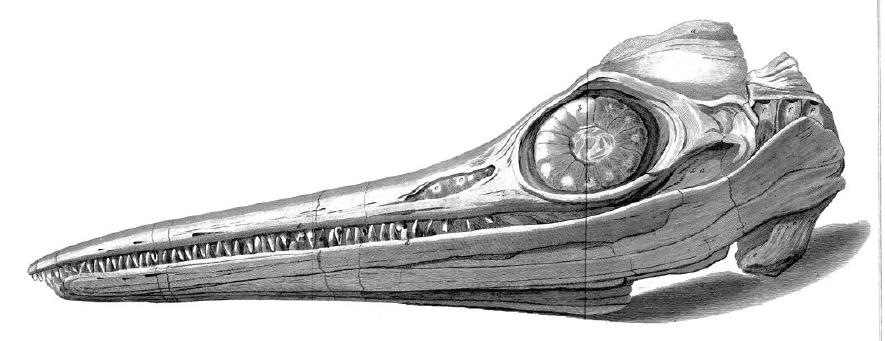 A drawing of the long, needle-toothed ichthyosaur skull — the kind of specimen Anning excavated at age twelve. (Public domain.)
It was the first ichthyosaur skeleton ever correctly identified. The Annings sold it to a local lord for £23 — enough to feed the family for six months and not nearly enough for what they had given the world. Within a generation, the specimen would be in the British Museum and the species would be one of the cornerstones of the new science of paleontology.
The Cuvier accusation
By her early twenties, Mary Anning was running the fossil business after her father's death. She knew the Blue Lias and Charmouth Mudstone cliffs as intimately as any geologist on the planet. She also dissected modern cuttlefish and fish in her shop in order to interpret the anatomy of the things she was pulling from the rock — comparative anatomy of a quality that visiting professors openly envied.
On 10 December 1823, in winter storm conditions, she uncovered the first nearly complete skeleton of a Plesiosaurus. The animal had a neck so absurdly long — thirty-five cervical vertebrae — that when Georges Cuvier, the founder of vertebrate paleontology and the most powerful anatomist in Europe, reviewed Anning's drawings of a second example, he declared the specimen a fake. Cuvier wrote to William Conybeare suggesting Anning had assembled the skeleton from the bones of multiple animals — fossil forgery for paying buyers being a known fraud of the era.
 Anning's Plesiosaurus — the thirty-five-vertebra neck that Cuvier first denounced as a forgery, then conceded was real. (Public domain.)
This was a catastrophic accusation. Had it stuck, it would have ended her career. The Geological Society of London called a special meeting in early 1824 to adjudicate. After examination of the physical specimen, the Society concluded the plesiosaur was authentic. Cuvier later admitted he had acted in haste and was mistaken. The reversal was complete enough that Anning's commercial standing not only survived but grew. Her shop became a required stop on the itinerary of every working geologist in Europe.
The flying dragon
In December 1828, Anning extracted from the cliffs the first British pterosaur skeleton — and the first pterosaur ever recovered outside Germany. The British Museum displayed it as a "flying dragon." She followed it in 1829 with a Squaloraja — a transitional fish form between sharks and rays — and continued through the 1830s with a second nearly complete plesiosaur, eventually classified as Plesiosaurus macrocephalus.
She also, in a separate letter to the geologist William Buckland — a letter that would be auctioned in 2020 for over £100,000 — proposed that the conical objects then called "bezoar stones," frequently found inside the ribcages of her ichthyosaur and plesiosaur specimens, were in fact fossilised faeces. Buckland accepted the argument, gave the objects a new name — coprolites — and published the finding under his own. The intellectual credit was Anning's; the published credit was Buckland's. This pattern would repeat for the rest of her career.
She also discovered that the fossilised belemnites she sold by the basket contained intact ink sacs, demonstrating that the creatures had been ancient relatives of modern squid and cuttlefish — a fact she established by dissecting living cephalopods alongside the fossils.
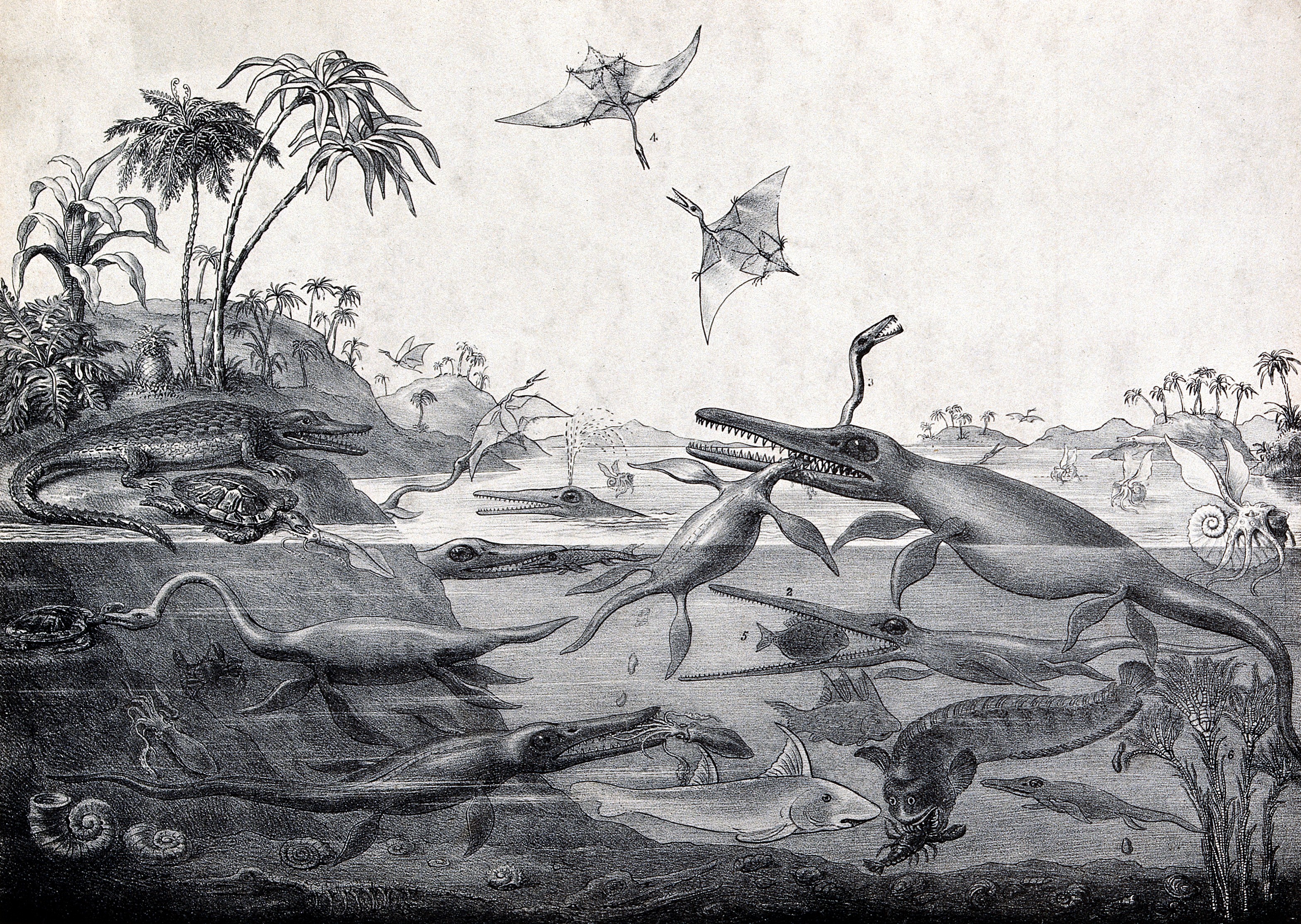 A prehistoric sea teeming with the marine reptiles Anning pulled from the Dorset cliffs — the first widely circulated image of deep time, derived from her finds. (Wellcome Collection, public domain.)
The wall
Charles Lyell consulted her. Richard Owen consulted her. William Buckland came to Lyme on his Christmas holidays specifically to walk the foreshore with her. In 1839, Buckland, Conybeare, and Owen — three of the most senior geologists in Britain — travelled to Lyme together so that Anning could lead them on a fossil-collecting excursion. She was, in practice, the field's leading expert in the marine reptile fauna of the British Jurassic.
She was also, formally, nothing. The Geological Society of London did not admit women as members. It would not do so until 1904, fifty-seven years after her death. The only piece of her scientific work published in her lifetime was a short extract — a letter to the editor of the Magazine of Natural History in 1839 questioning a published claim. The pattern is the same one familiar from the later careers of Rosalind Franklin, Sophie Germain, and Barbara McClintock: work done at the highest level, recognition handed elsewhere.
In 1838, the British Association for the Advancement of Science and the British government — pushed by Buckland and the Geological Society — awarded her a £25 annual civil-list pension in acknowledgment of her contributions to geology. It was the first piece of paid recognition she had ever received from the British state. She was 39.
Death and the long correction
Anning died of breast cancer in Lyme Regis on 9 March 1847, at age 47. In her final months, gossip in the town held that the increasing doses of laudanum she was taking for the pain had made her a drinker — a misreading her geological friends, who knew exactly what was happening, refused to dignify with reply. When her cancer was diagnosed in 1846, the Geological Society raised a subscription from its members to cover her medical bills. She is buried in the churchyard of St Michael the Archangel, Lyme Regis.
Her finds reshaped the work of every figure who built modern earth science. Charles Darwin, seven years her junior, read the papers her specimens had made possible. Alfred Russel Wallace, Jean-Baptiste Lamarck, and the geological catastrophists and uniformitarians who argued through the 1830s and 1840s were all, directly or indirectly, debating evidence she had pulled from Dorset mud.
In 2010, the Royal Society named Mary Anning one of the ten most influential British women in the history of science. The Geological Society of London — the institution that had refused her membership for life — issued a formal apology in 2009.
A working-class dissenter woman with no schooling found, identified, and correctly interpreted three of the most important fossil groups of the Mesozoic, and corrected the most powerful anatomist in Europe in the process. The history of paleontology before Mary Anning is a list of guesses. The history of paleontology after Mary Anning is a science.
Frequently asked questions
What did Mary Anning discover? The first correctly identified ichthyosaur skeleton (1811–1812), the first two nearly complete plesiosaur skeletons (1823 and 1830), the first British pterosaur and first pterosaur ever found outside Germany (1828), a Squaloraja fish skeleton (1829), and the evidence that coprolites were fossilised faeces and that belemnites contained ink sacs.
Why was Mary Anning denied membership in the Geological Society? Because she was a woman. The Geological Society of London did not admit women until 1904 — 57 years after Anning's death.
Was Mary Anning struck by lightning? No — she was held by a woman who was struck by lightning. Three women under an elm tree in Lyme Regis were killed in August 1800; the 15-month-old Mary, in the arms of one of them, survived.
Did Cuvier really accuse Mary Anning of fraud? Yes. Georges Cuvier initially reviewed her drawings of a second plesiosaur, thought the 35-vertebra neck implausible, and wrote to William Conybeare suggesting the specimen was assembled from multiple animals. The Geological Society convened a special meeting in 1824, examined the specimen, and confirmed it was real. Cuvier admitted he was wrong.
How much money did Mary Anning make from her discoveries? Very little. She lived in financial precarity for most of her life. The £25-per-year civil-list pension she received from the British government from 1838 onwards was her first state-funded income. When she was diagnosed with cancer in 1846, the Geological Society had to raise a private subscription from its members to pay her medical bills.
Sources: Wikipedia "Mary Anning" (verified 2026-05-20); cross-referenced against Britannica. Images: Wikimedia Commons / Wellcome Collection, public domain.