
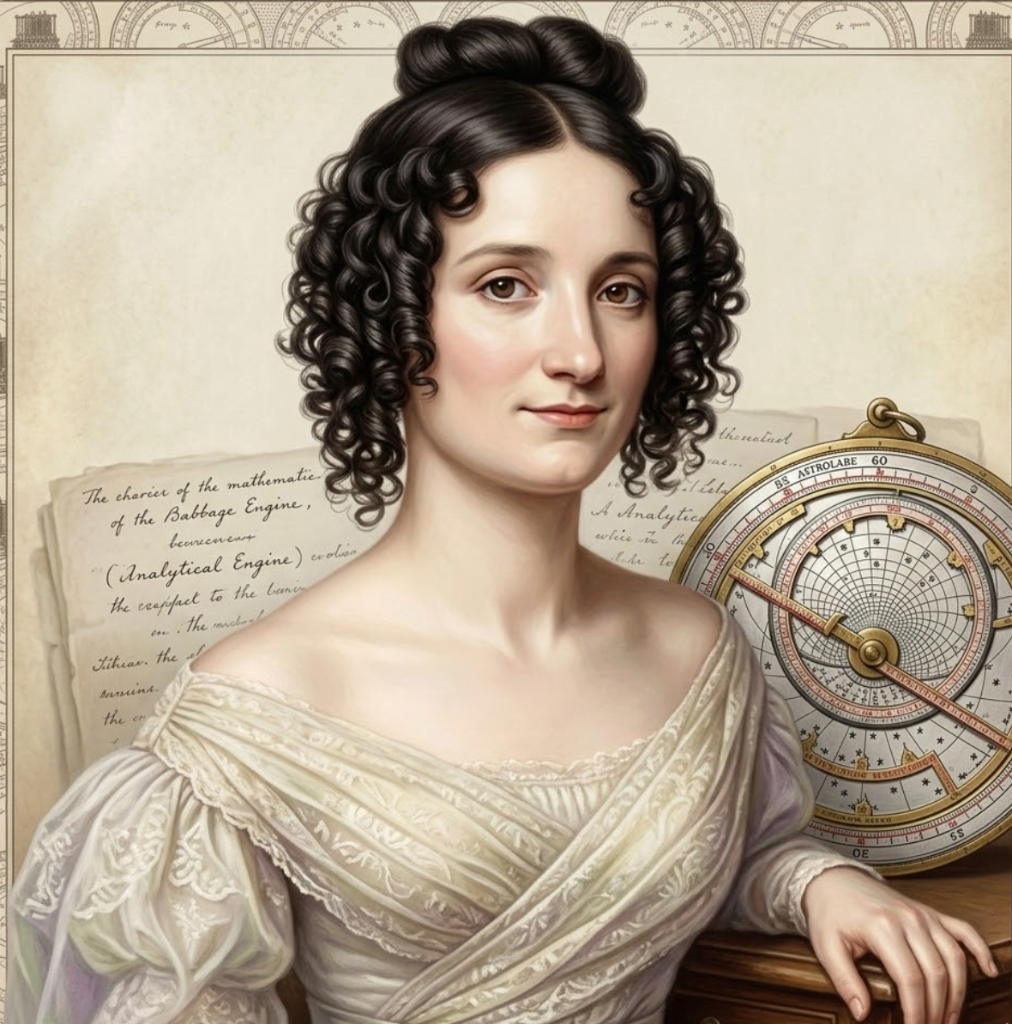
The First Programmers: From Ada Lovelace to the Moon
A Victorian countess, a Navy rear admiral with a moth in a logbook, and the woman whose code landed Apollo: computing’s founding firsts.
The first computer program was published in 1843, a century before the first computer that could run it. Its author was a 27-year-old countess, the daughter of a scandalous poet, and she saw further into the computing future than the machine's own inventor. The history of programming's firsts is short, strange and full of women.
1843: the first program — Ada Lovelace
Translating a paper on Charles Babbage's planned Analytical Engine, Lovelace tripled its length with her own notes. Note G contains a step-by-step method for computing Bernoulli numbers on the machine — recognised today as the first published algorithm intended for a computer. More prophetic still, she saw what Babbage did not: that a machine manipulating symbols "might compose elaborate and scientific pieces of music of any degree of complexity" — software, imagined whole, in the reign of Queen Victoria.
1936–1945: the theorists and builders
- Alan Turing defined, in a 1936 paper, the abstract machine that gave computing its mathematical foundations — then spent the war breaking Enigma at Bletchley Park.
- Konrad Zuse, working in his parents' Berlin living room, completed the Z3 in 1941 — the first working programmable computer — and designed Plankalkül, the first high-level programming language, before "programming language" was a phrase.
- John von Neumann's 1945 EDVAC report described the stored-program architecture every phone and laptop still uses.
1946: the first professional programmers
The six women who programmed ENIAC — Jean Bartik among them — received no introduction to the machine but its wiring diagrams. Programming meant physically rerouting cables and setting thousands of switches. At ENIAC's public debut, the press photographed the machine and the generals; the programmers went unnamed for forty years.
1952: the first compiler — Grace Hopper
The Navy mathematician built A-0, the first compiler, on a heretical premise: that programs could be written in something like English and translated by the machine itself. "Nobody believed that," she recalled. "They told me computers could only do arithmetic." Her work led directly to COBOL — for decades the world's most-used business language — and her team's 1947 logbook, with an actual moth taped beside the words "first actual case of bug being found," is preserved at the Smithsonian. She retired a rear admiral, the Navy's oldest serving officer.
1969: the code that landed on the Moon — Margaret Hamilton
Hamilton led the MIT team that wrote Apollo's flight software — and coined the term "software engineering" to make the discipline respectable. Three minutes before touchdown, Apollo 11's computer flooded with alarms; her software's priority scheduling shed low-priority tasks and kept the landing program running. The famous photograph of Hamilton beside a stack of listings as tall as she is shows what "the first software engineer" produced.
<iframe width="560" height="315" src="https://www.youtube.com/embed/IZptxisyVqQ" title="Ada Lovelace: The First Computer Programmer" frameborder="0" allowfullscreen loading="lazy"></iframe>"The most dangerous phrase in the language is: we've always done it this way."
— Grace Hopper
Watch: Ada Lovelace: The First Computer Programmer
The pattern
From Lovelace to ENIAC to Apollo, early programming was repeatedly entrusted to people the establishment undervalued — and they invented the field's foundations in the shadows of more photographed machines. The firsts are now monuments: the first algorithm, the first compiler, the first Moon landing's code, each with a name attached that history very nearly forgot.
Frequently Asked Questions
Who wrote the first computer program?
Ada Lovelace, whose 1843 'Note G' described an algorithm for computing Bernoulli numbers on Babbage's planned Analytical Engine.
Who built the first compiler?
Grace Hopper, whose A-0 system of 1952 first translated human-readable code into machine instructions, leading eventually to COBOL.
Where does the term 'software engineering' come from?
Margaret Hamilton coined it while leading development of the Apollo flight software at MIT in the 1960s.