The Most Prolific Mathematician Who Ever Lived
Roughly 850 works, half of them produced after he went blind: the impossible arithmetic of Leonhard Euler.
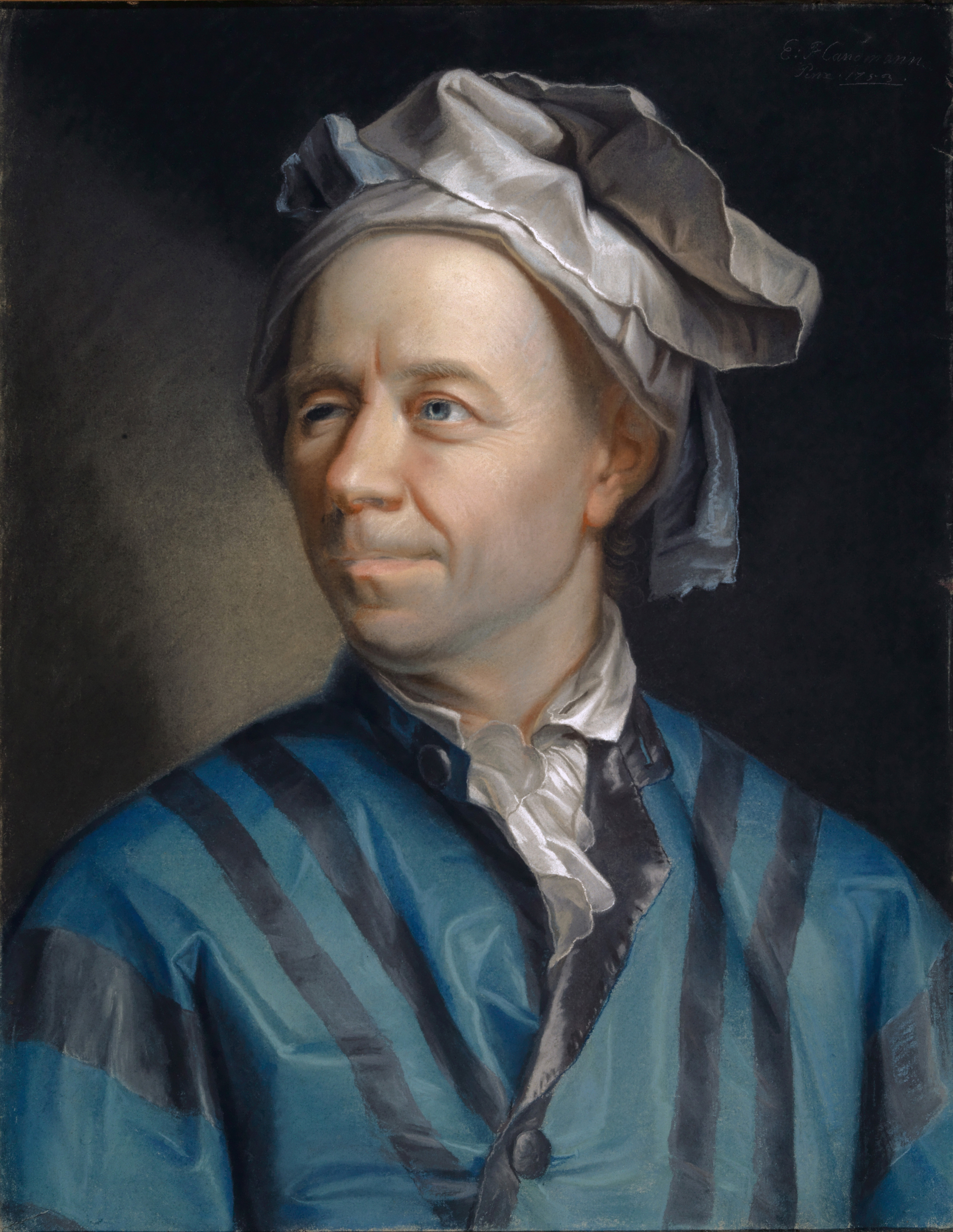
The complete works of Leonhard Euler have been in the process of publication since 1911 — and the project, the Opera Omnia, has now passed eighty volumes with more to come. No mathematician in history has produced more: roughly 850 books and papers, spanning every branch of the subject that existed in his century, plus several he invented.
The output
For long stretches of the eighteenth century, Euler wrote an average of about 800 pages of mathematics a year. The St. Petersburg Academy was still working through his backlog of unpublished papers decades after his death. Historians estimate that in the second half of the eighteenth century, roughly a quarter to a third of all mathematics and physics papers published in Europe came from this one man.
The notation you learned in school is largely his: f(x) for functions, e for the exponential base, i for the imaginary unit, Σ for sums, and the popularisation of π. He created graph theory in an afternoon's puzzle about the seven bridges of Königsberg, founded analytical mechanics and the calculus of variations, and left his name on so many results that mathematicians joke that theorems are named after the first person after Euler to discover them.
And one line of his — e^iπ + 1 = 0, Euler's identity, tying together the five fundamental constants — is routinely voted the most beautiful equation in mathematics.
Twenty questions, eight minutes on the clock, and a percentile measured against everyone who has taken it. No sign-up.
Take the IQ test →The blindness
Here the story leaves the realm of productivity and enters legend — documented legend. Euler lost effective use of his right eye in his late twenties. In 1766 a cataract took the left, leaving him almost totally blind. His response, reported by the Academy's records and his assistants' memoirs: "Now I will have fewer distractions."
Nearly half of his total output was produced after that date. He computed in his head to extraordinary depth — famous anecdotes have him settling his assistants' disputed arithmetic at the fiftieth decimal place — and dictated papers to a circle of secretaries, including his sons. On the day he died in 1783, he had spent the morning calculating the orbit of the newly discovered planet Uranus and teaching his grandchildren; the eulogy's phrase became mathematics' most famous epitaph: "He ceased to calculate and to live."
"Logic is the foundation of the certainty of all the knowledge we acquire."
— Leonhard Euler
The only rival
By raw paper count, one modern figure passes him: Paul Erdos, the itinerant Hungarian who co-authored roughly 1,500 papers with more than 500 collaborators, living out of two suitcases and giving his prize money away. But Erdős's record is collaborative by design — the "Erdős number" measures the network he built — while Euler's ~850 works were substantially one mind, one (eventually sightless) pair of eyes, and eight hundred pages a year. Mathematicians generally give the productivity crown to Euler and the connectivity crown to Erdős, and note that both records look safe forever.
Watch: e (Euler's Number) - Numberphile
The verdict
Laplace's advice to young mathematicians has survived two centuries because it is still true: "Read Euler, read Euler — he is the master of us all." The Opera Omnia will finish publishing, eventually. Nobody expects the record it documents to be approached, in any field, by anyone.
Frequently Asked Questions
How many works did Euler produce?
Roughly 850 books and papers; his collected works, the Opera Omnia, have been in publication since 1911 and exceed eighty volumes.
How did Euler work after going blind?
He computed in his head and dictated to secretaries — nearly half his total output came after he lost his sight in 1766.
Who has written more papers than Euler?
Paul Erdős, with about 1,500 — but they were collaborative by design; Euler's output was substantially one mind working alone.