The Greatest Symphony Written in Silence
By the premiere of the Ninth, Beethoven could not hear the orchestra, the applause, or the revolution he had just started.
On 7 May 1824, at Vienna's Kärntnertor Theatre, the most famous account in the history of music unfolded: at the end of the Ninth Symphony's premiere, the contralto Caroline Unger gently turned the composer around — because Ludwig van Beethoven, standing beside the conductor with the score, could not hear that the hall behind him had erupted.
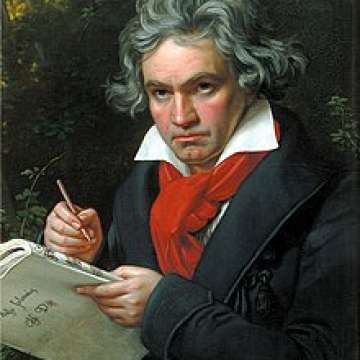
The slow catastrophe
Beethoven noticed the first ringing and fading in his late twenties. By 1802 he understood where it was heading, and in the village of Heiligenstadt he wrote the testament — addressed to his brothers, found only after his death — confessing he had considered ending his life, and stayed alive for one reason: "it seemed to me impossible to leave the world until I had brought forth all that I felt was within me." By his mid-forties, conversation was possible only through notebooks visitors wrote in; nearly 140 of these "conversation books" survive, one-sided transcripts of a genius's social life. By the Ninth's composition he was, for practical purposes, totally deaf.
What the silence contained
Here is the staggering ledger: virtually everything now considered Beethoven's summit — the Ninth and its Ode to Joy, the Missa Solemnis, the last five piano sonatas, the late string quartets that composers still describe as music from another century — was written by a man who could hear none of it except in his head. Musicians sometimes note that deafness may even have freed him: cut off from performance fashion, he wrote for an inner ear with no limits, producing harmonies and structures decades ahead of his audience.
Twenty questions, eight minutes on the clock, and a percentile measured against everyone who has taken it. No sign-up.
Take the IQ test →The Ninth itself broke every frame available: the longest symphony written to that date, and the first by a major composer to put human voices inside a symphony — Schiller's Ode to Joy transformed into a universal anthem. Its theme is today the official anthem of the European Union, and the symphony's manuscript is inscribed in UNESCO's Memory of the World register.
The premiere
Accounts differ on whether Unger turned him after the second movement or the finale — memoirs disagree, as memoirs do — but not on the essentials: five ovations, hats and handkerchiefs waved so the deaf man could see the applause, and police finally calling for order because such acclaim exceeded what was customary for royalty. The composer heard nothing.
"Music is a higher revelation than all wisdom and philosophy."
— Ludwig van Beethoven
The legacy measured
One statistic captures the Ninth's afterlife better than any review: when the compact disc was being standardised around 1980, the story goes — told by the executives involved — that its capacity was set at 74 minutes so that the Ninth Symphony could fit on a single disc. True in spirit if debated in detail, it says the essential thing: a century and a half later, engineers sized a global technology around a deaf man's symphony.
Watch: Ludwig van Beethoven - Pianist & Composer
The paradox that stands
Painters who went blind stopped painting; Monet nearly did. Beethoven, losing the single sense his art depends on, wrote better — the most extreme case in the history of creativity of catastrophe converted into style. "I will seize fate by the throat," he wrote to a friend early in his deafness. The Ninth is what that sentence became.
Frequently Asked Questions
Was Beethoven completely deaf when he wrote the Ninth Symphony?
For practical purposes, yes — by the 1824 premiere he could not hear the orchestra or the applause, communicating through conversation notebooks.
What is the Heiligenstadt Testament?
An 1802 letter to his brothers, found after his death, in which Beethoven confessed despair over his deafness and resolved to live for his art.
Why is the Ninth linked to the compact disc?
By industry accounts, the CD's 74-minute capacity was chosen so the Ninth Symphony could fit on one disc — a debated but telling story.