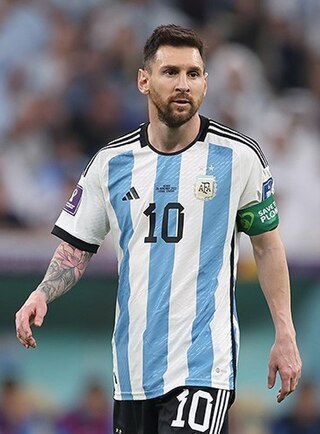
Lionel Andrés Messi was born on June 24, 1987, in Rosario, the third-largest city in Argentina — a port city on the Paraná River whose working-class northern barrios produce footballers the way the rest of the world produces accountants. His father Jorge worked in a steel factory; his mother Celia cleaned houses. The family was not poor by Rosario's standards, but they were a long way from the comfortable middle class, and the boy they called Leo was already a long way from ordinary. By the age of five he was playing in the street with his older brothers Rodrigo and Matías, running with a coordination and an instinct that made even those seasoned big brothers stop and watch. By eleven he was the finest player in the Rosario Central youth system. By twelve he was diagnosed with a growth hormone deficiency that would cost around £500 per month to treat.
FC Barcelona's director of youth football Carles Rexach watched the twelve-year-old Messi in a trial and famously wrote his contract offer on a napkin — a piece of hospitality lore that may be apocryphal but captures the urgency of the moment accurately. Barcelona agreed to fund Leo's hormone treatment; the family relocated to Catalonia; and the boy who would become the most decorated player in the history of the game began his education at La Masia, the club's fabled youth academy, in a dormitory where he was too shy to speak for weeks and cried every night for Rosario.
He made his first-team debut at sixteen years and 145 days, and scored his first competitive goal at seventeen — a beautifully composed chip over the goalkeeper that, in retrospect, contained the entire geometry of what was to follow. By twenty he was a first-choice starter in one of the great Barcelona sides under Frank Rijkaard; by twenty-one, under Pep Guardiola, he was the best player in the world. The 2008–09 treble season — La Liga, Copa del Rey, Champions League — announced the era of Messi: the low centre of gravity, the left foot that could thread the ball through impossible gaps, the ability to receive the ball at high speed in tight spaces and emerge a second later with the defence in a different postcode.
The Ballon d'Or came first in 2009, and then again in 2010, 2011 and 2012 — four consecutive awards, a record nobody had ever come close to. In the 2011–12 season he scored 91 goals in all competitions, a record for a calendar year that stands today. He won La Liga a record ten times with Barcelona, the Champions League four times, the Copa del Rey seven times. In 2012 he scored 86 goals in a single calendar year. He became the all-time leading scorer in La Liga history. He did these things not as an athlete who overpowered the opposition but as a player who made the opposition simply irrelevant — who moved through defensive structures as if the other team were engaged in a different activity.
The national team was his consuming anxiety. Argentina reached World Cup finals in 2014 and lost to Germany in extra time; reached Copa América finals in 2015 and 2016 and lost, both on penalties. After the second Copa defeat, Messi announced his retirement from international football, then unannounced it. The narrative of a player cursed at international level — endlessly contrasted with Maradona, who won the whole thing on his own — followed him like a shadow across the entire second half of his career. Copa América 2021, won in the Maracanã, provided the first relief. But the 2022 World Cup in Qatar was the resolution that football had spent eight years anticipating.
At thirty-five, grey at the temples, moving with the deliberate economy of a man who no longer needed to prove anything to anyone but had decided to do so anyway, Messi carried Argentina to the title in what many observers described as the greatest World Cup of all time. Seven goals and three assists. A semi-final goal of intuitive genius against Croatia. A final against France, played over 120 minutes and three penalties, that produced one of the finest individual performances in the tournament's ninety-year history. When he lifted the trophy in Lusail, the entire weight of Argentine expectation that he had carried since 2006 finally exhaled. He won a seventh Ballon d'Or for 2021 and an eighth for 2023. No player in history has won more.
عشرون سؤالاً وثماني دقائق على الساعة، ونسبة مئوية مقاسة مقابل كل من خاضه. دون تسجيل.
اخوض اختبار الذكاء →"You have to fight to reach your dream. You have to sacrifice and work hard for it."— Lionel Messi
"I don't need the best hairstyle or the best car. I need to win."— Lionel Messi
| Player | Career Goals | Ballon d'Or | World Cups |
|---|---|---|---|
| 🇧🇷 Pelé | 1,000+ | 1 (honorary) | 3 |
| 🇦🇷 Maradona | 345 | 1 | 1 |
| 🇫🇷 Zidane | 125 | 3 | 1 |
| 🇧🇷 Ronaldo R9 | 414 | 2 | 2 |
| 🇦🇷 Messi | 850+ | 8 | 1 |
| 🇵🇹 C. Ronaldo | 900+ | 5 | 0 |






.jpg)