What happened in Giessen
The Mental Calculation World Cup of 2012 ran from 29 September to 1 October in Giessen, Germany, with thirty-two competitors on the official results table. Ogasawara won the combined standing with 828.15 points. Hua Wei Chan of Malaysia was second on 523.83; Jan van Koningsveld of Germany was third on 513.98. The gap between first and second was larger than the gap between second and tenth.
The Guardian reported the result under a headline that stated the essentials plainly: a Japanese abacus teacher had won the Mental Calculation World Cup. That description, teacher rather than student or professional performer, is the only biographical detail about Ogasawara that the sources used for this page supply.
The four events, and the fifth
The World Cup is scored across four standard disciplines plus a set of surprise tasks. Ogasawara won the addition event with ten correct answers in 191 seconds, and won the square-root event with eight correct extractions. He also took the surprise-task category, scored as Most Versatile Calculator, with a maximum 500.00 points.
He did not sweep the board. Multiplication went to Freddis Reyes Hernandez of Cuba, who got ten eight-digit products right in 361 seconds. The calendar event, in which competitors name the weekday for dates drawn at random, went to Myagmarsuren Tuuruul of Mongolia with 57 points. Winning the overall title without winning every discipline is the normal shape of the competition: the combined score rewards range.
The field he beat
The names below Ogasawara on the 2012 table are not incidental. Jan van Koningsveld, third that year, is one of the organisers' own recurring figures in the European circuit, and the presence of competitors from Malaysia, Cuba and Mongolia in the category winners' list shows how thin and how international the discipline is.
Thirty-two entrants is the whole world of competitive mental calculation at a single meeting. The event is not a mass-participation contest with regional qualifying rounds; it is a small invitational field of people who have trained on the same four tasks, which is why a three-hundred-point margin is remarkable rather than routine.
What is documented, and what is not
Documented: the dates, the venue, the field size, the scores, the categories won and the description of Ogasawara as an abacus teacher from Japan. Those come from the official results table published by the World Cup's organisers and from the Guardian's report of the event.
Not documented in these sources: his age or date of birth, the town he teaches in, the school or club he belongs to, whether he trained on the soroban from childhood, and what he has done since 2012. No later World Cup result under his name appears in the editions checked for this page. Sites that supply an age or a life story for him without naming a source should be treated with suspicion.
Vinte perguntas, oito minutos no relógio e um percentil medido contra todos os que já fizeram. Sem cadastro.
Fazer o teste de QI →Where the title has gone since
The World Cup has stayed in Germany and stayed small. Bielefeld hosted the 2016 edition, won by Yuki Kimura of Japan with 668.64 points. Wolfsburg followed in 2018, won by Tomohiro Iseda of Japan with 757.18. Paderborn's Heinz Nixdorf MuseumsForum has hosted since, and the Indian competitor Aaryan Shukla won there in both 2022 and 2024, his 2024 total of 819.84 the closest anyone has come to Ogasawara's 2012 mark.
Measured against that sequence, the 2012 score holds up. Four editions and twelve years later, 828.15 remains the highest combined total recorded in the results tables consulted here, which is the strongest single argument for Ogasawara's place in the history of the sport.
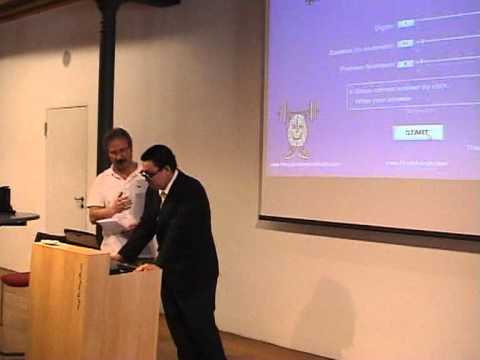
Watch: Naofumi Ogasawara on camera

| Pessoa | País | Marco | Idade / Dado |
|---|---|---|---|
| Naofumi Ogasawara | Japão | Vencer a Copa do Mundo de Cálculo Mental de 2012 | — |
| Stiaan Scheepers | África do Sul | Medalhas no Campeonato Mundial Júnior de Cálculo Mental | — |
| Mishti Dharmesh Shah | Índia | Copa do Mundo de Cálculo Mental 2024 | — |
| Hua Wei Chan | Canadá | Segundo lugar na Copa do Mundo de Cálculo Mental de 2012 | — |
| Tomohiro Iseda | Japão | Vencer a Copa do Mundo de Cálculo Mental de 2018 | — |
What is documented — and what is not
✓ Documented
- Won the 2012 Mental Calculation World Cup in Giessen with 828.15 points
- Won the addition, square-root and Most Versatile Calculator categories
- Described by the Guardian as a Japanese abacus teacher
- Beat Hua Wei Chan of Malaysia (523.83) and Jan van Koningsveld of Germany (513.98)
? Unverified, disputed or wrong
- No date of birth, age or home town in these sources
- No record of his training, school or club
- No documented result or public appearance after 2012
Questions people ask about Naofumi Ogasawara
What is Naofumi Ogasawara known for?
Winning the Mental Calculation World Cup held in Giessen, Germany, in 2012, with a combined score of 828.15 points.
How old is Naofumi Ogasawara?
No age or date of birth appears in the sources used here. The Guardian described him as a Japanese abacus teacher and gave no age.
Which events did he win in 2012?
Addition, square roots and the surprise-task category scored as Most Versatile Calculator. Multiplication went to Freddis Reyes Hernandez of Cuba and calendar calculation to Myagmarsuren Tuuruul of Mongolia.
How big was his winning margin?
Large. He scored 828.15 against 523.83 for the runner-up, Hua Wei Chan of Malaysia.
Is Naofumi Ogasawara on Wikipedia?
No English Wikipedia article for him is recorded in this research file. The primary records are the official World Cup results table and the Guardian's 2012 report.
Has anyone beaten his score since?
Not in the editions checked here. The highest later total found was Aaryan Shukla's 819.84 at Paderborn in 2024.
Where is Naofumi Ogasawara now?
No source used here records anything about him after the 2012 competition.
How many people compete at the World Cup?
The 2012 results table lists thirty-two competitors. The 2024 edition drew thirty-five from sixteen countries.
Quick quiz: how well do you know Ogasawara’s story?
What was Ogasawara's winning score in 2012?
Which event did he NOT win in 2012?
Where was the 2012 World Cup held?
Sources
- Japanese abacus teacher wins Mental Calculation World Cup — The Guardian, 2012-10-10
- Mental Calculation World Cup 2012 results — Mental Calculation World Cup (official), 2012
- Mental Calculation World Cup 2016 - Results — Mental Calculation World Cup (official), 2016
- Mental Calculation World Cup 2018 - Results — Mental Calculation World Cup (official), 2018
- Mental Calculation World Cup 2024 - Results — Mental Calculation World Cup (official), 2024
Checked by the Geniuses.club editorial team. Ages are given as of September 2026.
Descubra Mais Crianças Prodígio
Mais de 50 histórias de jovens gênios contemporâneos que transformam o xadrez, a música, a ciência e a arte.
Explorar Todos os Prodígios →Perfis de Crianças Prodígio Relacionados
 Stiaan Scheepers🇿🇦 África do Sul — O sul-africano que continuou voltando a Bielefeld com…
 Mishti Dharmesh Shah🇮🇳 Índia — Dois segundos lugares em Paderborn, e uma posição entre os cinco melhores…
 Chirag Rathi🇮🇳 Índia — O filho de um trabalhador da construção civil em Saharanpur…
 Hua Wei Chan🇨🇦 Canadá — Ele pode multiplicar dois números de três dígitos na cabeça…
 Tomohiro Iseda🇯🇵 Japão — Multiplicações de oito dígitos e raízes quadradas de seis dígitos…
 Tetsuya Ono🇯🇵 Japão — Segundo em Bielefeld por 28 pontos…


