On a low-lying island off the Tunisian coast — a place Jews had inhabited, by tradition, since the destruction of the First Temple — a boy born in 1851 would rise to govern the spiritual life of one of the oldest Jewish communities on earth, and leave behind a library of his own making.
Rabbi Moshe Zaken Mazuz (1851–1915) was the towering Torah authority of Djerba: a decisor of Jewish law, a Talmudist of rare range, a kabbalist, and the author of some sixteen works that still anchor North African rabbinic scholarship. Appointed to lead a rabbinical court at the age of twenty-four, he presided over the law and learning of Djerban Jewry for four decades, and in his final years served as Chief Rabbi of the entire island. The honorific Zaken — “the elder” — was not a statement of age but of stature: the wise one, the elder of the court.
The island of the priests
To understand Mazuz, one must first understand Djerba. The island’s Jewish community is among the most ancient and unbroken in the world; local tradition traces it to priestly and Levite families who arrived after the Babylonian exile of 586 BCE, and its El Ghriba synagogue is reckoned among the oldest in continuous use anywhere. Djerba never knew an Enlightenment rupture or a Reform movement. Its yeshivot ran without interruption; its scholars printed their works in Livorno and Tunis; and its leaders were expected to be at once jurists, teachers, mystics, and shepherds of a tightly woven society. It was into the Smaller Quarter — the Ḥara Ṣ’ghira — that Moshe Zaken Mazuz was born, the son of Rabbi Khamous (Kamus) Maatuk Mazuz, into a family already steeped in learning.
.JPG)
A judge at twenty-four
Mazuz studied under the sages of the island and, above all, under the celebrated Rabbi Chaim HaKohen — the author of Lev Shomea — whose mastery of Talmud and halakha shaped a generation of Tunisian rabbis. The young man’s gifts were obvious early. In 1875, when his own teacher died, the community took the extraordinary step of installing the twenty-four-year-old as Rosh Av Beit Din — head of the rabbinical court — of the Smaller Quarter. It was a position he would hold for roughly forty years. Around 1910 his authority was extended over the whole of Djerba, both Jewish quarters answering to a single Chief Rabbi for the first time in living memory.
Twenty questions, eight minutes on the clock, and a percentile measured against everyone who has taken it. No sign-up.
Take the IQ test →Contemporaries described a mind that paired ferocious analytic power with genuine humility. He was a posek — a decisor whose rulings settled disputes — but also a teacher who built scholars rather than dependents. Tradition records that he once dissuaded a childless couple from divorcing; the son later born to them entered the very chain of Djerba’s sages, a small ruling that rippled across generations.
A library in his own hand
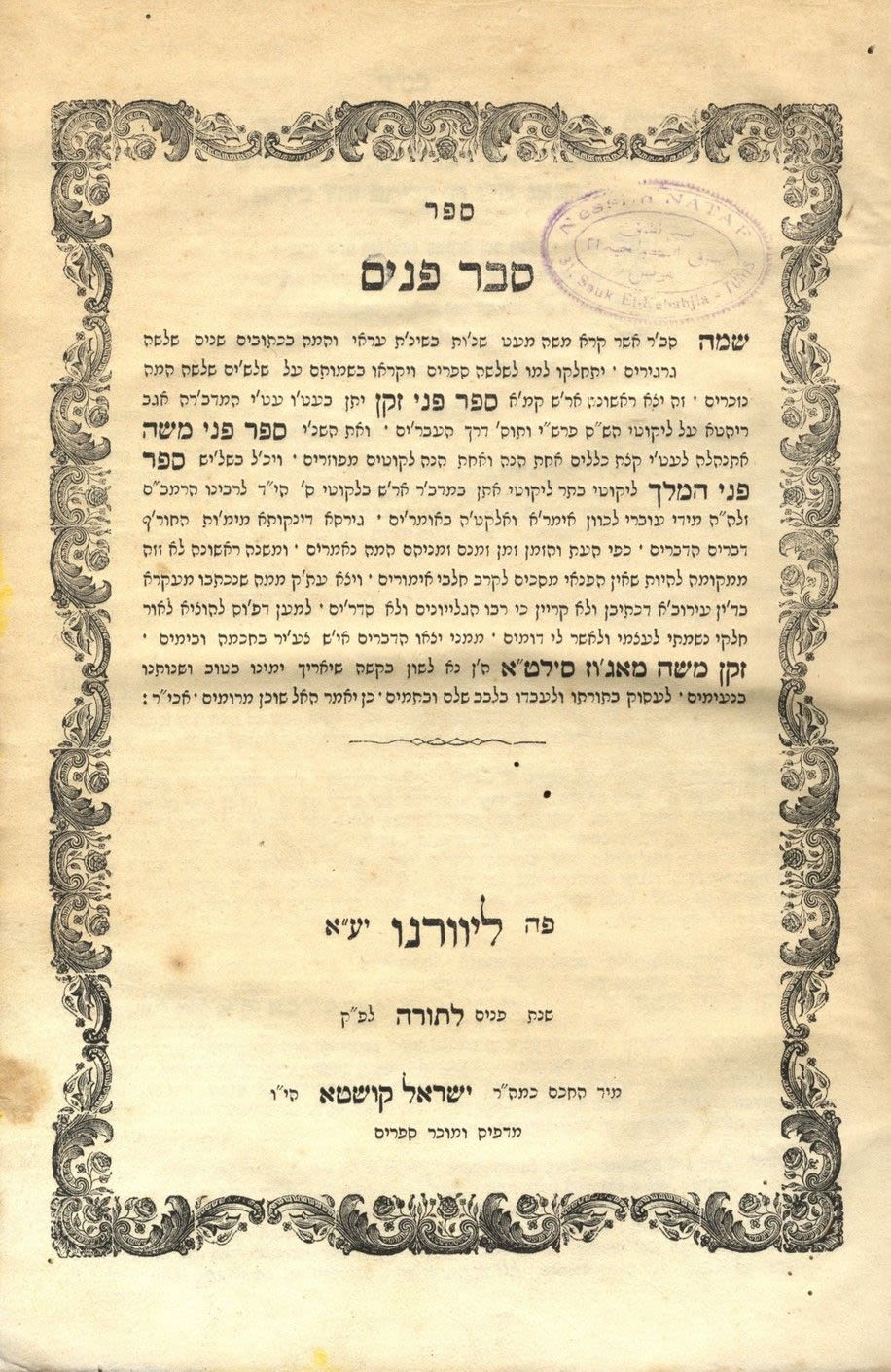
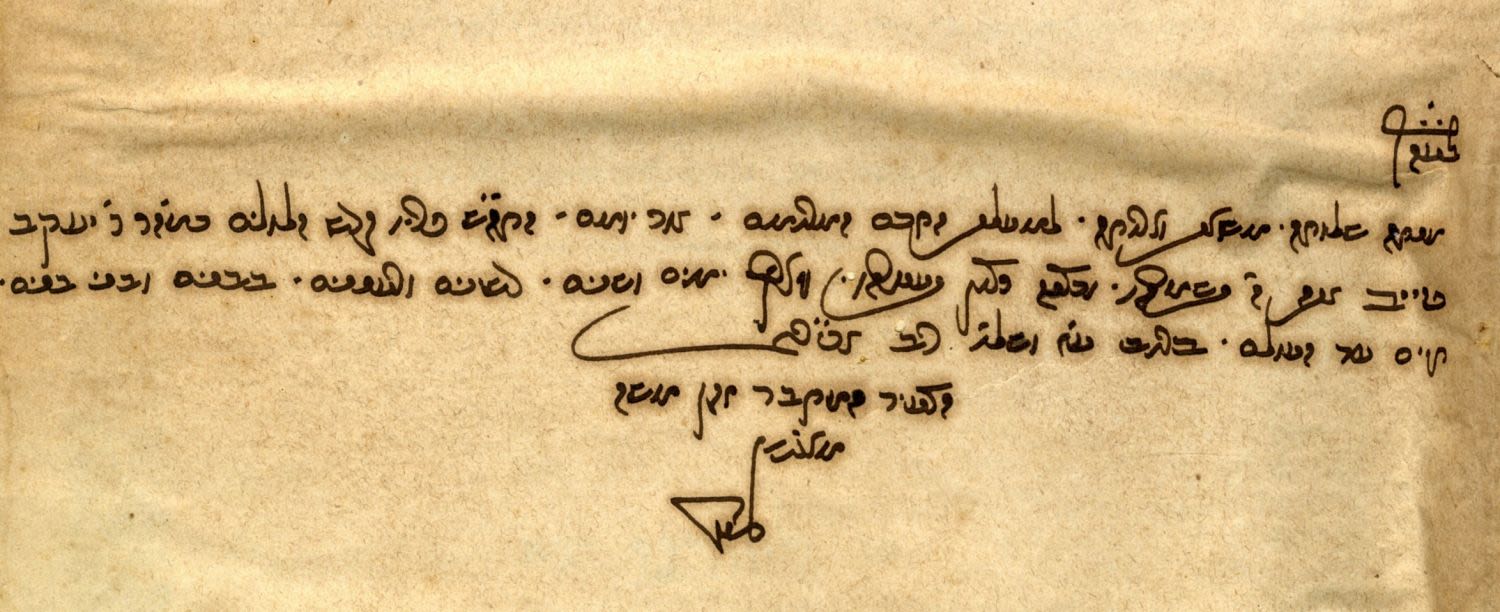
What sets Mazuz apart even among great rabbis is the sheer scale of what he wrote. His magnum opus, Sever Panim — “a pleasant countenance” — was printed in 1881 in Livorno, the Italian port city whose Hebrew presses served the entire Sephardic world. The volume gathers three distinct works under one cover: Pnei Zaken, novellae on the Talmud; Pnei Moshe, on the methodology and governing rules of the Talmud; and Pnei HaMelech, a commentary on Maimonides’ Mishneh Torah. At 142 folio leaves it was an ambitious debut for a provincial scholar, and surviving copies carry his dedication and signature in his own hand — a tangible trace of the man behind the law.
He never stopped. In Djerba in 1912–1913 he printed Sha’arei Torah and Sha’arei Moshe, and across his life he produced a remarkable shelf of titles spanning Talmud, law, homiletics, and ethics:
- Sever Panim — comprising Pnei Zaken, Pnei Moshe, and Pnei HaMelech (Livorno, 1881)
- Sha’arei Torah and Sha’arei Moshe (Djerba, 1912–1913)
- Tzadik veNisgav, Tzidkat Moshe, and BeYad Moshe
- Orchot Chaim, Shem Moshe, Vayakhel Moshe, and Hora’ot Zaken
That a single rabbi on a small Mediterranean island could author roughly sixteen books — ruling on questions of law while composing commentary on Talmud, Maimonides, and Scripture — is itself a measure of an extraordinary intellect. Today Tel Aviv University has conducted academic research on his Sha’arei Moshe, and his volumes circulate in the rare-book auctions of Jerusalem and Tel Aviv.
The students who carried the flame
A scholar’s deepest legacy is often his disciples, and here Mazuz’s reach is staggering. From his court and study hall came some of the defining rabbis of twentieth-century Tunisian Jewry:
- Rabbi Moshe Kalfon HaKohen, author of Shoel veNishal, whom Mazuz named his successor and who became one of the great halakhic authorities of Djerba;
- Rabbi Chaim Houri (b. 1885), later a beloved sage of Beersheba, Israel, whose grave remains a place of pilgrimage;
- Rabbi Mordechai Khamous (Amaïs) HaKohen, who rose to serve as Chief Rabbi of Tunisia;
- Rabbi Makhlouf Idan, whom he appointed rabbi of the Smaller Quarter, and Rabbi Yosef Boukhris.
Death and a name that endured
Rabbi Moshe Zaken Mazuz died on the 2nd of Iyar 5675 — April 1915 — at the age of sixty-four. His funeral drew vast crowds and representatives of the government, and the greatest rabbis of the region delivered his eulogies. Moshe Kalfon HaKohen stepped into his seat, and the chain held.
The Mazuz name he carried would become one of the most illustrious in Tunisian Jewry. In the century after his death, the family’s rabbinic tradition was transplanted to the State of Israel — carried by figures such as Rabbi Matzliah Mazuz and his son, Rabbi Meir Mazuz, founder of the influential Yeshivat Kisse Rahamim — so that the Torah of Djerba lives on far from the island that nurtured it. In Jerusalem, institutions bearing the name Mosdot Horeh Zaken were founded in his memory.
How we estimate his intellect
No psychometric record exists for a man born in 1851; an IQ figure is, in his case, a modern shorthand for documented achievement. Judged by the markers scholars actually leave — mastery of a vast and difficult literature, original contribution across Talmud, law, and mysticism, the authoring of roughly sixteen works, and the training of rabbis who themselves became giants — Rabbi Moshe Zaken Mazuz belongs among the most formidable minds of his era, with achievement-based estimates placing him near the 180 range. His true measure, though, is not a number but a chain of learning he forged and that has never been broken.
Geniuses.Club preserves his legacy alongside the world’s most consequential minds, with full biography, sources, and cross-links to the scholars, students, and dynasty that surround him.