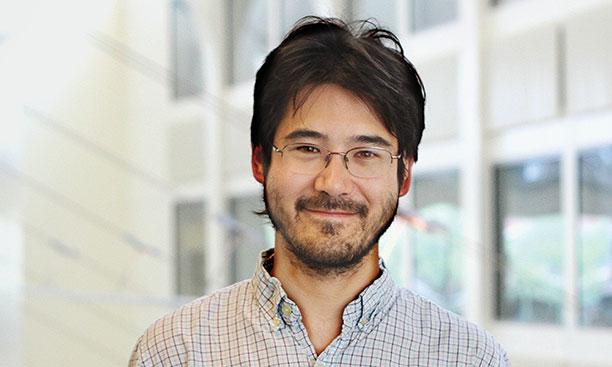
Christopher Michael Hirata is an American cosmologist and astrophysicist.
Hirata was a 13-year-old child prodigy when he won the gold medal in 1996 at the International Physics Olympiad. He studied physics at Caltech from the age of 14 to 18, graduating with a bachelor's degree in 2001. He did research at the age of 16 for NASA on the colonization of Mars and received his PhD under the supervision of Uroš Seljak in 2005 from Princeton University in Astrophysics thesis: "Weak Gravitational Lensing Theory and Data Analysis".
From 2005 to 2007 he was a visiting scholar at the Institute for Advanced Study. From 2006 to 2012 he was assistant professor and then full professor at Caltech before moving to the Ohio State University the following academic year in the same capacity. He is currently a professor at OSU's Center for Cosmology and AstroParticle Physics CCAPP.
Twenty questions, eight minutes on the clock, and a percentile measured against everyone who has taken it. No sign-up.
Take the IQ test →Research
Hirata's research emphasis is Cosmic Microwave Background CMB, dark energy and accelerating expansion of the universe, galaxy clusters and the large-scale structure of the universe and the formation of these structures, the Reionization epoch, and gravitational lenses as a tool of cosmology. Hirata works both in theory and in the analysis of observational data as well as in the design of telescopes specifically NASA's next generation of space telescopes. His overarching focus is on cosmology and on dark energy.
Hirata is considered a leading exponent of precision cosmology, combining interdisciplinary computer studies, theoretical studies, and observational astronomy including instrument development.
In 2010, with Dmitriy Tseliakhovich, he pointed to an unprecedented effect in cosmological perturbation theory for the calculation of the formation of the first structures in the universe. It is based on the fact that the speed of sound in baryonic matter as opposed to dark matter decreased drastically from relativistic to thermal velocities when the first atoms formed recombination epoch, which leads to supersonic velocity currents of baryonic matter which under gravitational influence of faster dark matter moves and quadratic perturbation terms. According to Hirata and Tseliakhovich, this leads to a suppression of the formation of the first structures with observable effects.
With others, he initiated a program for analyzing information from astronomical data for possible inferences on fundamental questions of particle physics and what it might suggest for creating new observation programs. A central question is whether the acceleration of the universe indicates dark energy retention of general relativity but with an additional dynamic scalar field or a modification of the general theory of relativity.
He is a member of NASA's proposed Wide Field Infrared Survey Telescope WFIRST space telescope.
Accolades
- 2012 - Presidential Early Career Award PECASE
- 2013 - Simons Foundation Investigator
- 2014 - Helen B. Warner Prize
- 2018 - New Horizons in Physics Breakthrough Prize for fundamental contributions to understanding the formation of the first galaxies in the universe and for sharpening and applying the most powerful tools of precision cosmology
.jpg)