
Toronto, 2003
The World Rubik's Games Championship of 2003 was held in Toronto, and Dan Knights won the main event with an average of 20.00 seconds. Twenty seconds is a long time by present-day standards and was a formidable one then: the sport had barely reconstituted itself, timing was inconsistent between events, and the pool of competitors who trained systematically was tiny.
The championship sits at a hinge point. The World Cube Association, which now sanctions competitions and maintains the official database of every result, was established the following year. Knights's title therefore belongs to the period just before speedcubing acquired the infrastructure that makes modern records comparable to one another.
How he learned
The Speedsolving wiki records that he got his first cube in March 1999 and learned the method devised by Jessica Fridrich — known to cubers as CFOP — from her own web page, bringing his times below thirty seconds by that summer. That detail is a small piece of internet history: a solving method published freely by its inventor, spreading to strangers, producing a world champion inside four years.
He kept competing after the title, appearing at one more world championship and at several United States tournaments between 2005 and 2009. His best official single time is recorded as 11.93 seconds, set at the Boulder competition in 2008 — comfortably faster than the average that won him the world.
From the cube to the microbiome
The wiki records that he became a mathematics teacher in 2004 and later an assistant professor in the Department of Computer Science and Engineering and the Biotechnology Institute at the University of Minnesota, where his research concerns host-microbiome interactions in human disease — the statistical and computational work of relating the bacterial populations in a human body to what goes wrong in it.
The through-line is not puzzle-solving but pattern extraction under constraint. A speedcuber learns to recognise a configuration and execute the right sequence without deliberation; computational biology is the same instinct applied to data that does not resolve in twenty seconds.
What is documented — and what is not
Documented: the 2003 world championship win in Toronto with a 20.00-second average; a first cube in March 1999 and sub-thirty-second times by that summer; further competition between 2005 and 2009; a best official single of 11.93 seconds at Boulder in 2008; a move into mathematics teaching in 2004; and an academic post at the University of Minnesota working on host-microbiome interactions.
Not documented in the sources used here: his date of birth beyond an approximate year; his degrees and where he took them; his current academic rank and the composition of his laboratory; and the official World Cube Association record of his results, which could not be retrieved for this page. Every claim above rests on secondary sources, and readers checking the record should start with the WCA's own database.
عشرون سؤالاً وثماني دقائق على الساعة، ونسبة مئوية مقاسة مقابل كل من خاضه. دون تسجيل.
اخوض اختبار الذكاء →Why the 2003 title is hard to compare
Speedcubing is now one of the most precisely documented competitive activities in the world. Every official solve since the World Cube Association's founding sits in a public database with the competitor, the venue, the scramble and the time. World records fall in fractions of a second and are contested within weeks.
None of that existed in Toronto in 2003. A 20.00-second average was won under a looser regime, against a field that had mostly taught itself from web pages, using cubes that were slower and stiffer than anything a competitor would touch today. The right way to read the result is not against the modern record book but against its own moment — the year the sport restarted, and the last year before anyone was keeping proper score.
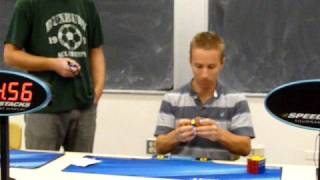
Watch: Dan Knights on camera

| الشخص | الدولة | الإنجاز | العمر / البيان |
|---|---|---|---|
| Dan Knights | الولايات المتحدة | الفوز ببطولة العالم لألعاب روبيك عام 2003 في تورنتو | 20 عاماً |
| Breandan Vallance | المملكة المتحدة | الفوز ببطولة العالم لمكعب روبيك عام 2009 | — |
| Michał Pleskowicz | بولندا | الفوز ببطولة العالم لمكعب روبيك عام 2011 | — |
| Philipp Weyer | ألمانيا | الفوز ببطولة العالم لمكعب روبيك عام 2019 | — |
| Patrick Ponce | الولايات المتحدة | الرقم القياسي العالمي الفردي بـ 3x3x3 بيد واحدة | — |
What is documented — and what is not
✓ Documented
- Won the 2003 World Rubik's Games Championship in Toronto with a 20.00-second average (Speedsolving wiki).
- First cube in March 1999; learned the CFOP method from Jessica Fridrich's web page.
- Best official single of 11.93 seconds at Boulder in 2008.
- Recorded as a University of Minnesota academic working on host-microbiome interactions.
? Unverified, disputed or wrong
- All claims here rest on secondary sources; the World Cube Association's official profile could not be retrieved.
- His exact date of birth is not published.
- His degrees, current academic rank and laboratory details are not documented here.
- His placing at the further world championship he entered is not recorded.
Questions people ask about Dan Knights
What did Dan Knights win?
The 2003 World Rubik's Games Championship in Toronto, with an average of 20.00 seconds.
What is Dan Knights's best time?
His best official single is recorded as 11.93 seconds, set at the Boulder competition in 2008.
When did he start cubing?
March 1999, when he got his first cube. He was solving in under thirty seconds by that summer.
What does Dan Knights do now?
He is recorded as a researcher at the University of Minnesota, in computer science and engineering and the Biotechnology Institute, working on host-microbiome interactions in human disease.
Was his record official?
The 2003 championship predates the World Cube Association, founded in 2004, which now maintains the official results database. This page could not retrieve the WCA record of his results.
Is Dan Knights on Wikipedia?
There is no standalone Wikipedia article about him. Wikipedia's articles on the World Cube Association and on speedcubing cover the context of his title.
How old is Dan Knights?
The Speedsolving wiki gives his birth year as about 1979. No exact date of birth is published in the sources used here.
Quick quiz: how well do you know Dan’s story?
What average won Dan Knights the 2003 world title?
Which method did he learn in 1999?
What does he research at the University of Minnesota?
Sources
- Dan Knights — Speedsolving.com Wiki, n.d.
- World Cube Association — Wikipedia, n.d.
- Speedcubing — Wikipedia, n.d.
Checked by the Geniuses.club editorial team. Ages are given as of September 2026.
اكتشف المزيد من الأطفال المعجزين
أكثر من 50 قصة لعباقرة شباب معاصرين يغيّرون الشطرنج والموسيقى والعلوم والفن.
استكشف جميع المعجزين →ملفات أطفال معجزة ذات صلة
 Breandan Vallance🇬🇧 المملكة المتحدة — مراهق اسكتلندي حقق متوسط 10.74 ثانية للفوز ببطولة…
 Michał Pleskowicz🇵🇱 بولندا — متوسط 8.65 ثانية فاز بلقب العالم عام 2011. بعد…
 Philipp Weyer🇩🇪 ألمانيا — خمس محاولات، ثلاث احتُسبت، بمتوسط 6.74…
 Patrick Ponce🇺🇸 الولايات المتحدة — بيد واحدة، 5.62 ثانية: أسرع من متوسط اليدين…
 Graham Siggins🇺🇸 الولايات المتحدة — خمسة وستون مكعباً تم حفظها، معصوب العينين، و63…
 Stanley Chapel🇺🇸 الولايات المتحدة — حفظ مكعب 4x4x4 مخلوطاً، وضع عصابة عينين وقام…